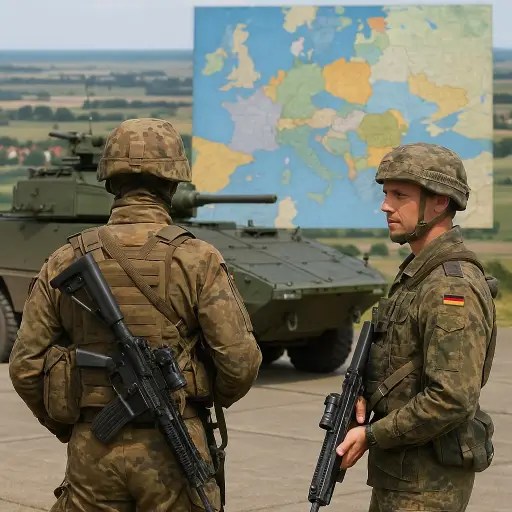
As the transatlantic defence guarantee shows signs of fragility, Europe pushes to chart an independent security course amid changing global dynamics.
In the corridors of power in Brussels and capitals across Europe, a new phrase is increasingly heard: strategic autonomy. The term evokes the ambition of the European Union (EU) and its member‑states to reduce dependence on the North Atlantic Treaty Organization (NATO) framework dominated by the United States, and instead build a credible and self‑reliant European defence posture.
Historically, Europe’s security architecture has rested on American military power — a “shield” that allowed many capitals to invest less in high‑end capabilities and instead rely on U.S. nuclear deterrence, air‑lift, command‑and‑control and global reach.
But with Washington signalling a strategic pivot toward the Indo‑Pacific, questions about America’s enduring commitment to Europe have grown louder. In response, European policymakers are increasingly asking: Can Europe protect itself — without waiting for Washington? And if so: how fast, how comprehensively and at what cost?
Drivers of change
Several converging trends have put Europe in this moment:
- Shifting U.S. posture: American policy has drifted through administrations toward “less Europe, more Pacific” emphasis, together with more transactional attitudes toward allies. This has triggered anxiety in European capitals.
- Russia’s war in Ukraine: The Kremlin’s invasion of Ukraine in 2022 laid bare the limits of European readiness and the scale of resources required for sustained high‑intensity operations. The conflict sharpened the call for Europe to bolster its defences and not assume that U.S. support will be automatic.
- Technology and supply‑chain vulnerabilities: Europe remains dependent on U.S. (and, in other domains, Chinese) systems for critical defence and dual‑use technology. To strengthen autonomy, European capitals recognise the need to reduce external dependencies — including on the U.S. — in defence manufacture, cyber, space and critical raw materials.
- Increased defence spending and public expectation: Member states are ramping up budgets, even as they rhetorically embrace a vision of defence independence. But a gap remains between aspirations and capability.
What does strategic autonomy mean in practice?
There is no single, universally agreed definition of strategic autonomy in Europe — and that is part of the challenge. Nonetheless, several concrete dimensions are taking shape:
- Procurement and industrial base reform: Europe is actively seeking to shift its military‑equipment spending toward European suppliers and away from overriding reliance on the U.S. market.
- Operational independence: The ambition is to have European forces capable of conducting distinct missions — whether in the EU’s own neighbourhood or as part of global coalitions — with U.S. involvement as complementary rather than essential.
- Strategic decision‑making: Autonomy also implies the ability to choose when, where and how to act without being inevitably constrained by U.S. strategic priorities. Some European leaders view this as a way to diversify alliances and reduce external leverage.
- Interoperability, but not subservience: Europe remains embedded in NATO and values the U.S. role, but the goal is a more balanced transatlantic partnership where Europe carries its share of the burden and isn’t simply the junior partner.
The realities and constraints
However, the ambition of strategic autonomy runs into significant structural and political obstacles:
- Capability shortfalls: Analysts note that Europe currently lacks the scale, logistics, intelligence infrastructure, nuclear deterrent and expeditionary capacity to handle a sustained peer force confrontation without U.S. support.
- Divergent threat perceptions: Europe’s 27 member states differ in their threat analysis, national defence cultures and willingness to invest. That makes coordinated action and pooling of resources politically challenging.
- Industry fragmentation and cost duplication: European defence industry remains fragmented across multiple national systems, rather than a truly pan‑European supply chain. This reduces economies of scale and makes it harder to catch up technologically.
- Budgetary and economic pressure: With inflation, energy costs and social spending demanding attention, defence budgets face competition and may struggle to sustain necessary investment over decades.
- Nuclear deterrence gap: No EU country other than France has a nuclear arsenal, and Europe remains reliant on U.S. (and NATO) nuclear guarantees for high‑end deterrence. Closing that gap is politically and technically daunting.
Recent milestones and policy shifts
In 2025, Brussels took steps that signal this shift from aspiration to action:
- The Commission advanced plans that direct large defence‑investment loans toward European manufacturers and joint procurement, effectively tying EU budget support to domestic defence capacity.
- A strategic blueprint known as “Readiness 2030” (formerly “ReArm Europe”) was announced, with the aim to mobilise hundreds of billions of euros over the next decade for infrastructure, procurement, R&D and joint defence forces.
- Policy research and commentary increasingly frame the U.S. alliance as a necessary but no longer sufficient foundation: “Europe must build a European pillar that can stand on its own while keeping the U.S. engaged.”
What lies ahead?
What does this mean for Europe over the coming years?
- More joint procurement and capability pooling: Expect more EU‑wide programmes, cross‑border procurement (for example, for drones, air‑defence systems, satellite architectures) and attempts to reduce duplication.
- Stronger EU defence industry: Member states will push for consolidation and standardisation within Europe’s defence‑industrial base to catch up with U.S. and Chinese counterparts.
- Greater operational ambition: Europe may deploy more often independently or with limited U.S. support, particularly in its surrounding regions — Africa, the Mediterranean, possibly the Arctic.
- Tighter transatlantic coordination, but new dynamics: Rather than simply accepting U.S. leadership, Europe will demand more equal partnership. This may create tensions in NATO but also opportunity for a rebalanced alliance.
- Time and investment required: Strategic autonomy is more a horizon than an immediate reality. Analysts caution the transformation will take a decade or more — much depends on economic stability, political will and threat evolution.
Conclusion
The “American shield” of post‑war Europe — underwritten by U.S. military capacity and NATO’s 5‑1 rule (five continents supporting one transatlantic alliance) — is showing visible signs of strain. Europe’s drive for strategic autonomy is less about abandoning the U.S. than about ensuring it is not left exposed if America’s commitment wavers or its strategic focus shifts.
If successful, Europe would become a more confident and capable security actor, able to define its own agenda, share the burden, and act with less dependency. If not, the continent risks being under‑prepared, fragmented and perpetually reliant on external guarantors. The next decade will reveal whether this effort becomes a transformative pivot — or a half‑measured ambition.
 The Tower Post