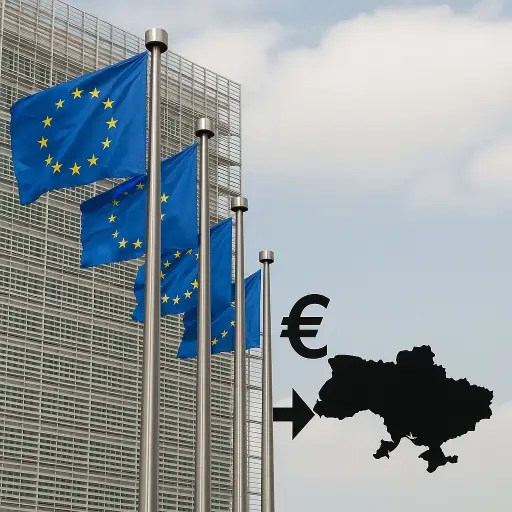
Brussels eyes a €140–185 billion “reparations” loan to Kyiv, backed by blocked Russian funds and set to begin flows in April 2026.
In a high‑stakes initiative aimed at shoring up Ukraine’s long‑term financial and military resilience, leaders of the European Union (EU) are edging toward a landmark agreement to use frozen Russian assets to provide urgent support to Ukraine. The deal, expected to be formalised by the end of 2025, envisions the creation of a large‑scale interest‑free loan beginning in April 2026, backed by billions of euros in blocked assets belonging to Russia’s central bank and other state‑linked entities.
The Mechanics of the Deal
According to EU documents, up to €185 billion of Russian sovereign assets frozen in EU jurisdictions — much of it held in Belgium via the securities‑depository Euroclear Bank — could be leveraged to issue a “reparations loan” to Ukraine. Under this structure, the assets themselves would not be immediately confiscated; instead, the EU would issue debt or guarantee instruments using the frozen funds as collateral or backing, and Ukraine would begin receiving disbursements around April 2026. Repayment would only be triggered if and when Russia pays war‑reparations — though analysts say the risk of such repayment is minimal.
Political Momentum and Member‑State Dynamics
The proposal has won high‑level backing. Friedrich Merz, Germany’s chancellor, has publicly endorsed the plan and called on EU partners to act swiftly. But it is not without controversy. Some member states caution that the plan must navigate complex legal terrain, respect international‑law obligations and avoid burdening national budgets or the euro’s credibility.
Belgium, home to large holdings of the frozen assets, is a key player and has pressed for safeguards to ensure it does not carry disproportionate risk. Meanwhile, EU‑wide unanimity remains elusive: one hold‑out nation could block the mechanism under treaty provisions.
Legal and Financial Hurdles
International‑law scholars and financial authorities agree: actual confiscation of sovereign assets is fraught with risk. The plan skirts this by calling the loan “interest‑free” and tying it to future reparations rather than asserting an outright seizure. Nevertheless, EU officials emphasise that the mechanism must be firmly grounded in law to ensure predictability for markets and protect the integrity of the euro.
There are practical considerations too: how to channel tens of billions of euros in a war‑zone environment, oversee expenditures, coordinate defence procurement, and manage risk if Russia retaliates or defaults.
Implications for Ukraine and Europe
For Ukraine, the incoming financial flow could be transformative. Document leakages show that parts of the planned loan would finance defence‑industry investment within Ukraine and the EU, while other portions would fund weapon acquisitions globally. Kyiv faces mounting budget shortfalls, rising military costs and uncertainty over U.S. aid — making European action increasingly critical.
For Europe, the move signifies a shift: rather than relying solely on fresh member‑state contributions or U.S. backing, the EU is seeking to tap resources already frozen in its jurisdiction. This could recast Europe from a donor to a more autonomous actor in the war‑economy. But the gamble is significant: legal missteps or macro‑financial blow‑back could undermine European credibility or invite Russian retaliation.
Timeline and Next Steps
- Late October 2025: EU summit expected to finalise high‑level political agreement.
- Through 2025: Legal, structural and fiscal frameworks to be drafted — including guarantees, risk‑sharing, governance of fund flows.
- April 2026: First disbursements to Ukraine slated to begin.
- 2026–2030: Ukraine uses the funds for defence, reconstruction and budget support — with repayment contingent on a future Russian payment of reparations, though recovery of such payments remains uncertain.
Risks and Open Questions
- Legal challenge: Will Russia (or other state actors) mount challenges claiming sovereign immunity or property rights violations?
- Market reaction: Could perceived asset appropriation or legal ambiguity unsettle investors or push central banks toward gold and away from Western assets?
- Member‑state cohesion: Can all 27 EU members unite behind one mechanism, avoid vetoes, and maintain shared governance?
- Ukraine oversight: How will the EU ensure that large volumes of funds travelling into Ukraine’s economy are managed transparently, effectively and aligned with defence priorities?
- Russia response: Could Moscow react by seizing Western assets, cutting off energy flows, or escalating the conflict to force renegotiation?
Why This Matters
This framework marks one of the most ambitious efforts yet in the war‑economy: converting the penalty of frozen Russian assets into a forward‑looking support mechanism for Ukraine. It embodies Europe’s desire to step up as a strategic actor, not just a contributor. At the same time, the deal illustrates the tangled nexus of law, finance, war and geopolitics — and the thin line Europe must walk to maintain legal integrity, financial stability and strategic resolve.
As the EU moves toward agreement, the coming months will test whether Europe can translate bold ambition into operational action — and whether Ukraine will be ready to absorb and deploy the funds when they start flowing in April 2026.
 The Tower Post