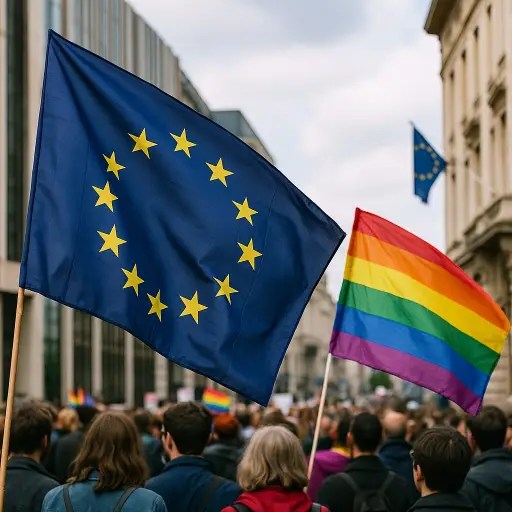
Brussels sets out bold new roadmap to strengthen legal protections, inclusion and social change across the EU in the wake of rising backlash against LGBTIQ+ rights
In a landmark move for human rights policy in Europe, the European Commission has officially launched its new LGBTIQ+ Equality Strategy 2026‑2030, setting an assertive agenda to deepen inclusion, bolster legal safeguards and promote social change across the European Union. The strategy arrives at a critical moment, as many member states face growing political backlash and discrimination against LGBTIQ+ individuals.
The Commission’s initiative builds directly on the preceding 2020‑2025 strategy, which strengthened legal protections and sought to mainstream equality across EU policy. That earlier framework reduced reported everyday discrimination among LGBTIQ+ people from 42 % in 2019 to 36 % in 2023.
KEY PILLARS AND COMMITMENTS
According to official sources and stakeholder submissions, the new strategy will focus on several major areas:
- Strengthening legal and institutional protections for LGBTIQ+ people, including across employment, health, education and recognition of gender identity and sex characteristics.
- Building inclusive societies, including countering anti‑LGBTIQ narratives and discrimination, empowering civil society organisations, and ensuring that remote or rural regions are not left behind.
- Promoting equality in practice, by shaping workplace inclusion, education programmes, health access and ensuring that funds and programmes across the EU are aligned with the aims of a “Union of Equality”.
- Stepping up the external dimension, meaning the EU will increasingly apply its equality policies in its external relations, aid and diplomacy—responding to what rights organisations call a “global emergency” for LGBTIQ+ rights.
FROM CONSULTATION TO COMMITMENT
The launch is the culmination of months of consultation: the Commission opened a public “call for evidence” earlier this year to inform the renewal of the strategy. Civil society groups welcomed this, but also flagged key priorities and concerns. For example, the European Trade Union Committee for Education emphasised that meaningful change in education — inclusive curricula, safe working environments for LGBTIQ+ staff and robust teacher training — must be central.
A SHIFTING LANDSCAPE OF RIGHTS AND BACKLASH
While the EU moves ahead with these plans, the broader European context remains fraught. Member states vary widely in how they protect LGBTIQ+ rights; in some places the legal safeguards are weak or under threat. The previous strategy’s implementation report noted that although discrimination is slowly falling, trans and intersex individuals continue to face high levels of harassment.
Observers say the new strategy is a necessary step to preserve and accelerate progress. In a recent submission, Human Rights Watch argued the EU must elevate its external action on LGBTIQ+ rights to match emerging challenges internationally.
IMPLEMENTATION CHALLENGES AHEAD
Nevertheless, the strategy carries significant implementation hurdles. The EU cannot force member states to adopt identical laws — much depends on national parliaments, equality bodies and civil society. Monitoring and enforcement remain perennial difficulties. The Commission’s 2024 implementation review noted that only 12 member states have national LGBTIQ+ action plans in place.
Some critics also warn that the strategy’s language may clash with national traditions or political climates. A recent opinion by Christian Council International, for example, expressed concern about how new provisions might affect “freedom of religion and conscience, parental rights and the biological foundations of human identity”.
WHAT TO WATCH NEXT
For stakeholders and anyone following equality policy in Europe, key next steps will include:
- How the Commission sets concrete targets and indicators for the strategy, making it more measurable and accountable than its predecessor.
- The alignment of EU funding streams (such as the Citizens, Equality, Rights and Values programme) with LGBTIQ+ equality objectives, especially for under‑resourced civil society organisations.
- National uptake: whether member states adopt or revise national action plans in line with the new strategy. The Commission has signalled it will increase peer‑learning and best‑practice exchange.
- The degree to which the EU embeds LGBTIQ+ equality in its foreign policy and external programming — something advocacy groups say is urgently needed.
- How the strategy addresses emerging areas like digital hate speech, intersectional discrimination, intersex rights, and recognition of non‑binary/trans identities.
CONCLUSION
The launch of the EU’s 2026–2030 LGBTIQ+ Equality Strategy represents a clear signal: Brussels wants to move beyond rhetoric to concrete action in advancing equality for LGBTIQ+ people across the Union. The scope is broad and ambitious — covering legal frameworks, societal attitudes, inclusion, and external engagement. But the effectiveness of the strategy will ultimately hinge on how well it is translated into national laws, funded programmes and everyday protections on the ground.
As the European Commission begins rolling out detailed action plans and supporting measures, the coming months will be crucial: will this strategy mark a turning point in Europe’s quest for a truly inclusive Union of Equality — or will it remain a laudable blueprint whose impact depends on decade‑long follow‑through?




 The Tower Post