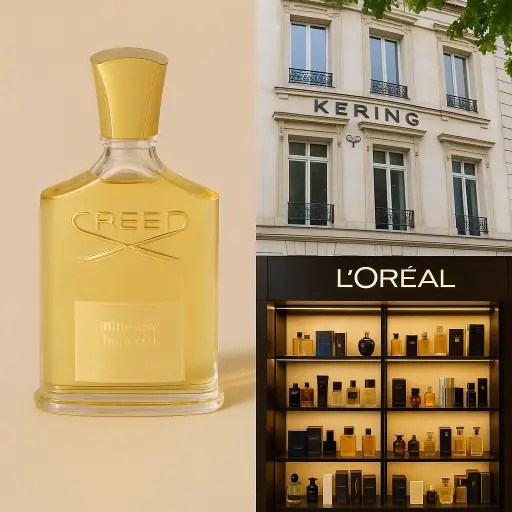
Luxury powerhouse Kering offloads its beauty arm — including heritage perfume house Creed — to L’Oréal, as it pivots back to core fashion brands and offloads non‑core assets.
In a landmark deal for the luxury goods and beauty industries, Kering has agreed to sell its beauty division — built around its high‑end fragrance label Creed — to global cosmetics giant L’Oréal for approximately €4 billion.
The move marks a dramatic strategic shift for Kering under newly‑appointed CEO Luca de Meo, who, barely weeks into his tenure, is refocusing the group back on high‑fashion and leather goods and away from the ancillary beauty business.
A change of course
Kering’s foray into beauty began in earnest in 2023 with the acquisition of Creed — a heritage perfumery with royal roots and strong niche prestige in the luxury fragrance category. The move was part of the group’s plan to build out a beauty arm under the banner “Kering Beauté”, intended to complement its marquee fashion houses such as Gucci, Balenciaga and Bottega Veneta.
However, as market conditions evolved and the fashion group’s debt burden grew — Kering reported a net debt of approximately €9.5 billion at the end of June 2025 — the makeup of the business came under review.
In his remarks announcing the deal, De Meo commented: “Joining forces with the global leader in beauty, we will accelerate the development of fragrance and cosmetics for our major Houses, allowing them to achieve scale … This partnership allows us to focus on what defines us best: the creative power and desirability of our Houses.”
Deal specifics and what it includes
The transaction covers the sale of Kering’s beauty arm — including Creed — and grants L’Oréal 50‑year exclusive licences to develop, market and distribute fragrance and beauty products under the Gucci, Bottega Veneta and Balenciaga brands. These licences will commence once existing Kering agreements expire (notably the current Gucci fragrance licence with Coty is due to end in 2028).
The deal is expected to close in the first half of 2026, subject to regulatory approvals and customary conditions.
On L’Oréal’s side, the acquisition represents the largest‑ever deal in its portfolio and underscores its ambition to deepen its presence in the ultra‑luxury fragrance segment where Creed is already a strong player globally.
Strategic implications
For Kering:
– The divestment allows Kering to sharpen its focus on its core (fashion, leather goods, accessories) and reduce exposure to lower‑margin beauty operations where it has under‑performed relative to competitors.
– The move helps de‑leverage the group’s balance sheet, freeing up liquidity and simplifying the business model — a priority for De Meo.
– Kering retains brand control: by licensing Gucci, Bottega Veneta and Balenciaga beauty to L’Oréal, Kering keeps the fashion branding while outsourcing the capital‑intensive beauty operations.
For L’Oréal:
– The deal adds a true “heritage” luxury fragrance brand in Creed to its portfolio, strengthening its position in the niche ultra‑premium segment.
– It secures long‑term rights to develop beauty and fragrance for world‑renowned fashion houses, aligning with L’Oréal’s ambition to dominate luxury beauty.
– The partnership also opens the door to explore the burgeoning “luxury wellness and longevity” segment: Kering and L’Oréal plan a 50/50 joint venture to develop experiences and services at the intersection of luxury and wellness.
Industry context & reaction
The timing of the deal underscores how luxury groups are rethinking the role of beauty and fragrance in their portfolios. While fragrances can be highly profitable, they also require scale, global distribution and significant marketing investment — areas where incumbent beauty groups like L’Oréal hold an advantage. Kering evidently determined that its competitive edge lay elsewhere.
Market response was broadly positive: shares of Kering rose on the news, as investors welcomed the debt‑reduction potential and the sharper strategic focus.
For L’Oréal, the move is seen as aggressive and timely: luxury beauty growth is expected to outpace mass market, and niche fragrances are increasingly fashionable among younger consumers seeking exclusivity and craftsmanship.
Risks & next steps
Despite the promise, the move carries risks for both parties:
– Kering will need to ensure that its fashion brands continue to deliver while relying on a partner for the beauty component — brand consistency and coherence remain key.
– L’Oréal must successfully integrate Creed and execute the long‑term licences without diluting brand heritage or alienating luxury consumers.
– Regulatory approvals (especially in Europe) and smooth transition of existing contracts (like the Gucci‑Coty licence) will be crucial for a clean hand‑over in 2026.
The take‑away
The sale of Kering’s beauty business to L’Oréal for €4 billion marks not simply a financial transaction, but the crystallisation of a strategic realignment in the luxury sector. Kering signals that it’s doubling down on what it does best — fashion leadership — while L’Oréal asserts its dominance in luxury beauty by acquiring heritage brands and securing long‑term licences. Together, the two are also betting on the next frontier: luxury wellness and longevity.
For stakeholders, this marks a moment when strategy trumps diversification, and where specialization once again triumphs in a world of brand saturation and shifting consumer preferences.




 The Tower Post