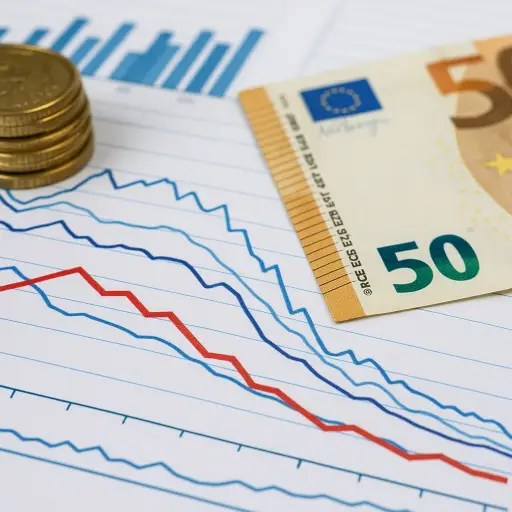
Rising debt costs, sluggish growth, and investment shortfalls weigh on European finances as net worth dips to –49.1% of GDP.
The European Union’s fiscal balance sheet has taken another hit this year, with the bloc’s general government net financial worth declining by €172 billion in the second quarter of 2025, according to the latest figures released by Eurostat. At the end of Q2, the EU’s overall net financial worth stood at –€9,024 billion, equivalent to –49.1% of the bloc’s GDP.
The deterioration marks a continuation of a troubling trend: the figure represents a €396 billion drop compared to the same period in 2024, signaling deepening structural imbalances across member states despite signs of moderate economic growth.
Mounting Debt and Slower Recovery
The contraction in net financial worth largely stems from rising public debt and falling financial asset values, as governments across the bloc contend with higher borrowing costs and the lingering effects of recent economic shocks.
Since the start of 2024, the European Central Bank’s sustained policy of high interest rates—aimed at taming inflation—has sharply increased debt servicing costs for many EU members. Although inflation has cooled to just under 3% by late 2025, the fiscal legacy of emergency spending and energy subsidies continues to weigh heavily on national budgets.
“Governments are still paying for past crises while trying to invest for the future,” said Claudia Renzi, senior economist at the European Fiscal Observatory. “The result is a squeeze: debt keeps rising, and the asset side of the ledger isn’t keeping pace.”
Divergent National Trajectories
The data mask significant divergence among member states. Germany, the EU’s largest economy, recorded a relatively modest deterioration of 0.3 percentage points of GDP in its net financial position, buoyed by robust tax receipts and cautious fiscal management.
By contrast, France, Italy, and Spain saw sharper declines, driven by heavier public investment programs and slower-than-expected growth. Italy’s public net financial worth, for instance, fell to nearly –160% of GDP, a new post-pandemic low.
In Central and Eastern Europe, fiscal buffers remain thinner. Countries such as Hungary and Romania experienced widening deficits due to currency pressures and delayed EU fund disbursements, further straining their balance sheets.
Investment Gaps and Fiscal Reform Challenges
Economists warn that the EU’s worsening financial position could hamper its ability to finance green and digital transitions—two pillars of the bloc’s long-term growth strategy. Despite ambitious policy frameworks like NextGenerationEU, the implementation of reforms and projects has been uneven.
“Public investment levels are still below what’s needed to meet 2030 climate targets,” noted Sven Becker, policy analyst at Bruegel. “Governments are constrained by high debt ratios, yet the costs of inaction will be even higher in the long term.”
Looking Ahead
As the EU prepares for its 2026 budget cycle, policymakers face difficult choices between maintaining fiscal discipline and stimulating growth. The European Commission is expected to revisit fiscal rule reforms aimed at granting member states greater flexibility in balancing debt reduction with investment spending.
For now, the financial picture remains fragile. Even as economic growth stabilizes and inflation recedes, the combined effects of high interest rates, slower productivity, and geopolitical uncertainty—particularly in energy markets—continue to erode the EU’s net worth.
“The numbers are a warning sign,” said Renzi. “Europe’s challenge is not just about debt—it’s about ensuring that today’s spending builds tomorrow’s prosperity.”
Summary:
At the close of Q2 2025, the EU’s general government net financial worth deteriorated to –€9,024 billion (–49.1% of GDP), marking a quarterly fall of €172 billion and an annual decline of €396 billion. With high debt costs and uneven growth weighing on public finances, the EU’s fiscal resilience is being tested once again.




 The Tower Post