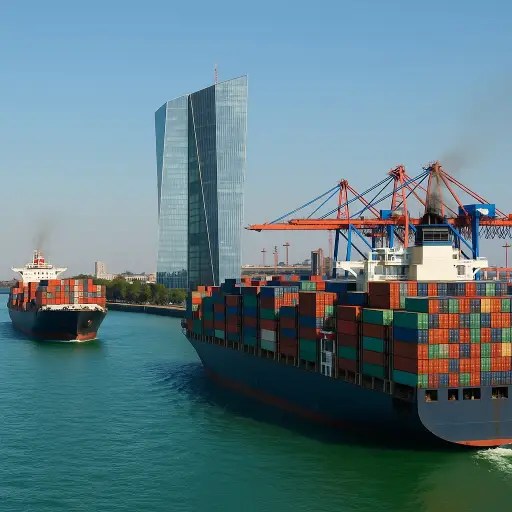
With firms absorbing much of the strain, European Central Bank President Christine Lagarde cautions that consumers may soon bear the burden — and the broader economy could follow.
In a tone imbued with concern and caution, the European Central Bank (ECB) has sounded a warning that the broader global economy has not yet fully absorbed the impact of the tariff barrage emanating from the United States. While much of the immediate shock has been carried by firms and trade-actors, consumers in Europe and beyond may face the next wave — and monetary-policy makers are alert to deeper risks ahead.
In a recent televised interview, Christine Lagarde, President of the ECB, stressed that although the costs of higher U.S. tariffs have begun to bite into corporate profit margins, they have not yet been passed fully to end-users — meaning the worst may still lie ahead.
“It’s a question of time,” she said, noting that companies in both the U.S. and Europe were absorbing roughly two-thirds of the tariff cost rather than passing it on — a tactic that may prove unsustainable.
The Anatomy of a Hidden Shock
From the outset, the U.S. administration’s decision to impose significant tariffs on a wide range of imports has carried ramifications that extend far beyond customs posts. The immediate effect has been on exporters, importers and supply-chain intermediaries. But the transmission to consumers, though delayed, is increasingly on the ECB’s radar.
According to Lagarde, firms have been using their profit margins as a buffer: absorbing part of the cost in hopes that the shock will prove transient. But that protection may fade. The longer firms absorb costs, the less likely they can continue to do so without passing them on — or without reducing investment, employment or raising prices.
There are also broader structural risks. The ECB highlighted that trade-tensions are among the key uncertainties interfering with investment, business confidence and the transmission of monetary policy.
Europe’s Exposure — And the Monetary Policy Implication
Europe, as a region deeply embedded in global trade flows, is particularly exposed. Firms that export to the U.S. or rely on U.S.-dollar funding could see margin pressure, weaker demand, or cost shocks from rising input prices.
The ECB’s blog, for example, noted that “firms are still running down inventories and absorbing the shock in margins, so the full effects of U.S. tariffs have yet to become clear.”
For the ECB, this poses a twin challenge: battling too-high inflation from cost-push pressures, while guarding against growth weakening if trade and investment falter. The implications for monetary policy are profound. If tariffs erode potential growth, as internal staff analysis suggests, then central banks may face a harder balancing act between inflation and growth.
Where the “Pain” Is Hidden — And Where It Might Emerge
Current layer:
- Firms reducing margins rather than raising prices.
- Some substitution of trade flows, inventory buffers, cost-absorption.
- For now, consumer price signals remain modest – giving a false sense of resilience.
Next layer (what the ECB fears):
- When companies’ margins are no longer tenable, they may raise prices — meaning consumers see higher cost of living.
- Investment could be cut back, employment growth slowed, and trade flows reduced — meaning a drag on growth itself.
- Policy-transmission may weaken: if firms facing cost shocks invest less, monetary stimulus may have muted effects.
Lagarde warned explicitly that “when they [firms] don’t, because it’s becoming too tight, then it will be on the consumer.”
A Broader Alert for Global Markets
This warning comes amid an already fraught global outlook. Earlier this month, the International Monetary Fund (IMF) noted that although the world economy remains “unexpectedly resilient,” the full impact of trade-restriction policies has yet to play out.
In Europe, central-bank watchers note that one part of the transmission chain is already under stress: external funding in U.S. dollars, for example, where euro-area banks hold significant liabilities. According to the ECB’s Chief Economist Philip R. Lane, “Dollar funding … may come under pressure” amid tariff- and trade-driven volatility.
Taken together, the message is clear: the global economy may appear to be holding up, but beneath the surface — in corporate margins, trade exposure, investment decisions — the shock waves are still rolling in.
What To Watch In Coming Months
- Corporate margins: Will firms continue to absorb cost burdens, or will price rises follow?
- Consumer inflation: Are we seeing early signs of pass-through from margins to prices — and will that show up in inflation statistics?
- Investment and hiring: If firms cut back due to uncertainty or margin squeeze, growth may slow.
- Trade volumes: Monitoring export/import flows may give early signals of a broader slowdown.
- Monetary policy signals: Should the growth side soften while inflation remains sticky, the ECB faces a more complex policy trade-off.
Conclusion
With the global economy already navigating multiple headwinds — energy-price volatility, geopolitical risk, structural transformation from digitalisation and climate transition — the added pressure of tariffs is hardly trivial. The ECB’s message is unambiguous: the “hidden” costs of U.S. tariffs may currently lie beneath the surface, but time is working in favour of their emergence.
For policymakers and markets alike, the period ahead may bring the real test: when the cushion of margin absorption deflates and the shock moves from balance-sheets into everyday prices and investment decisions, the growth story may become more fragile. Europe’s central bank is sounding the alarm now — and in doing so, is asking whether we’ve still got time to act before the next wave hits.

 The Tower Post