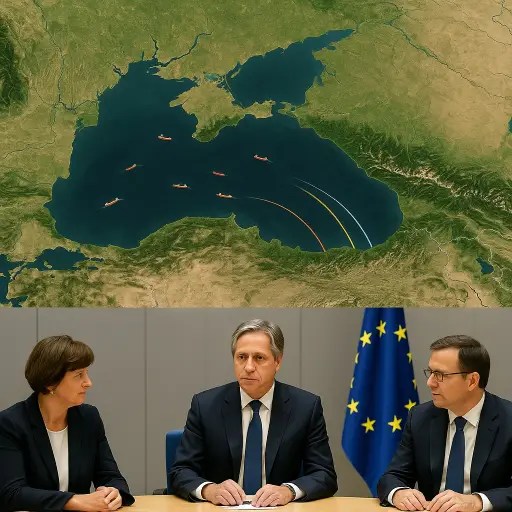
At a high‑level ministerial gathering, the EU and its partners launch a cross‑regional agenda to link security, trade and infrastructure from the Black Sea to Central Asia.
In a marked strategic shift, the European Union (EU) has deepened its engagement with neighbouring geographies by convening foreign ministers from EU member states alongside partners including Armenia, Moldova, the Central Asian republics, Turkey and Ukraine. The meeting, organised under the banner of a “cross‑regional connectivity agenda”, sets out a holistic vision for linking security, trade and infrastructure across a surprisingly wide arc stretching from the Black Sea and Caucasus region into Central Asia.
A strategic pivot in European diplomacy
What makes this gathering particularly noteworthy is the breadth of participation and the ambition of the agenda. The EU has long worked bilaterally with countries in the Black Sea and Caucasus, and increasingly with Central Asia — but this effort takes a broader, multi‑regional dimension. By crossing traditional regional divides, Brussels is signalling that stability, prosperity and connectivity in one region cannot be treated in isolation: the Black Sea area and Central Asia are now being treated as part of a single strategic corridor of opportunity and vulnerability.
Officials outlined three core pillars for cooperation:
- Security and resilience — addressing maritime security, hybrid threats, and infrastructure protection in the Black Sea‑Caucasus zone, while recognising that Central Asia’s stability also factors into European security calculus.
- Trade and economic connectivity — expanding transport corridors, customs cooperation and investment frameworks to ease trade flows from Central Asia through the Southern Caucasus into Europe.
- Infrastructure and digital links — building energy, transport and digital‑infrastructure linkages that knit the regions together and tie them into the European market.
Anchoring the Black Sea agenda
For the Black Sea and Caucasus region, the emphasis is on managing an increasingly complex security environment and turning it into a zone of connectivity rather than division. With the war in Ukraine, the region has gained heightened strategic salience. The meeting paid particular attention to maritime security in the Black Sea basin and to safeguarding export routes for grain and energy supplies. It also flagged the need to protect critical infrastructure — ports, pipelines, telecom systems — from hybrid threats and disruptions.
Trade and infrastructure in the region are gaining new impetus. For example, participants discussed how to link Black Sea ports, rail networks and trans‑Caucasus corridors into a coherent system. The EU’s interest is clear: by strengthening the Black Sea flank, Brussels aims to secure its eastern trade corridor and reduce dependencies. The underlying message: the Black Sea region is no longer a peripheral theatre — it is part of the EU’s broader connectivity ambition.
Extending the scope to Central Asia
Equally significant is the attention paid to Central Asia. While historically the focus for many European actors has been on Russia, China or South Asia, the EU now appears to view the five Central Asian republics and their transport, energy and digital links as key to its Eurasian strategy. Ministers addressed how improved connectivity could shorten transit times for goods, open up new routes for energy and raw materials, and provide Europe with improved access to growth markets.
To this end, discussions included how to accelerate development of transport corridors across the Caspian region, deploy digital infrastructure to enhance customs procedures, and cooperate in renewable‑energy projects as part of the EU’s green agenda. The EU’s infrastructure push is increasingly cast in terms of strategic diversification: reducing risk by routing trade and energy flows through multiple pathways that bypass fragile or contested zones.
Challenges and the path ahead
While the agenda is grand, its execution will face real obstacles. First, the geopolitical complexity: the Black Sea‑Caucasus region includes states with widely differing interests, and Central Asia remains a contested space of influence between major powers. Any tangible infrastructure progress will require sustained alignment among many actors. Second, funding and governance remain issues. Large‑scale transport or energy infrastructure linking Europe and Central Asia demands investment, regulatory alignment and long‑term maintenance commitments. Third, conflict and instability pose a persistent drag. In the Black Sea region, unresolved territorial tensions risk derailing connectivity projects; in Central Asia, resource competition, geography and domestic institutional weakness may slow progress.
Nevertheless, participants emphasised a step‑by‑step approach. The ministers agreed to establish a coordination framework under the cross‑regional connectivity agenda, with the aim of aligning investment planning, regulatory settings and strategic priorities across regions. The EU reaffirmed its role not only as financier but as convener: bringing together governments, private‑sector players and multilateral agencies to build durable linkages.
Why this matters for Europe today
For the EU, this moment is about more than infrastructure or trade: it’s about shaping a geopolitical environment favourable to its interests. By investing in connectivity that spans from the Black Sea through the Caucasus into Central Asia, Europe seeks to anchor stability, secure supply chains and cultivate new markets — while counter‑balancing influence that may emanate from other global players. In short, the agenda reflects the EU’s evolving self‑understanding: from a regional actor in Western Europe to a connectivity broker for the broader Eurasian landmass.
Moreover, the agenda aligns with broader global trends: the acceleration of trade between Asia and Europe, the diversification of energy supply routes, and the digitalisation of cross‑border commerce. In this context, the EU’s initiative is timely — and it interlocks with other efforts such as the so‑called Middle Corridor and alternative East‑West transport axes. By casting the Black Sea and Central Asia as interconnected horizons, the EU is positioning itself to ride this wave rather than being left behind.
Outlook: what to watch next
In the months ahead, several indicators will test whether this agenda moves from aspiration to action:
- The launch of a central coordination mechanism or secretariat tasked with aligning projects and tracking progress.
- A concrete pipeline of infrastructure investments (ports, rail, pipelines, digital hubs) that crosses regional boundaries and involves European financing and private participation.
- Enhanced customs and trade facilitation agreements that reduce friction at border crossings between the Black Sea, Caucasus and Central Asia.
- Progress on security cooperation, especially around protecting maritime routes, energy installations and digital infrastructure from hybrid risks.
- A forum or summit bringing together EU and partner states to review progress, share investment planning and deepen policy coordination.
If these steps materialise, the EU’s cross‑regional connectivity agenda could reshape the map of European‑Eurasian interaction — anchoring new corridors of trade and influence in a region long regarded as marginal but now at the centre of global flux. For Thursday’s post, what emerges is a new chapter in European diplomacy: one that stretches from the Black Sea’s historic shores to the sweeping steppes of Central Asia, and seeks not simply to connect space, but to anchor strategic outcomes.

 The Tower Post