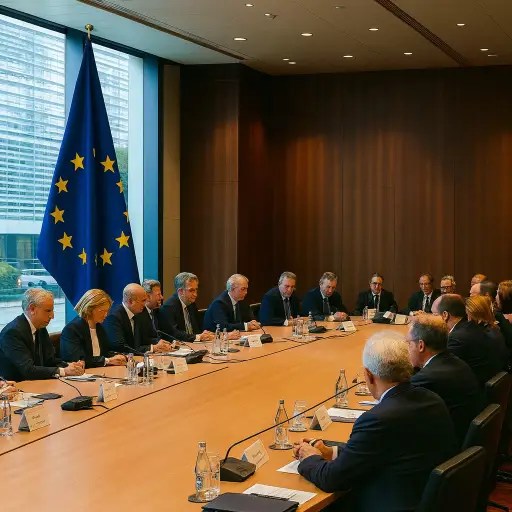
Brussels under pressure from Eastern‑ and Southern‑European capitals considers scaling back flagship legislation on deforestation, carbon pricing and transport ahead of Thursday’s summit.
Brussels — The European Commission (EC) is planning to scale back key elements of the bloc’s ambitious climate agenda just days before a major summit of EU leaders. The move comes as several member states from Eastern and Southern Europe press for relief from what they call excessive costs and administrative burdens tied to green regulation.
In the coming summit scheduled for Thursday, member‑state heads will gather in Brussels to discuss the bloc’s next steps on climate policy. But already, internal lines of tension are visible: on one side, capitals demanding flexibility; on the other, climate‑policy proponents warning that watering down the rules would undermine the EU’s long‑term credibility.
Exemption for Small Farmers and Eased Deforestation Rules
One of the most immediate changes under consideration affects the Regulation on Deforestation‑free Products (EUDR), the landmark law adopted in 2023 to prevent the import into the EU of commodities linked to deforestation.
Under the proposed modifications, small‑scale farmers and small enterprises would receive significantly reduced reporting requirements, a longer compliance timeline, and lighter due‑diligence obligations. According to the EC’s proposal, micro‑ and small companies may have to wait until December 2026 before enforcement becomes strict, rather than adhering to earlier deadlines.
While the law’s full entry into force remains scheduled for 30 December 2025 for larger operators, the change reduces the administrative load on smaller actors, particularly in countries with less robust compliance capacity.
This shift reflects growing concern in capitals such as Poland, Romania and Greece, where agriculture remains a politically sensitive sector and where officials feel that ambitious EU climate regulation may risk local livelihoods.
Loosening Carbon Pricing and Transport Measures
Pressures are mounting not just for the deforestation regulation, but also for changes to the bloc‑wide carbon pricing regime and transport emissions rules. The Commission is reviewing proposals to loosen the carbon market for homes and cars, and to revisit the 2035 ban on new internal‑combustion engine vehicles — potentially allowing cars running on carbon‑neutral fuels or biofuels to remain on the market.
Such a pivot comes amid strong objections from Member States facing steep renovation costs for heating systems, or where the auto sector remains a dominant employer and industrial base. The eastern flank of the Union argues that the pace and burden of change threaten competitiveness and social cohesion.
At the same time, the EC is signalling it will propose stronger cost‑curbing measures in the revised carbon‑market mechanism, implicitly acknowledging the economic strain felt by EU governments.
Political Stakes Ahead of Thursday’s Summit
The timing of the policy revisions is politically charged. With the summit on the horizon, the Commission appears keen to render draft concessions to member states beforehand, perhaps hoping to secure a smoother consensus among the 27 leaders.
For the EC, the balancing act is delicate: it must accommodate domestic pressures from member states while preserving the integrity of the European Climate Law and the wider European Green Deal, which committed the bloc to climate‑neutrality by 2050.
Failure to deliver on credibility could spark backlash from environmental NGOs and climate‑focused Member States in Scandinavia and Western Europe, who view the Green Deal as a cornerstone of EU leadership on the global stage.
What’s at Risk?
Critics warn that concessions now may undermine long‑term ambition. One expert pointed out that delaying transport decarbonisation places greater burden on other sectors and raises system costs in future years.
Moreover, the deforestation‑law tweaks may weaken traceability and enforcement, potentially send negative signals globally about the EU’s commitment to climate and biodiversity goals.
From an economic viewpoint, while easing burdens may support short‑term competitiveness for some regions, the longer‑term costs of delayed transition and increased climate risk could outweigh immediate gains.
What to Watch on Thursday
At the summit, several key questions will dominate:
- Whether the Commission’s revised proposals will be formally endorsed or merely discussed, and how much room remains for further negotiation with the European Parliament and national governments.
- The extent to which the bloc’s climate target for 2040 (or the next incremental step after 2030) will be adjusted to reflect the new leniencies for certain sectors.
- How capitals frame the concessions with their electorates: will they present the adjustments as pragmatic relief or as a retreat from ambition?
- Whether member states currently pushing for stronger measures will react to the changes – and possibly seek to anchor stronger safeguards in other legislation to compensate.
Final Word
The EU stands at a crossroads. On one route lies the continuation of robust climate policy — unabated, internationally credible, and aligned with the net‑zero ambition that Europeans have collectively endorsed. On the other route lies incremental dilution of those ambitions in the name of immediate flexibility, with the attendant risk of credibility erosion.
As the summit looms on Thursday, what emerges from Brussels will speak volumes about where Europe’s environmental leadership truly stands.




 The Tower Post