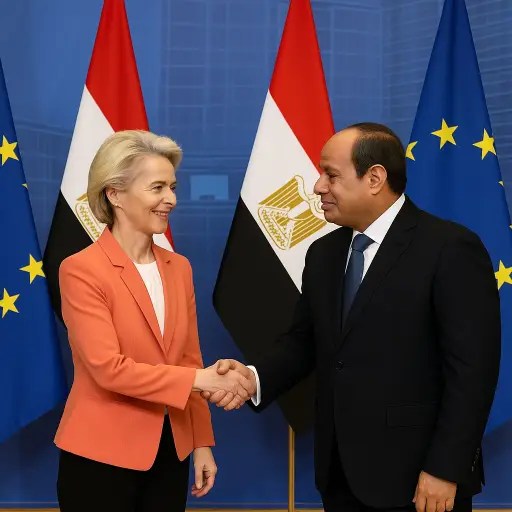
The first EU–Egypt bilateral summit in Brussels marks a turning point in Europe’s Mediterranean strategy — addressing migration, Gaza’s turmoil and economic cooperation.
The European Union and Egypt held their first bilateral summit this week in Brussels, opening what both sides described as a “new era of strategic partnership.” The high-level meeting, led by European Commission President Ursula von der Leyen and Egyptian President Abdel Fattah el-Sisi, centered on three priorities: managing migration, stabilizing Gaza, and deepening trade and investment links.
The summit follows a turbulent year in which the Gaza conflict, rising migration pressures and a fragile regional economy have tested both Europe’s unity and Egypt’s resilience. Officials on both sides hailed the talks as a significant step toward a “comprehensive and balanced” relationship.
Migration: Shared Burden, Shared Interest
Migration topped the agenda. European leaders praised Egypt for its efforts to curb irregular departures from its Mediterranean coast, while Egyptian officials stressed the need for sustainable solutions that create jobs and stability at home.
Von der Leyen said the EU aims to “move from crisis management to long-term cooperation,” announcing new financial support for Egypt’s border management, education and job creation. The joint declaration also commits to exploring legal migration channels, expanding training programs for young Egyptians, and improving return and reintegration systems for those crossing irregularly.
Egypt currently hosts more than nine million refugees and migrants, including large communities from Sudan, Syria and the Horn of Africa — a fact Cairo says illustrates its crucial role in regional stability.
Gaza and Regional Stability
The war in Gaza loomed large over the summit. Egypt, a key mediator between Israel and Palestinian factions, urged the EU to maintain humanitarian support and back post-war reconstruction efforts.
El-Sisi warned that “the Gaza crisis threatens to ignite the entire region if diplomacy fails,” calling for a durable cease-fire and a coordinated reconstruction plan involving Egypt, the EU and international partners.
The EU reaffirmed its support for Egypt’s mediation efforts and pledged additional funding for humanitarian corridors through Rafah and the Sinai. Brussels reiterated its commitment to a two-state solution, calling it “the only viable path to lasting peace.”
Trade and Investment: Turning Policy into Partnership
While security dominated headlines, trade and investment were the concrete deliverables. The EU remains Egypt’s largest trading partner, accounting for nearly a quarter of the country’s total foreign trade. At the summit, the European Commission announced the launch of a €750 million co-investment platform to support private-sector development, clean energy, logistics, and green hydrogen projects.
The initiative is seen as part of Europe’s broader strategy to strengthen supply chains across the Mediterranean and reduce reliance on Asian markets. For Egypt, it represents a chance to attract fresh capital and ease pressure on its struggling currency.
“We are building a partnership based on mutual benefit,” said Egypt’s Minister of International Cooperation, Rania Al-Mashat. “Trade must serve our people — through jobs, technology transfer and sustainable growth.”
Human Rights and Realpolitik
Despite the upbeat tone, critics warned that the partnership risks prioritizing border control over human rights. Several NGOs in Brussels called on the EU to ensure that migration funding is tied to accountability and protection standards.
EU diplomats acknowledged the tension but argued that engagement is preferable to isolation. “We can only influence outcomes through cooperation,” said one senior official. “Egypt’s stability is vital to Europe’s own security.”
Looking Ahead
Both sides agreed to hold annual summits, alternating between Cairo and Brussels, with the next meeting planned for mid-2026. Six joint working groups — on trade, migration, security, energy, digital transition and education — will begin meeting early next year.
For Europe, the summit marks a recalibration of its Mediterranean policy — one that blends pragmatic cooperation with geopolitical necessity. For Egypt, it offers validation on the international stage and potential relief from economic pressures.
As the Brussels communiqué concluded:
“A stable, prosperous Egypt is in the interest of the European Union. A strong, engaged Europe is in the interest of Egypt.”
Whether this first bilateral summit becomes a genuine turning point — or just another diplomatic headline — will depend on what happens next: jobs, investments and peace on the ground.


 The Tower Post