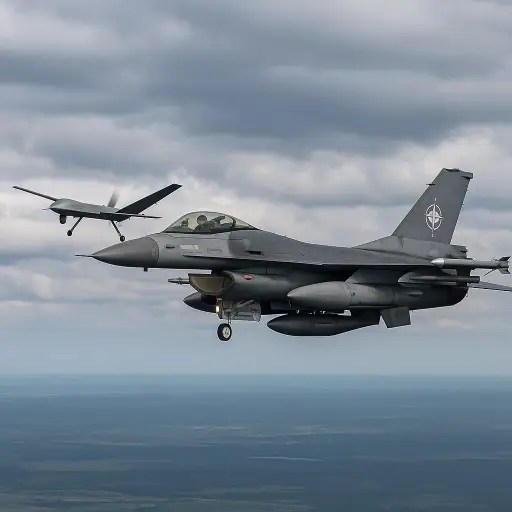
While overt airspace violations by North Atlantic Treaty Organization (NATO) allies appear under control, Moscow’s use of drones, cyber‑attacks and subversion keeps the alliance on high alert.
A shift is underway on Europe’s eastern frontier: according to NATO’s top military commander, the bold aerial breaches that once defined the Kremlin’s probing efforts seem to have abated — but a subtler, more insidious campaign has taken their place.
In an interview, Alexus G. Grynkewich, the alliance’s Supreme Allied Commander Europe (SACEUR), stated that recent months show a marked reduction in overt violations of allied airspace by Russia’s military jets, suggesting that NATO’s quick reaction alerts and joint air policing efforts have helped establish credible deterrence. At the same time, however, he warned of continued and intensifying hybrid‑threat activity – from drones and cyber intrusions to influence campaigns and infrastructure sabotage.
Deterrence By Air: A Levelled Playing Field?
According to publicly‑reported incidents, Moscow’s aircraft intrusions into NATO airspace have not vanished but appear more cautious. For example, three Russian jets flew into Estonian airspace on 19 September. NATO intercepted and escorted them out, sending a diplomatic and military message. On the same flank, more than 20 drones penetrated Polish airspace in early September, triggering a NATO response that led to the first‑ever engagement of drones launched from Russia in a NATO nation’s airspace.
Grynkewich credited the combination of allied vigilance, improved surveillance and stronger coordination for raising the cost of testing NATO’s borders. As he put it, “Russia appears more cautious following our response … but that doesn’t mean they’re gone.”
Yet analysts caution already against mistaking this lull for complacency. A recent commentary argued that the incident‑rate may have dropped, but the complexity of the threat has surged — particularly in realms where attribution is difficult and responses slow.
The Rise of the Underdog Threats: Drones, Cyber & Subversion
While large‑scale air incursions may be less frequent, hybrid threats remain very active—and arguably more dangerous because they operate in the grey zone.
Drone Proliferation
Russian‑aligned drone activity has multiplied along NATO’s eastern flank. The widely reported Polish incident involved 19‑23 drones entering Polish airspace on the night of 9‑10 September, triggering Article 4 consultations and the launch of the allied operation Operation Eastern Sentry. Those drones included models known as “Gerbera” — used by Russia and its proxies as decoys and for reconnaissance. NATO officials say detecting and countering such small, low‑signal drones represents a new challenge.
Cyber and Infrastructure Attacks
In parallel, Russia’s toolkit of cyber and information operations has remained active. NATO and member states report persistent campaigns targeting critical infrastructure, telecoms, supply chains and public perceptions. The challenge is compounded by the fact that these attacks fall below the threshold of armed conflict, leaving responses ambiguous and political.
Influence and Subversion
Beyond kinetic threats, Moscow continues to exploit disinformation, social‑media influence operations, and covert networks to shape narratives in Eastern Europe. Germany, Poland, the Baltic states and the United Kingdom have all pointed to such efforts as part of a broader strategy of strategic competition.
NATO’s Response: From Reaction to Anticipation
Recognising this changing threat landscape, NATO has begun recalibrating how it defends its eastern flank.
- Integrated Air and Missile Defence
Under the Eastern Sentry operation launched in mid‑September, NATO moved to combine air policing, surface‑to‑air missile systems, maritime assets and rapid‑reaction fighters into a unified posture across the Baltic and Poland‑Belarus border region. - Hybrid‑Threat Focus
NATO’s strategic concept now emphasises hybrid threats as a core domain of defence. Member states are increasing investment into counter‑drone systems, cyber resilience and intelligence sharing to address asymmetrical tools of aggression. - Whole‑of‑Society Approach
The alliance recognises that defending against hybrid threats demands more than military hardware: critical infrastructure protection, supply‑chain resilience, public‑information campaigns and private‑public cooperation are vital. Several allied capitals are bolstering their national frameworks accordingly. - Burden‑Sharing and European Focus
While the United States remains a key pillar, NATO’s European members are increasingly expected to step up. Recent U.S. legislative attention to supporting NATO’s eastern flank reflects this shift.
The Road Ahead: Risks and Uncertainties
Even with improved deterrence in the air, several risk factors loom:
- Escalation Mis‑calculation: If a drone or aircraft causes damage or casualties, the pace of response and the question of who acts could spark unintended escalation between NATO and Russia.
- Attribution & Tailored Response: Hybrid actions are often difficult to attribute definitively; states may respond cautiously, reducing deterrence effectiveness.
- Technological Catch‑Up: Russia’s use of low‑cost, mass‑produced drones, electronic warfare and deception tactics places pressure on NATO’s traditional high‑end systems. Analysts warn alliance need to adapt faster.
- Political Cohesion: Robust deterrence requires unity among all 32 + allies. Divergence in threat perception, defence spending, or national rules of engagement may undercut readiness.
Conclusion
For NATO, the September‑2025 air incursions may mark a turning point: the overt show of force by Russian jets appears to have receded, signalling that the alliance’s deterrence posture is beginning to work. Yet, this is no time for complacency. The battle has shifted into a more pervasive and complex domain — one where drones, cyber‑attacks and subversive influence can erode the alliance’s coherence and resilience without the fanfare of fighter‑jet scrambles.
As General Grynkewich counselled: “Deterring the obvious threat is only half the mission — we must also anticipate the invisible ones.” In the evolving confrontation with Moscow, NATO’s next test will not just be about controlling skies, but mastering the grey zone of hybrid warfare.




 The Tower Post