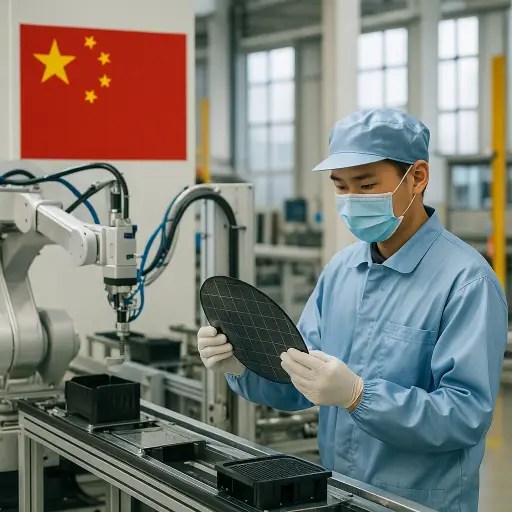
Beijing’s industrial strategy gains momentum — and Europe finds itself caught between US–China rivalry and its own trade and tech dilemmas
As the geopolitical fault lines between the United States and China sharpen, Beijing is doubling down on its ambition to build a self‑sufficient technology base, a move with significant consequences not only for Washington, but for Europe’s trade and tech positioning as well.
At a plenary meeting earlier this week, the ruling Chinese Communist Party laid out a refreshed five‑year blueprint emphasising the construction of a “modern industrial system” and a concerted push toward technological self‑reliance. The timing is far from coincidental: it comes amid a growing US campaign to restrict China’s access to advanced chips and software, and a parallel Chinese strategy to insulate itself from such constraints.
A strategic adjustment
China’s drive is rooted in policies long in motion, such as the “dual circulation” strategy, which prioritises domestic markets and internal innovation while maintaining outward economic engagement. But what is clear now is that the prevailing external environment has accelerated the transition: US export controls on advanced computing and semiconductors are cited as reasons why China must ramp up its own capacities rather than rely on foreign supply.
While Beijing once shied away from naming its industrial policy blueprint explicitly, analysts note that what was launched as Made in China 2025 is now manifesting in new forms under different labels — but with similar core goals.
In practical terms, the strategy covers:
- Domestic production of key components such as semiconductors, industrial machinery, and core materials.
- State‑led investment and support for “national champions” in emerging technologies (AI, quantum, 5G/6G, chips).
- Supply‑chain insulation: reducing reliance on foreign origin for critical inputs, including rare earths and advanced chip tools.
Europe in the cross‑winds
For Europe, the significance is two‑fold. On one hand, the continent remains deeply embedded in global technology and manufacturing networks in which China plays a major role; on the other hand, it faces strategic risks if China’s tilt toward self‑reliance shrinks the space for European firms or rewrites trade dynamics.
European firms may find that access to Chinese markets becomes more conditional, as Beijing prioritises domestic players and restricts foreign firms’ roles in critical technologies. Meanwhile, Chinese steps to weaponise its dominance in certain upstream supply chains (such as rare‑earth materials) present supply vulnerabilities for European manufacturing.
Furthermore, the US‑China rivalry means Europe must navigate a delicate path: if Washington tightens its tech and export controls further, European firms may find themselves forced to choose sides or manage dual regulatory regimes. Meanwhile, Beijing’s closer alignment of industrial policy with geopolitical objectives means Europe’s trade‑and‑technology strategy will need to adapt.
Unpacking the risks and opportunities
Risks:
- If China achieves greater self‑reliance, global competition in high tech will intensify, potentially eroding European firms’ margin for partnering with China or relying on Chinese‑led supply chains.
- Disruption to global supply chains: China’s leverage over rare earths or advanced manufacturing inputs could force Europe into costly sourcing shifts or strategic dependencies of its own.
- Regulatory fragmentation: Diverging standards, export regimes and industrial policy priorities between US, China and Europe may raise compliance and investment costs for European companies targeting global markets.
Opportunities:
- Europe can partner with China (where appetites exist) but on its terms — emphasising technology transfer, standards shaping and diversification.
- The shift may open space for European technology producers to step in where China’s domestic capability remains weaker, especially if China prioritises its own firms first.
- Europe can leverage the US–China rivalry to solidify alternative supply chains and stronger regional cooperation in advanced manufacturing, semiconductors, and critical raw materials — reducing its own risk of over‑dependence on either side.
What to watch in the coming months
- Whether China’s next five‑year plan (2026‑2030) formalises stronger state support for emerging tech and mandates metrics for self‑sufficiency in sectors such as semiconductors and AI.
- US decisions on further export controls, particularly those targeting software and computing tools — any new measures could accelerate China’s self‑reliance trajectory.
- European policy responses: how Brussels and individual capitals update their strategies for investment, trade, standards and industrial cooperation in light of Sino‑US tech competition.
- Real‑world supply‑chain moves: escalation of Chinese export restrictions on key inputs (rare earths, components), or increased Chinese inward investment in Europe (especially in battery, telecom, chip sectors).
Final word
Saturday, October 25, 2025, finds the global technological arena shifting. For China, the message is clear: not just to “catch up”, but to build resilience and autonomy in domains that once defined the frontier of US‑led innovation. For Europe, the moment invites recalibration — defending and advancing its interests in a world where trade and technology are not just economic questions, but strategic ones.
Beijing’s ambition for tech self‑reliance is no longer a distant policy aspiration — it is a practical adjustment to a world of mounting confrontation, supply‑chain fragility and industrial contestation. The ripple effects will be felt across continents, and Europe will need to choose how it positions itself between rising powers and shifting tides.



 The Tower Post