
With the European Parliament proposing a €193.9 billion budget for 2026, EU governments face a high‑stakes negotiation balancing research, industry and armed readiness.
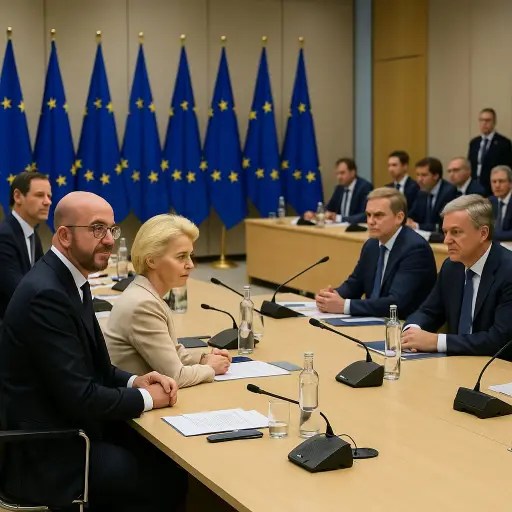
As Saturday dawns across Europe, heads of state and government of the European Council are preparing to settle into what promises to be one of the most complex budget negotiations in years. They must reconcile the ambitions of the European Parliament, which recently put forward a draft 2026 EU budget of €193.9 billion — heavily focused on research, industry competitiveness and defence readiness — with national priorities and fiscally cautious capitals.
The Parliament’s proposal arrives at a moment when geopolitics, industrial pressures and internal economic weaknesses converge. The idea is to provide the Union with the tools to become more than simply a market: to become a strategic actor capable of defending its interests and modernising its productive base.
At the same time, the Council of the European Union — representing the governments of member states — signalled in July a more modest position: a 2026 draft budget of about €186.24 billion in commitments and €186.49 billion in payments, excluding special instruments. The gap between Parliament and the governments sets the stage for a tug‑of‑war: how much can (or should) Europe spend to become more competitive and better defended — while remaining fiscally credible?
Stakes and priorities
The Parliament’s proposal carries three interlocking ambitions:
- Research and industry competitiveness
- Defence readiness
- Flexibility and crisis‑resilience
Key friction points include budget size versus ambition, defence industrial base versus sovereignty, fiscal rules, and the balance between industrial and social priorities.
What happens next
Over the coming weeks, the European Parliament, Commission and the Council will engage in “trilogue” negotiations. The outcome will depend heavily on compromises — perhaps via targeted increases for high‑priority lines (research, defence) and perhaps via offsetting savings elsewhere.
Implications for Europe
If Europe agrees a large step‑up in budget, the signal is political: the EU intends to act as a strategic bloc, not merely a regulatory or market society. In defence terms, this may accelerate procurement programmes, boost the European arms‑industry supply chain, and reduce dependence on non‑EU suppliers.
On the competitiveness side, stronger EU funding could enable wider rollout of advanced manufacturing, AI, semiconductors and green tech — but only if coupled with structural reforms and delivery capacity in member states.
Conclusion
Saturday’s budget debate among EU leaders marks a critical moment. Will the European Union seize the moment to deepen its competitiveness and bolster its defences — or will national caution trim the sails of ambition? The €193.9 billion figure advanced by Parliament is not just arithmetic — it is a statement of purpose. How governments respond will define the EU’s political, industrial and military trajectory for years ahead.



 The Tower Post