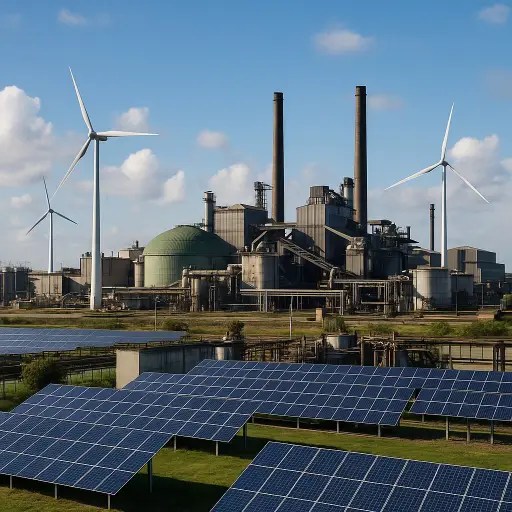
The ambition of the European Union (EU) to convert its industrial heartlands into a green and climate‑neutral powerhouse is running into turbulence. As member‑states and manufacturing firms race to deliver on policy goals—from the Green Deal to the Net Zero Industry Act—they are confronting a dual threat: rapidly rising costs of energy and materials, and fierce competition from low‑cost challengers abroad.

Europe’s strategy, in essence, is to transform heavy‑industry players into low‑carbon champions: steelworks powered by green hydrogen, chemical plants fueled by renewable energy, and supply chains reshored under the banner of “strategic autonomy.” But analysts and industry insiders warn that the plan may falter unless underlying economic fundamentals are addressed.
Rising costs squeeze margins
Electrification, hydrogen and other low‑carbon technologies all require an energy input dramatically higher in cost today than conventional fossil‑fuel systems. Many European producers are finding themselves at a disadvantage compared to global competitors operating in jurisdictions where energy and labour costs remain lower. The result: margins are under strain, investment decisions are delayed and some industrial players are looking to relocate or scale back.
Furthermore, regulatory demands—carbon‑pricing, stricter emissions controls, supply‑chain due‑diligence—impose additional cost burdens. While these are part of the transition’s logic, they also widen the gap between aspirational goals and commercial viability.
Global competition eats into advantage
European firms aiming to be first‑movers face a further challenge: the flood of imports and overseas production of goods made with cheaper energy and looser standards. Some sectors warn that unless import barriers or level‑playing‑field measures are strengthened, the “premium” of being green could become a liability.
For example, producers in Asia and elsewhere, benefitting from inexpensive coal or subsidised power, can undercut European equivalents even once transport and tariffs are factored. Thus, Europe’s industrial strategy must not only address internal cost structure but also the global competitive environment it faces.
Policy ambition meets fiscal reality
In Brussels and capitals across Europe, the political will to deliver a green industrial renaissance is clear. The Net Zero Industry Act sets out milestones for manufacturing of clean technologies in the EU. But the gap between ambition and execution is widening as budgets, regulatory frameworks and project pipelines struggle to keep pace.
Support measures such as direct subsidies, state‑aid approvals and streamlined permitting are in varying states of maturity across member states. Delays in factory build‑outs, supply‑chain bottlenecks (for critical minerals, for example) and unclear long‑term regulatory signals are dampening investor confidence.
Case in point: heavy manufacturing
Consider a large steelworks in northern Europe planning to convert to hydrogen‑based production. Its blueprint is technologically sound and aligned with EU goals. But the plant faces multiple headwinds: higher electricity costs for electrolysis, scarcity and high cost of renewable hydrogen, stricter regulation on waste and emissions, and competition from steel imports produced with cheaper (though more carbon‑intensive) methods elsewhere.
Unless the economics improve—via lower energy costs, favourable financing, or import protections—the plant may delay its conversion or choose an alternate location.
Danger of losing industrial competitiveness
The broader risk is that Europe might transition its energy system while simultaneously deindustrialising its manufacturing base. If industrial plants relocate abroad, the continent may import more finished goods—reducing its control over value‑chains, losing jobs, and undermining its strategic autonomy.
Such an outcome would invert the logic of the transition: rather than becoming a hub for next‑generation manufacturing, Europe could become a net importer of green goods made elsewhere, while still bearing the costs of green infrastructure investments.
Three imperatives for the coming year
To avoid this pitfall, policymakers and industry leaders say three areas demand urgent attention:
- Cost parity for green energy
Europe must accelerate the deployment of extremely low‑cost renewable energy and storage so that manufacturing powered by it becomes commercially viable at scale. Without this, green production will remain niche. - Strengthening competitive frameworks
Ensuring that imports adhere to comparable environmental and labour standards—or else face tariff or regulatory adjustment—is critical to avoid “carbon leakage” and unfair competition from jurisdictions with lower standards. - Coordinated industrial policy and funding
The transition requires not only regulatory scaffolding but also capital: long‑term financing, public‑private partnerships, and certainty over future rules. Delays or fragmentation across member states risk diluting the scale and pace of deployment.
Outlook for 2026 and beyond
As Europe moves into 2026, the next 12 to 18 months will be critical. If cost pressures continue unabated, if global competitors accelerate while Europe remains hampered by regulatory or investment bottlenecks, the industrial transition could falter—just as the energy transition rolls on. That would leave Europe with clean grids but hollowed‑out industry.
Conversely, if the bloc succeeds in aligning energy, policy and industrial levers, the reward could be immense: green manufacturing hubs, new export opportunities, and regained industrial strength. The divergence between these paths is growing ever sharper—and Europe’s industrial future may hinge on choices made today.
This moment of reckoning matters: as the green ambitions crystallise into investment decisions and strategic realignments, the continent’s industrial trajectory may be set for a decade.



 The Tower Post