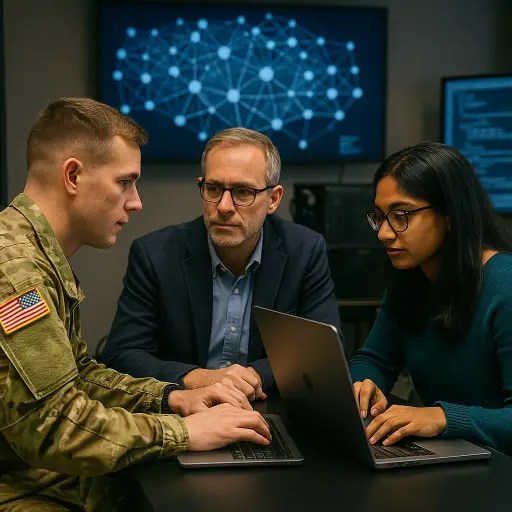
New fellowships crest a broader wave of defense–tech cooperation—bringing uniformed practitioners into the lab to speed responsible AI from concept to capability.
CAMBRIDGE, Mass. and MONTEREY, Calif. — The United States military is deepening its on‑campus footprint at two of the nation’s most influential research hubs — the Massachusetts Institute of Technology (MIT) and the Naval Postgraduate School (NPS) — by embedding uniformed fellows inside academic artificial‑intelligence projects. The approach mixes graduate‑level education, hands‑on experimentation, and operational problem‑solving to push AI from promising research to fielded tools.
The model is not entirely new. Since 2019, the Department of the Air Force–MIT Artificial Intelligence Accelerator has paired Airmen and Guardians — “Phantoms,” in program parlance — with MIT researchers on practical lines of effort such as trusted autonomy, predictive maintenance, decision support, and human‑machine teaming. Fellows arrive in focused cohorts, follow a structured curriculum, and then plug into research groups where their operational perspective shapes problem selection and evaluation. In parallel, they learn how to transition code into secure, governable systems that can survive beyond the demo stage.
What is new this fall is the widening embrace of the embedded‑fellow model across services — and the more explicit link between education and operational adoption. The Marine Corps has launched an AI fellowship track that places Marines at NPS in Monterey while also tapping into the ecosystem created by the Air Force–MIT accelerator. Framed as an implementation step for the Corps’ 2024 AI strategy, the Marine initiative blends classroom instruction, faculty mentorship, and a capstone prototype tied to a concrete challenge from the fellow’s home command. Fellows are expected to return to their units as translators and implementers — able to scope use cases, navigate data access, and shepherd solutions through acquisition and compliance gates.
Timing underscores the momentum. The Marine Corps set an application deadline of Sunday, October 26, 2025, for its Fiscal Year 2026 AI fellowship opportunities, emphasizing that late submissions will not be accepted. The deadline lands amid a broader sprint inside the Department of Defense (DoD) to professionalize the AI workforce and shorten the gap between labs and line units. The Pentagon’s Chief Digital and Artificial Intelligence Office has pushed common tooling, governance guidance, and shared evaluation practices; the service‑level fellowships are the human capital to make those practices stick.
Inside these programs, “embedded” is more than a label. Fellows show up not as passive students but as contributors who carry operational context into the room. In Cambridge, military cohorts join MIT research teams working on defined objectives — say, designing evaluation frameworks for teaming a pilot with autonomy in the loop, or building data pipelines that allow maintenance models to learn safely from messy, real‑world signals. In Monterey, Marines move through a seminar‑and‑studio rhythm: morning instruction on foundations such as model assessment, data governance, and the ethics of deployment; afternoons devoted to team sprints on a prototype that must run on realistic infrastructure and be accompanied by a plan for training, monitoring, and updating.
The projects are deliberately varied. Logistics and sustainment remain perennial targets because predictive maintenance and workflow optimization can show returns quickly. But newer cohorts are also tackling contested electromagnetic‑spectrum operations, small‑unit decision aids that fuse sensor feeds into digestible recommendations, and planning tools that compress the time between sensing and maneuver. In each case, the fellow’s job is to ensure that research artifacts survive contact with the real world: data is noisy and siloed; authority chains are complicated; cyber‑hardening and safety constraints are non‑negotiable. Fellows become the connective tissue between algorithms and adoption.
Education is the through‑line. Rather than one‑off short courses, the MIT and NPS fellowships treat AI as a literacy to be practiced, measured, and refreshed. Participants work through curated curricula, earn graduate‑level credit or certificates, and — crucially — leave with an implementation brief for their home organizations. That brief forces a reckoning with procurement and policy: What datasets are required and who owns them? How will models be monitored and retrained? Which ethics and test‑and‑evaluation gates apply, and in what order? The result is less a “cool demo,” more a repeatable, governable path to capability.
Industry has a presence, but at arm’s length. Companies contribute guest lecturers, open‑source tools, and transitional testbeds. The schools and DoD stakeholders, however, keep classrooms vendor‑agnostic while exposing fellows to the commercial ecosystem they will inevitably navigate. The wager is that more technically fluent officers and civilians will make better customers, ask sharper questions, and reduce the odds of “AI theater” — flashy videos that wilt at the first operational exercise.
The cultural shift is notable. On campuses that once debated whether to engage with the Pentagon at all, the presence of embedded fellows signals a pragmatic détente: projects are scoped to societal benefit and operational need, guardrails for responsible use are explicit, and results are expected to be peer‑reviewed where possible. For their part, the services appear increasingly comfortable learning in public alongside academic partners, provided that sensitive data and mission specifics stay fenced off. That balance — open methods, protected context — is fragile, but it is becoming a norm.
Skeptics warn of pitfalls. Embedding can produce “shadow IT,” where prototypes never get resourced for production. Fellows can be pulled back to their units before projects mature. And over‑indexing on short fellowships risks a skills treadmill that burns out talent. Program managers say they are countering those risks with alumni networks, follow‑on funding paths for the most promising prototypes, and rotational billets that allow fellows to return for deeper stints or to mentor new cohorts. Early indicators, they argue, suggest that the model is already paying dividends in faster problem framing and cleaner transitions to accredited environments.
If the pipelines continue to scale, expect more cross‑pollination between services and specialties. Previous cohorts have mixed pilots, maintainers, cyber operators, and intelligence analysts; future ones could include logisticians, lawyers, medical officers, and contracting professionals who must hard‑wire governance, safety, and procurement into deployment plans. That diversity is not mere optics — getting AI safely to the field is as much about data rights, evaluation, and sustainment as it is about model architecture.
The formal objective is sober: accelerate responsible AI adoption while improving readiness and reducing risk. The informal objective is cultural: normalize the idea that the military learns alongside universities in transparent, peer‑reviewed settings — and that such collaboration can coexist with national‑security guardrails. On both coasts, the embedded‑fellowship model is becoming a template: pick real problems, pair them with learners who own those problems, and demand a path to scale from day one.
By anchoring operators at the center of academic AI projects, the Pentagon is betting that education is not a cost center but a force multiplier. For MIT and NPS, the bet is that disciplined problem‑owners sharpen research, speed translation, and surface the questions that matter most before code ever touches a weapon system. As Sunday arrives with another cohort’s deadline, the posture is hard to miss: defense–tech education cooperation is no longer a pilot — it’s an operating concept.




 The Tower Post