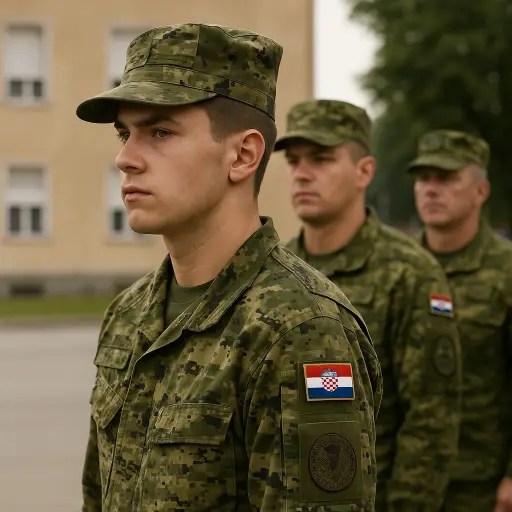
Zagreb’s decision to reinstate compulsory military service for young adults reflects growing defence concerns in the Balkans and Europe as a whole
In a significant shift in defence policy, the Croatian Parliament approved legislation on Friday reinstating compulsory military service for individuals born in 2007, reawakening a system that has been dormant for nearly two decades.
The measure, championed by Defence Minister Ivan Anušić and backed by a decisive 84‑11 vote with 30 abstentions in the 151‑member assembly, signals Croatia’s determination to bolster its defence posture in the face of shifting regional and global security dynamics.
Why Now?
The decision to revive conscription comes amid heightened tensions in Europe — most notably, the ongoing war in Ukraine and increased military activity in the Western Balkans. For a NATO and European Union member state, Croatia’s move underscores a recognition that “business‑as‑usual” defence strategies may no longer suffice.
Defence Minister Anušić told lawmakers: “We are seeing a rise in various types of threats … that demand swift and effective action from the broader community.”
In practical terms, around 18,000 men turning 18 each year would be subject to the two‑month training cycle — the first cohort under the renewed system.
What the Law Covers
Under the changes:
- All Croatian men born in 2007 will be eligible for basic training lasting two months.
- Women are not subject to mandatory service but may volunteer for basic training.
- Conscientious objectors will be offered alternative civil‑service routes, such as civil protection or public service.
- Training will take place at barracks in Knin, Slunj, and Požega.
- A monthly net allowance of about €1,100 has been proposed for conscripts during the training period.
Regional Implications
Croatia’s re‑introduction of conscription comes in a broader context of Balkan militarisation and uncertainty. Analysts view the move not only as a strengthening of Zagreb’s defence readiness — but also as a signal in a region still shaped by the legacy of the 1990s conflicts and contemporary pressures.
Additionally, with arms‑procurement and defence spending rising, the reinstatement of conscription underscores Croatia’s evolving role within NATO as a regional stabiliser facing Southeastern Europe’s shifting security contours.
Domestic Reception & Challenges
While broadly supported in parliament, the policy faces domestic questions around implementation and costs. Critics argue shorter training cycles may not suffice for modern warfare readiness and question whether the military infrastructure can handle the influx of new conscripts.
Furthermore, the government must balance this initiative with commitments to professional armed forces, modern equipment procurement, and integration with NATO standards — making logistics and personnel management key issues.
To ensure smooth rollout, the Ministry of Defence has announced that medical examinations and call‑ups will commence by late 2025, with the first training batches ending this year or early next.
What to Watch
- Recruitment and attrition rates among new conscripts.
- Training quality and operational readiness in a modern threat environment.
- Regional and NATO responses to Croatia’s decision.
- Budgetary and logistical implications for the Ministry of Defence.
Bottom Line
By reinstating compulsory military service, Croatia is recalibrating its defence posture for a more unpredictable Europe. The policy marks a decisive shift — acknowledging that in today’s security climate, expanding the footprint of national defence is not optional. For young Croatians born in 2007 and beyond, two months of military service may now become part of their civic chapter. Whether this move strengthens regional security or sparks new debates remains to be seen.



 The Tower Post