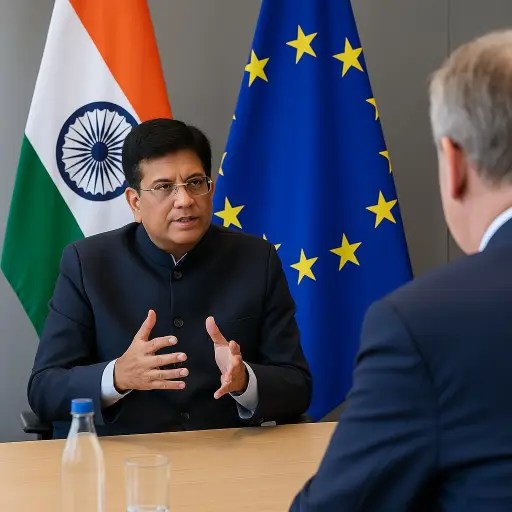
With India’s commerce minister in Brussels on 27–28 October, negotiators press to unlock market access and tackle non‑tariff barriers as both sides chase an ambitious year‑end landing zone.
Hopes for an India–European Union free‑trade agreement (FTA) entered a decisive phase in Brussels as India’s Commerce and Industry Minister convened back‑to‑back meetings with senior European Commission officials to push a complex deal across the line. The talks, held under heavy political guidance and a compressed calendar, aim to reconcile classic tariff asks with a thornier web of non‑tariff measures, standards and sustainability rules that now define modern trade.
Officials on both sides describe this week’s round as a “narrowing exercise”: not a grand unveiling, but an attempt to turn convergences into text and isolate the few—but politically charged—holdouts. The stakes are plain. The EU remains one of India’s largest trade partners and a critical destination for goods, services and investment. For Brussels, India’s fast‑growing market, manufacturing scale and role in Indo‑Pacific supply chains make it a prize worth hard bargaining.
What makes this push different from previous bursts of energy is the overlay of industrial policy and security. Supply‑chain resilience, trusted digital flows, green‑transition inputs and de‑risking from single‑supplier dependencies now sit alongside classic tariff schedules. This has shifted the centre of gravity in the negotiation from customs cuts to “how” trade happens: which rules govern product safety, how data may move, what counts as sustainable, and which certifications are mutually recognised.
Market access: fewer tariffs, more predictability
Tariff offers remain the political headline. European carmakers are lobbying for lower duties and clearer import procedures; Indian exporters are pressing for relief on textiles, leather, engineering goods and processed foods. But negotiators say predictability matters as much as the numbers. Companies want binding commitments on simplified customs procedures, faster risk‑based inspections and harmonised documentation that reduce dwell time at ports and borders.
The non‑tariff maze: testing, labels and paperwork
The heavier lift lies in non‑tariff measures (NTMs). Indian firms complain of duplicative or costly conformity assessments, fragmented documentation for standards, and complex sanitary and phytosanitary (SPS) protocols that slow shipments or up‑end entire product lines. Brussels counters that the EU’s high consumer‑safety bar is non‑negotiable, but acknowledges that “compliance pathways” could be streamlined.
Draft text under discussion includes mutual recognition of selected conformity‑assessment bodies, expanded use of supplier‑declarations for low‑risk products, and pilot “green lanes” for firms with a clean compliance record. A joint committee would troubleshoot SPS/TBT (technical barriers to trade) irritants in real time, publish guidance notes for small exporters and run time‑bound reviews when rules change.
Rules of origin: guarding the gate, enabling value‑chains
Rules of origin (ROO) remain sensitive. The EU seeks robust thresholds to prevent trans‑shipment through India by third countries; New Delhi wants flexible cumulation so its manufacturers can source components globally while still qualifying for preferences. Negotiators are working on sector‑specific recipes—higher thresholds for sensitive goods, simpler formulas where supply chains are well‑documented—paired with data‑sharing on customs audits to build trust without paralysing trade.
Digital trade and data transfers
While neither side seeks a “copy‑paste” of other digital chapters, both want clear ground rules. The evolving text centres on interoperable privacy safeguards, transparent algorithmic accountability for high‑risk uses, and consumer redress. India is pushing to recognise its domestic privacy regime for adequacy‑like treatment, while the EU presses for guardrails that are compatible with its own standards. An annex under discussion would enable paperless trade, e‑invoicing recognition and single‑window customs interfaces to cut friction for SMEs.
Sustainability and the green pivot
No modern FTA avoids climate policy. The EU’s carbon border adjustment mechanism (CBAM) looms large for steel, aluminium and potentially additional sectors. India seeks transitional flexibilities and technical assistance to decarbonise heavy industry; Brussels wants credible measurement, reporting and verification and a roadmap for low‑carbon production. The emerging compromise ties tariff preferences to cooperation platforms—on green hydrogen, critical minerals, battery recycling and sustainable textiles—while preserving the EU’s right to regulate.
Public procurement and services: cautiously opening doors
Public procurement is inching forward through transparency rules and non‑discrimination commitments on a defined list of central‑government entities, short of full market‑wide opening. Services—where India has offensive interests—are a bright spot. Proposals include streamlined business‑visitor categories, faster recognition of professional qualifications in IT, engineering and design, and pilot mobility quotas linked to skills‑partnership programs. European firms are pushing for nondiscriminatory treatment in Indian logistics, insurance and digital services—areas still under active drafting.
Agriculture and GIs: politics on a plate
Agriculture remains politically sensitive. The EU seeks improved access for premium agri‑food and beverages, stronger enforcement against counterfeit geographical indications (GIs), and science‑based SPS rules. India is protective of dairy and some cereals, wary of sudden import surges and labelling regimes it considers too prescriptive. The landing zone likely features carefully managed tariff‑rate quotas, long phase‑ins and a GI list engineered to avoid consumer confusion while safeguarding legacy brands on both sides.
Dispute settlement, small‑business wins
On dispute settlement, the sides appear close to a two‑step process: consultations and mediation first, with an arbitral backstop that includes timelines and a code of conduct for panellists. For small firms, the chapter on SMEs would publish a one‑stop portal explaining applicable standards, testing sites and step‑by‑step guidance for claiming preferences, accompanied by helplines in multiple languages.
Domestic politics: threading the needle
Trade negotiators are technicians; trade deals are political. In Brussels, any agreement must be squared with member‑state sensitivities, particularly on agriculture and procurement. In New Delhi, domestic industry wants calibrated openness and solid safeguards on standards and data. Both sides know that a badly framed chapter can ignite backlash that delays ratification or hollows out the promised gains.
What success looks like
A realistic outcome this week would be a clear political signal and a near‑final text on a majority of chapters, plus a framework to close the toughest files in the coming weeks. Businesses would watch for three things: a transparent schedule of tariff reductions; plug‑and‑play rules for testing, certification and digital paperwork; and a credible plan to manage CBAM‑adjacent emissions reporting without strangling trade in red tape.
For companies, the prize is operational: smaller compliance budgets, faster customs clearance and stable rules that outlast political cycles. For governments, it is strategic: anchoring the EU and India in a rules‑based partnership that strengthens supply‑chain resilience, advances the green transition and gives both sides leverage in a brittle global trading system.
The next mile
If talks in Brussels deliver momentum, negotiators will spool up technical sessions to convert annotated text into legal scrub. Business‑facing pilots—on mutual recognition in selected sectors, digital customs documentation and SME support—could begin even before formal entry into force. None of it will be easy. But for the first time in years, the politics and the policy appear to be pointing in the same direction.
As Tuesday’s meetings wrap, officials will measure success less by grand declarations and more by what disappears: duplicative tests, opaque paperwork, and days lost at the border. In trade, quiet fixes are often the loudest wins.

 The Tower Post