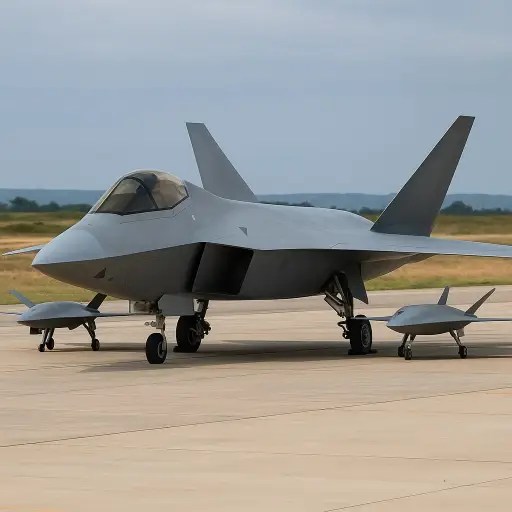
As political turmoil in France ripples through the trinational Future Combat Air System (FCAS) scheme, Europe’s ambition to field a sixth‑generation fighter by 2040 teeters on the edge of collapse.
The grand ambition of Europe’s defence‑industry bloc — the Franco‑German‑Spanish “Future Combat Air System” (FCAS) — is facing a severe crisis that could derail what was billed as a landmark €100 billion investment in Europe’s strategic autonomy.
Launched in 2017 by Emmanuel Macron and Angela Merkel, the tri‑national programme was designed to deliver by 2040 a new “system of systems”: a sixth‑generation fighter jet supported by swarming drones and a European combat cloud.
But eight years on, stakeholders admit that the project is teetering. According to a German defence ministry source, a key trilateral meeting to reset the programme “has been postponed”.
Cracks in the industrial alliance
Much of the trouble stems from unresolved disputes over industrial work‑share, leadership and intellectual‑property rights. The French manufacturer Dassault Aviation insists on being the prime contractor for the aircraft portion of the programme — a demand that is at odds with earlier agreements and has frustrated German partners, particularly Airbus Defence & Space.
The stalemate has become deeply political. German Chancellor Friedrich Merz has publicly urged France to honour the original deal, stating that if the terms are broken, progress toward the next development phase will be “unlikely”. Meanwhile, a recent editorial warned that FCAS “may collapse” unless urgent corrective action is taken.
Paris under pressure
France’s internal political turmoil has added fuel to the fire. With the French government undergoing a shake‑up and defence‑budget debates deeply contested in the National Assembly, the air has turned shaky for long‑term projects. A French Senate report noted that the industrial demands from Paris — especially the push for an 80 % work‑share — have unsettled partners in Berlin and Madrid.
Such ambitions conflict with the trilateral principle of equitable burden‑sharing. Germany and Spain fear becoming junior partners while France secures the lion’s share of contracts. The result: growing mistrust among participants and slipping timelines.
Consequences of a collapse
If FCAS fails — or falls into indefinite limbo — the ramifications will be profound. Pan‑European aspirations for defence sovereignty would take a body‑blow. Germany, heavily invested in the project, would face a strategic void, possibly forcing it to rely more heavily on U.S. suppliers. Analysts suggest France might still proceed solo with a future fighter, but at vastly increased cost and risk.
From an industrial‑economic perspective, hundreds of companies across the three countries stand to lose contracts, jobs and strategic positioning in the global defence market. Missed timelines could concede technological leadership to rival programmes such as the UK‑Italy‑Japan Global Combat Air Programme (GCAP).
The choices ahead
Before the end of the year, programme backers must decide whether to reaffirm the trilateral path, restructure the partnership or perhaps even walk away. Chancellor Merz and President Macron agreed in August that a decision would be taken by year‑end.
Among the options:
- Reset governance and return to the earlier “best athlete” model that assigns lead contractors based on capability, not nationality.
- Allow France to take lead on the fighter aircraft while Germany and Spain focus more on remote carriers, combat cloud and sensors.
- Or dissolve the tri‑national accord and let national programmes proceed independently — a path that would undermine the original logic of European cooperation.
Why it matters
FCAS isn’t just a jet. It is a symbol of Europe’s ambition to become a global defence actor and reduce reliance on external suppliers. The stakes: technological leadership, industrial jobs, geopolitical relevance. In an era of rising competition from China and the U.S., a fragmented Europe risks getting left behind.
The programme stands at a crossroads. The next few weeks will determine whether Europe’s flagship fighter‑jet initiative remains a beacon of cooperative ambition — or becomes a cautionary tale of fractured alliances and missed opportunity.


 The Tower Post