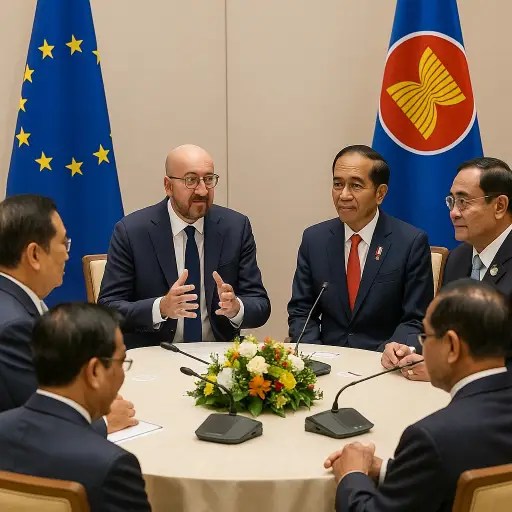
EU Participation in ASEAN Summit Signals a Shift to Multilateralism
As the calendar turns to Tuesday a significant diplomatic moment is unfolding: for the first time, the European Council President will attend the Association of Southeast Asian Nations (ASEAN) Summit, marking a visible shift by the European Union from Europe‑centric diplomacy to broader global multilateral engagement.
A new chapter in Brussels–Jakarta (and beyond) relations
In recent years, the European Union has declared its ambition to become a global actor not simply via partnerships but via strategic blocs and networks. Its choice to dispatch its top Council representative to the ASEAN leaders’ summit demonstrates a concrete follow‑through of that ambition. This attendance signals that Europe regards Southeast Asia not merely as a region of commercial opportunity but as a strategic partner in security, trade, connectivity and the rules‑based international order.
Trade and connectivity: more than words
Economic ties between the EU and ASEAN have already grown. Connectivity — in the sense of infrastructure, digital links, supply‑chain integration and visa/travel facilitation — has become a core pillar of EU‑Asia diplomacy. Studies cite that the EU has been steadily investing in projects across Southeast Asia to strengthen trade facilitation, digital infrastructure and people‑to‑people links. By sending the Council President to the summit, Brussels is elevating connectivity from the bureaucratic realm into the political limelight, signalling that this isn’t simply about pipes and cables but about strategic alignment.
Security in a shifting world
Europe’s security outlook has evolved dramatically. From the war in Ukraine to increasing uncertainty in the Indo‑Pacific, the EU now sees external regions as directly relevant to its stability. For ASEAN, which straddles major power rivalries and maritime flashpoints, the EU’s arrival is a welcome sign that its partners are paying attention. By attending the summit, the EU underscores an intent to share responsibility — be it maritime security, cyber‑defence, supply‑chain resilience or even freedom of navigation.
Why now? Why Southeast Asia?
Several interrelated factors are feeding this pivot:
- The EU’s own strategic compass is recalibrating: Rather than being solely a European actor, it aims to become a “global connector” and multilateral hub.
- Southeast Asia is increasingly central in global trade, supply‑chains and geopolitical competition. ASEAN member states collectively are estimated to number around 670 million people, and the bloc is often described as one of the busiest theatres of global trade and diplomacy.
- Connectivity gains strategic weight: Digital, logistic and infrastructure links define 21st‑century influence nearly as much as traditional diplomacy. Europe’s “Global Gateway” initiative and other connectivity programmes reflect this.
- A rules‑based, multilateral mindset: By aligning with ASEAN, which emphasises regional dialogue and consensus, the EU is engaging in diplomacy that rests on open institutions rather than bilateral power‑plays.
Open questions on the agenda
Of course, attending a summit is only the beginning. What remains to be seen includes:
- Concrete deliverables: Will the EU and ASEAN agree to major new trade agreements, or formalise investment frameworks?
- Security architecture: Will Europe plug into existing Southeast Asian security frameworks, or create its own parallel initiatives?
- Connectivity commitments: Will the EU back infrastructure or digital‑connectivity projects in ASEAN at scale, and will Southeast Asian states reciprocate open standards and data governance aligned with European norms?
- Normative alignment: The EU emphasises human rights, rule‑of‑law and democracy; ASEAN has a more diverse set of regimes and priorities. Will that limit the depth of engagement?
Implications for global governance
This move can be seen as a signal that Europe is doubling down on multilateralism. Rather than choosing one great‑power alignment, Europe is seeking to embed itself in regional groupings, to leverage collective diplomacy and to avoid zero‑sum blocs. For ASEAN, deeper engagement with the EU helps it diversify partnerships beyond the usual big players. For the world, this may mark a structural shift: we may see more blocs interacting with one another (EU↔ASEAN↔Africa, etc) rather than old direct bilateral relationships.
A new “West meets East” rhythm?
As the Council President takes his seat among ASEAN leaders, the optics matter. The EU is making a statement: it belongs in the Indo‑Pacific conversation. For ASEAN, the presence of a European leader is a reminder that the region is global, not peripheral. For both, the question is whether this moment leads to a “plateau” of engagement or becomes a stepping‑stone to deeper integration.
Conclusion
The attendance of the European Council President at the ASEAN Summit this Tuesday marks a turning point. It is both symbolic and substantive: symbolic in that Europe is showing up; substantive in that the agenda spans trade, security, connectivity and multilateral governance. Whether this event leads to meaningful new architectures (trade agreements, connectivity funds, security pacts) will determine if this is a mere photo‑op or the start of a new era. For now, the message is clear: Europe is shifting its gaze outward, and Southeast Asia stands centre stage.

 The Tower Post