
Amidst the rise of online shopping, Europe’s physical retail stores are regaining relevance — reinventing themselves as experience hubs and omnichannel anchors to support digital growth.
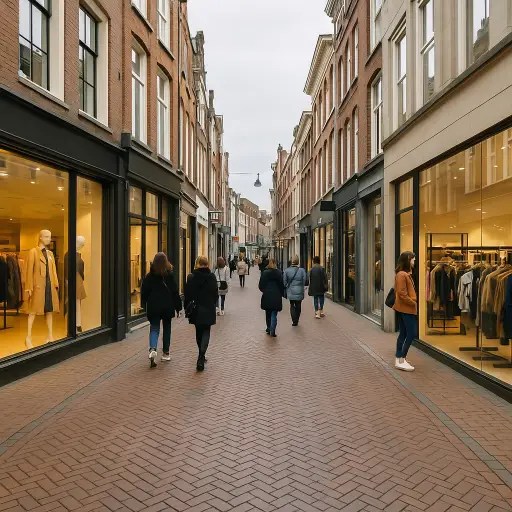
In the wake of a decade‑long e‑commerce boom, European retail is witnessing a notable pivot: the revival of brick‑and‑mortar stores across major high streets and city‑centre locations. After years of forecasts predicting the slow demise of physical retail in favour of digital‑only models, the narrative is shifting. Analysts and industry surveys increasingly point to a scenario in which physical shops are not merely surviving — they are being re‑imagined as integral parts of the broader retail strategy.
In a recent update to the European retail market, CBRE reported that in the first half of 2025, visitor numbers to prime retail destinations rebounded strongly in Q2, with year‑on‑year sales showing approximately a 2 % uptick. Meanwhile, the consultancy report from AEW titled The Long‑Awaited Renaissance of European Retail forecasts that in‑store sales will stabilise and grow modestly — around 0.6 % annually on average through 2029 — even as online commerce continues to rise.
Why the shift?
Several factors are driving the renewed confidence in physical retail spaces:
- Omnichannel synergies. Retailers are increasingly recognising that stores act as effective support hubs for online operations. At the recent Shoptalk Europe 2025 conference in Barcelona, industry participants singled out the strategic role of physical stores: far from being merely “additional inventory locations”, they are being repurposed into immersive, data‑driven experience centres.
- Consumer appetite for experiential shopping. According to a survey conducted by Euromonitor in early 2025, 54 % of “connected consumers” prefer shopping in physical stores that deliver an engaging, immersive experience rather than simply transaction‑based visits.
- Stabilising retail‑property fundamentals. The real estate metrics for European high street and prime retail have improved. The AEW report notes that prime retail vacancy across the EU dropped to approximately 3 % in Q3 2024, while rents are expected to edge up modestly (around 1.3 % p.a. through 2029).
- Strategic store optimisation. A survey by CBRE in late 2024 found that 72 % of European retailers planned to expand their bricks‑and‑mortar offering; many signal a desire for larger, more experiential store formats.
What this means for high‑street strategy
The emerging blueprint for physical retail — especially across Europe’s urban and capital locations — differs markedly from the traditional “transaction only” model. Stores are increasingly being designed as multipurpose destinations:
- Showrooms for product discovery and brand engagement, rather than just point‑of‑sale outlets.
- Fulfilment hubs: enabling “click‑and‑collect”, same‑day pickup, returns and exchanges, blurring the offline/online boundary.
- Data capture and customer‑service nodes: physical interactions provide richer insights and loyalty building than purely digital channels.
- Experience spaces: incorporating immersive design, events, in‑store services (e.g., personalisation, try‑before‑you‑buy), and other “stickiness” mechanisms to drive footfall.
One often‑cited statistic underscores the importance of physical presence: stores located within a 20‑minute drive of a customer can boost the retailer’s online sales in that vicinity by 10 – 20 %.
Regional variations and challenges ahead
Despite the positive momentum, the comeback of bricks‑and‑mortar is neither uniform nor without obstacles. Key challenges remain:
- Consumer confidence in Europe remains below pre‑pandemic levels, influenced by inflation, interest rates and macro‑economic uncertainty.
- E‑commerce continues its strong growth trajectory: recent reports estimate that online retail accounted for around 16 % of total European retail sales in 2024, with projections pointing to 20 % by 2029.
- The newcomers of physical retail must excel at execution: larger stores carry higher cost structures, and the margin pressures in non‑grocery retail remain acute.
- Secondary locations, under‑performing high‑streets and out‑of‑town retail parks face tougher headwinds; the “comeback” narrative applies primarily to prime high‑street assets in major European cities.
The broader implication for retailers and landlords
For retailers, the message is increasingly clear: strategy must be omnichannel and store‑aware. Online‑only models are no longer sufficient as standalone platforms — they must integrate with physical locations to build brand presence, foster loyalty and capture local foot‑traffic. Landlords and property investors, meanwhile, are re‑thinking their portfolios. Prime retail space is back in favour, and the outlook for rental growth, though modest, is positive. As noted by the AEW analysis, expected total returns for high‑street retail assets in Europe for 2025‑29 are estimated at ~7.4 % p.a. — a competitive yield in the current environment.
Outlook for the remainder of 2025 and beyond
As we move further into the second half of 2025, the retail sector in Europe appears to be entering a more stabilised phase: a moderate growth period where physical stores reclaim strategic relevance, albeit with diversified roles and lower expectations of double‑digit growth. The major winning formula will likely involve:
- Seamless integration of online and offline channels.
- Personalised, engaging in‑store experiences.
- Smart use of technology (e.g., sensors, data analytics, inventory optimisation) to drive store performance and tie into digital networks.
- Careful location strategy: prime urban sites, high footfall corridors, and flexible formats that can cater to community and discovery needs rather than purely large‑box retail.
For Europe’s high streets, the message is cautiously optimistic: physical retail is not dead. It is adapting — evolving from an “either/or” proposition (online vs offline) into an integrated, mutually‑reinforcing ecosystem. For retailers that get this right, the high‑street may once again assume its place as a vital pillar of the retail landscape.




 The Tower Post