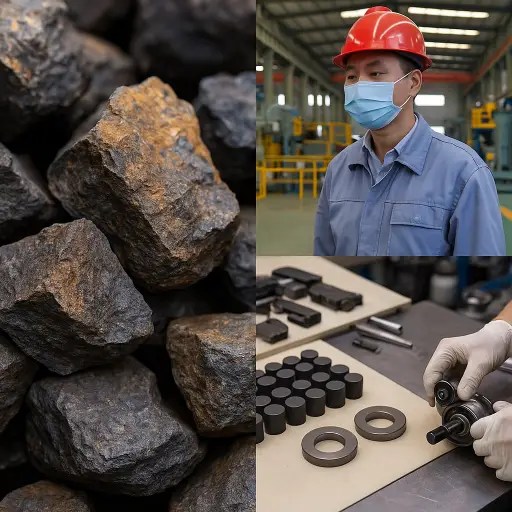
Brussels warns of using anti‑coercion powers as Beijing expands controls on minerals fundamental to clean‑tech and defence supply chains
As the world facing deepening tensions over critical mineral supply chains, the European Union (EU) has declared that the latest export controls unveiled by China on rare‑earth elements (REEs) are “extremely serious” — and Brussels is now openly signalling that it may activate its seldom‑used anti‑coercion instrument in response.
In recent weeks, China’s Ministry of Commerce announced a significant expansion of export restrictions on rare‑earths and the technologies that process them. These new measures extend beyond the seven elements already subject to licensing controls earlier this year to include five additional heavy rare earths and require myriad products and components containing even trace amounts of Chinese‑origin material to obtain approval.
European trade officials view the development as less about domestic environmental‑ or safety‑regulation and more about geopolitical leverage. At a press briefing, one senior EU diplomat dismissed Beijing’s insistence that the restrictions were standard export‑control practice and called them a “clear signal of strategic coercion.”
The context for this confrontation is unmistakable: China dominates the processing capacity for rare earths — controlling over 90 % of refined output — and supplies critical inputs for electric vehicles, wind turbines, defence electronics and high‑end manufacturing. Europe’s reliance on Chinese feedstock is stark: one study estimated that European industry imports virtually all its rare‑earth magnets and a large share of raw materials from China.
Impact on European industry
The ripples of China’s export policy are already being felt across European supply chains. According to industry associations, several automotive‑parts plants in Europe have suspended production due to shortages of rare‑earth magnets. The bloc’s trade commissioner has expressed concern that without diversified supply, European manufacturers face operational risk.
For Brussels, the urgency is two‑fold: first, to manage the immediate supply‑shock risk; second, to address the structural vulnerability of European industry’s dependence on foreign critical‑minerals supply. Last week, the European Commission launched a new framework, codenamed “RESourceEU,” to accelerate partnerships with non‑Chinese suppliers (Australia, Canada, Kazakhstan, Ukraine among them), plus ramp up domestic recycling and processing capacity.
At the same time, EU policymakers are engaging in pre‑emptive defensive diplomacy. The bloc has held meetings with Chinese counterparts, pressed for greater transparency in the licensing regime, and requested a “fast‑track channel” for European companies.
The anti‑coercion instrument looms
Perhaps the most notable signal from Brussels is the revived mention of the EU’s “anti‑coercion instrument,” a trade‑defence tool allowing the union to impose surcharges, restrict exports, or block access to public procurement when a foreign actor uses economic dependence to apply pressure. While the instrument has never been used, its invocation at this juncture underscores how deeply Brussels views the rare‑earth situation: not as standard trade friction but as coercive economic statecraft.
European Commission President Ursula von der Leyen recently warned that if China does not provide clearer assurances and improved access, “we have no interest in escalation, … but we are ready to deploy all instruments in our toolbox.” Analysts suggest that should China maintain its hardline posture, the EU could respond by restricting exports of strategic goods in which Europe holds leverage, or by cutting Beijing’s access to European public‑markets and subsidies under the anti‑coercion framework.
Within the EU, member states are divided: some — particularly Germany and France, whose industries are acutely exposed — are pushing for a robust response. Others remain cautious, wary of triggering a trade war with China. But momentum appears to be building for collective action given the scale of risk.
China’s calculus
From Beijing’s perspective, the rare‑earth policy serves multiple strategic ends. First, it demonstrates China’s grip over a supply chain vital to the global green‑transition and high‑tech industries. Second, it offers leverage amid broader trade and diplomatic negotiations — especially with the US and EU. Analysts note the timing is no accident: the tightened controls were announced just ahead of high‑level bilateral meetings and in the context of mounting Washington‑Beijing tension.
Beijing insists the measures are standard export‑controls for dual‑use goods and dismisses European concerns as exaggerated. In July, Foreign Minister Wang Yi reiterated that Europe “can still meet its legitimate needs through proper applications,” while urging Brussels to respect Chinese regulatory autonomy.
However, Chinese willingness to negotiate has been qualified: Beijing has offered “green‑channels” for EU applicants but maintains the right to deny licences for defence‑oriented or high‑tech users.
What happens next?
As Europe watches closely, several scenarios are in play:
Short term:
– European industry will press for rapid assurances and processing of licences for rare‑earth imports.
– Brussels may intensify diplomatic pressure on China, possibly seeking coordination with allies such as the Group of Seven (G7).
– The EU’s new framework (RESourceEU) will start operations — joint purchasing, stockpiling, diversification of supply chains.
Medium term:
– Should China persist, the EU may activate the anti‑coercion instrument: restricting exports of strategic goods or imposing new measures targeting China’s economic dependence.
– Europe will ramp up domestic capacity for refining and recycling rare earths, reducing reliance on China’s processing dominance.
– Industry restructuring may follow: automakers, defence contractors and electronics firms will adjust sourcing, redesign components, and stockpile critical inputs.
Long term:
– A bifurcation of global supply chains appears increasingly probable: one led by China, another anchored in Europe‑North‑America‑Australia and allied partners.
– Rare‑earths may become weaponised components in trade diplomacy, prompting sustained industrial policy shifts and investment flows.
– Europe’s strategic autonomy agenda will accelerate — less just green‑transition optics, more security imperative for critical minerals.
A new front in the trade war
While rare‑earths once played a niche role in global trade, today they stand at the intersection of industrial policy, national security and geopolitics. For Europe, the risk is clear: a supply squeeze of elements like dysprosium, terbium or neodymium could disrupt not only electric vehicles and wind turbines but also defence electronics and computing systems.
As the EU signals its readiness to retaliate, the stage may be set for a new kind of trade confrontation — not simply tariffs, but control over vital minerals that underpin the transition to a digital, green and geopolitically contested economy. In that sense, the rare‑earths battle might become as defining for this decade as energy security was in the last.
Europe is bracing. China is flexing. The global supply chain is the battleground.

 The Tower Post