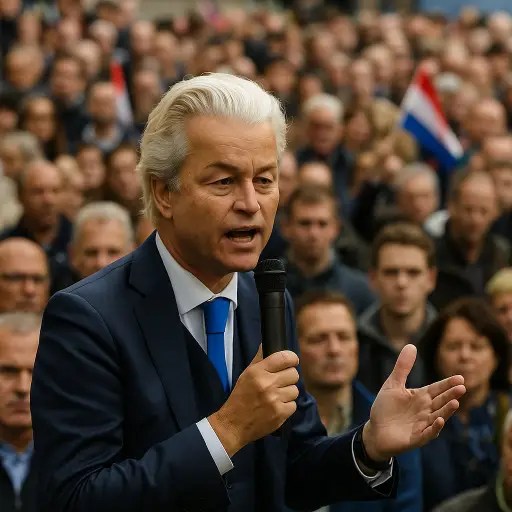
With just days until the Netherlands votes, Geert Wilders demands a break in the political isolation that threatens his pathway to power.

The Netherlands enters a pivotal moment in its political trajectory as it marches toward national elections scheduled for the end of October. At the centre of the storm is Geert Wilders, leader of the far‑right Party for Freedom (PVV), who is pressing his case for partnership in government even as the rest of the political class keeps him at arm’s length.
Wilders, whose party leads in the polls heading into election day, has made his pitch loud and clear: he insists that voters’ will must translate into governance — and that other parties reconsider their refusal to work with him. According to Reuters, he told reporters that “the voter is in charge … not the other parties”.
A Party on the Rise… but Locked Out
Wilders’s ascent is dramatic and unmistakable. After a surprise surge in the previous election, the PVV emerged as a dominant force. Polls ahead of the latest vote continue to place his party in front.
And yet, despite the momentum, his path to power is blocked. Major parties have ruled out forming a coalition with him, citing concerns over his ideology, governing style and reliability. The centre‑right People’s Party for Freedom and Democracy (VVD), among others, has declared the PVV “an unbelievably untrustworthy partner”.
That dynamic means that even if Wilders’s party wins the most seats, forming a government will be a steep challenge. Analysts say the only realistic route may be a minority government or a highly unstable arrangement — or for Wilders to abandon his ambitions of being prime minister altogether.
Why the Tensions?
The heart of the dispute lies in Wilders’s policy agenda — particularly on immigration and asylum — and his conduct in government. Earlier this year, the PVV withdrew from the governing coalition, handing the Prime Minister the resignation of his Cabinet and triggering snap elections.
Wilders had demanded sweeping changes to asylum policy — including closing borders, shutting down reception centres, and revoking dual citizenship for some. His withdrawal from government negotiations raised serious questions about his willingness to compromise and govern responsibly.
Other issues feed into the broader unease: the Netherlands, while a globally oriented nation, is now debating whether the rise of populism will change its role in Europe and its international alliances. In this context, many parties see Wilders as a risk to both domestic stability and foreign policy continuity.
The Election Looms
With the vote imminent, the atmosphere is tense. Wilders is campaigning hard — in traditional strongholds like Volendam, he stands before crowds that see him as the only credible alternative to the status quo.
Yet his lead has narrowed. One recent Bloomberg piece noted that the PVV’s advantage is shrinking in the final stretch as voters consider their options and as rival parties coalesce around the idea of a “stable centre”.
Observers warn that the vote may not yield a clear result. The fractious Dutch system of many parties means that whatever the outcome, forming a coalition will prove complex. Some analysts suggest the real moment of reckoning may come after the election, during the long negotiations to build a government.
Why It Matters
For the Netherlands this election is more than a routine cycle. It is a referendum in part on whether the rise of the far‑right will translate into actual power, or whether the established parties can block that rise and steer the country back toward the centre.
For Europe, too, the result will resonate. Given the Netherlands’ role in the EU and NATO, the question of whether a Wilders‑led or influenced government takes shape could shift regional politics and policy priorities — from migration to defence.
And for voters, the decision is about more than seats and take‑aways. The refusal of other parties to work with Wilders raises deep questions about democratic representation: can a party that wins the most votes be left out if nobody will partner with it? Wilders made that very point in his recent remarks: the voter, he insists, should determine governance.
Looking Ahead
As campaigning enters its final days, three scenarios seem plausible:
- Wilders wins the most seats and still ends up in opposition because no one will form a coalition with him.
- Wilders wins and tries to form a minority government — but this results in legislative gridlock and possible early fresh elections.
- A rival set of parties manages to sneak ahead, assembling a “centre coalition” that excludes the PVV despite its strong showing.
All three carry risks. Dutch voters may face months of negotiations before a functioning government emerges — the very kind of political turbulence many hoped this election might end.
For now, one thing is clear: the Netherlands’ upcoming vote will not simply choose a government — it may decide whether far‑right populism will move beyond voice and into the corridors of power. And whether the rules of coalition politics in the Netherlands will evolve in response.


 The Tower Post