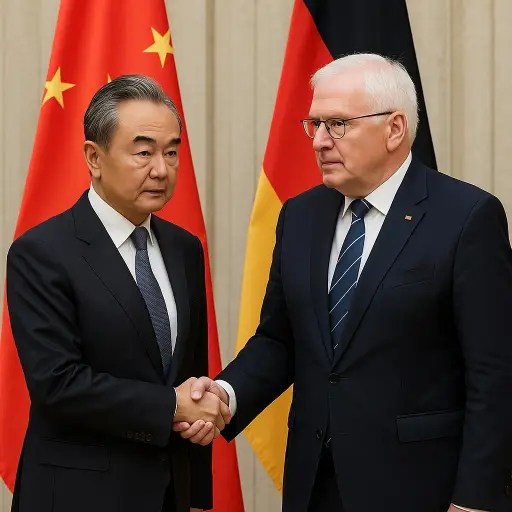
In the wake of a postponed Berlin–Beijing trip by Germany’s foreign minister, both capitals move quickly to calm frayed ties and reiterate the importance of their economic partnership.

Berlin / Beijing – On a crisp autumn morning ahead of the week’s midpoint, representatives of both the Federal Republic of Germany and the People’s Republic of China found themselves engaged in a delicate balancing act: acknowledging a disruption in diplomatic intercourse while projecting continuity, stability and mutual interest.
The trigger for this bilateral moment was the unexpected decision by German Foreign Minister Johann Wadephul to postpone a much‑anticipated ministerial visit to Beijing. The trip, originally scheduled as the first leg of high‑level engagement by Germany’s new government under Chancellor Friedrich Merz, was called off after the Chinese side reportedly confirmed only one meeting with its direct counterpart, leaving other scheduled engagements in limbo.
In Berlin, officials presented the postponement as procedural rather than confrontational. A spokesperson from the German Foreign Office said the trip had been delayed, not cancelled indefinitely, pointing to unresolved logistics and the need for broader discussions ahead of departure.
In Beijing, the tone was conciliatory. At a routine press briefing, the Chinese Foreign Ministry’s spokesman urged Germany to adopt a “strategic, long‑term” view of bilateral ties, underlining respect, equality and win‑win cooperation. “China and Germany, as two major countries and economies, need to set examples in forging a new‑type major‑country relationship,” the Chinese spokesperson said.
What Went Wrong — and Why The Public Calming?
Observers note that the visit’s cancellation exposed several underlying tensions. Berlin had intended to use the Beijing trip to press China on a range of issues — from export limits on rare‑earths and semiconductors to China’s support for Russia in the war in Ukraine, and broader security concerns in the Indo‑Pacific.
The stumbling point reportedly was that China confirmed only the meeting with the Chinese foreign minister Wang Yi, but not the other requested engagements. That omission was seen in Berlin as a lack of sufficient access and an indicator of discomfort in the relationship.
From the Chinese side, the message emphasises that while ties may be under stress, the broader economic and strategic link remains intact. Germany remains China’s largest European trade partner, with more than two‑hundred billion USD in bilateral trade this year.
And so both capitals pivoted into what analysts call “damage control mode”: publicly stress the partnership, quietly negotiate the next steps.
Balancing Act Between Economy and Realpolitik
Germany finds itself walking a tightrope. On one hand, its export‑oriented economy has deep roots in the Chinese market; on the other, Berlin has adopted a sharper stance on China’s geopolitical posture, aligning with broader European and transatlantic concerns.
Wadephul himself has signalled a harder line: insisting that Germany retains its autonomy regarding the “One‑China” policy and raising alarms about any coercive shifts in the Taiwan Strait.
China, meanwhile, is aware of the optics. A key partner in Europe, Germany’s mood matters not just for bilateral trade but for Beijing’s ties across the continent. Hence the rapid refrain: yes, there’s friction — but the relationship is bigger than any one visit.
What Happens Next ?
Germany’s foreign ministry says it wants to reschedule the trip “at a later time”. Until then the two sides are expected to concentrate on lower‑key channels of communication: working groups on trade, climate and technology; economic dialogues; and ministerial contacts at less headline‑grabbing levels.
At the domestic level, German lawmakers from across the spectrum are demanding clarity. One prominent Social Democratic lawmaker described the postponement as a “bad sign” for Berlin’s China policy, calling for an active, strategic foreign‑policy approach.
In China, commentary notes that Germany must recalibrate its view of Sino‑German ties: not simply as bilateral trade but as part of the wider global complex in which Beijing operates. And Germany is urged to “deal with facts, not with confrontation narratives”.
The Stakes Are Real
While the public narrative emphasises calm, the latent stakes are significant. Germany’s manufacturing base depends on secure access to critical materials and stable global trading conditions. China’s export curbs on rare earths and semiconductors are of direct concern to Berlin.
From the Chinese view, Europe is an arena where strategic positioning matters — in technology, market access, and geopolitical alliances. The German visit was seen as a signal of how serious Berlin is prepared to be in addressing contested issues. The hesitancy to engage fully may itself send a message.
Conclusion
For the moment, Germany and China are riding out the storm. The headline‑visit was postponed, not cancelled; the public rhetoric emphasises partnership, not confrontation. But beneath the surface, both governments are assessing where the red lines lie.
Berlin wants to maintain its export engine and geopolitical autonomy; Beijing wants a European anchor in Germany without incentivising public confrontation. The calculus is complex, but both sides agree: the relationship matters. Their next steps — in the coming weeks and months — will determine whether the fallout from this cancelled trip becomes a blip or a broader turning point.


 The Tower Post