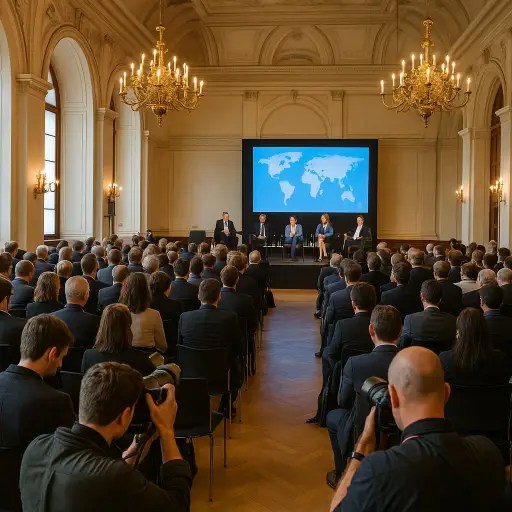
At the 2025 International Press Institute World Congress in Vienna, more than 600 journalists from 100 countries confront rising threats to independent journalism and shape a collective strategy for the future.
Vienna — In a pivotal gathering underscoring the urgency of the moment for journalism worldwide, more than 600 media professionals representing over 100 countries converged in Vienna for the 2025 World Congress of the International Press Institute (IPI). The event, held in the Austrian capital from October 23 to 25, brought together editors, correspondents, media‑innovators and press‑freedom defenders under the theme “Defending the Future of Free Media.”
Against the backdrop of growing authoritarian pressure, disinformation campaigns and technological disruption, this year’s meeting marks the organisation’s 75th anniversary and signals a renewed commitment to safeguarding independent journalism.
Press freedom under pressure
Delegates heard repeated evidence of the mounting obstacles facing journalists around the world: arbitrary arrests, state surveillance, economic capture of media outlets, and a global surge in tactics to silence dissenting voices. During the opening ceremony at the University of Vienna campus, IPI Executive Director Scott Griffen reminded attendees that while the institutions of free media have long been cornerstones of democracy, they now face an “existential test” as power‑structures tighten their grip.
The event also served as an urgent forum for discussing emerging challenges. From algorithmic manipulation to AI‑driven content suppression, the contours of the threat landscape are widening. Panel discussions probed the ways in which digital platforms and state actors alike are redefining the battleground for free expression.
Global solidarity, local vulnerabilities
While participants came from a wide range of geographies, one of the recurring themes was that local vulnerabilities are global in scale. Reporters from Ukraine described frontline coverage under bombardment and incarceration; their counterparts from Ethiopia and Georgia spoke of legal harassment, exile and media shutdowns. Australian editors and U.S. newsroom executives, meanwhile, reflected on creeping economic dependencies and political rhetoric undermining public trust in the press.
A highlight of the congress was the announcement of the 2025 IPI‑IMS World Press Freedom Hero Awards. Seven distinguished journalists from Georgia, the United States, Palestine, Peru, Hong Kong, Ukraine and Ethiopia were honoured for extraordinary courage in the face of severe repression. Two of the honourees – from Ukraine and Palestine – were recognised posthumously after giving their lives in pursuit of truth.
Innovation and sustainability for the future
Alongside the advocacy‑heavy agenda, the congress placed strong emphasis on innovation, business models and the sustainability of independent media organisations. The accompanying Media Innovation Festival explored tools for digital storytelling, audience engagement and alternative funding streams — an acknowledgment that defending press freedom goes hand‑in‑hand with creating viable media enterprises for the coming decade.
Start‑ups and established media houses alike swapped best practices: how to preserve journalistic standards while adopting new platforms; how to protect source confidentiality and reporter safety in the digital age; how to survive when advertising revenue shrinks and state subsidies are under question.
Outcomes and ongoing commitments
By the close of the three‑day gathering, participants emerged with a shared outlook and a set of commitments. These included:
- A cross‑regional pledge to support (and where necessary, defend) journalists under threat — through legal, financial and logistical means.
- A collaborative roadmap for monitoring and responding to algorithmic attacks on independent journalism.
- Renewed calls for governments and multilateral institutions to recognise free media as a public good, and to enact policies accordingly.
- Agreements to deepen networks of exchange — physically, digitally and institutionally — so that no newsroom stands alone.
In his closing remarks, Griffen said the Congress was not simply a moment of reflection but a launching point. “We enter a new era,” he said, “in which the freedom to inform and the freedom to be informed are no longer givens, but missions.” Delegates dispersed for home assignments, reassured in their collective strength yet acutely aware of the work ahead.
Looking ahead
The challenges uncovered in Vienna are not hypothetical. From war‑zones to closed societies, from shrinking local media markets to algorithmically‑driven disinformation ecosystems, journalists face hostile terrain. Yet the global solidarity displayed at this year’s IPI Congress suggests that media leaders are no longer willing to cede the public sphere quietly.
As one delegate from Latin America put it: “We came here to be reminded of why we do this — and to find allies who will stand with us when the next threat knocks.” If the journalistic community returns home with both renewed purpose and new tools, then Vienna may have marked a turning point in the defence of press freedom.




 The Tower Post