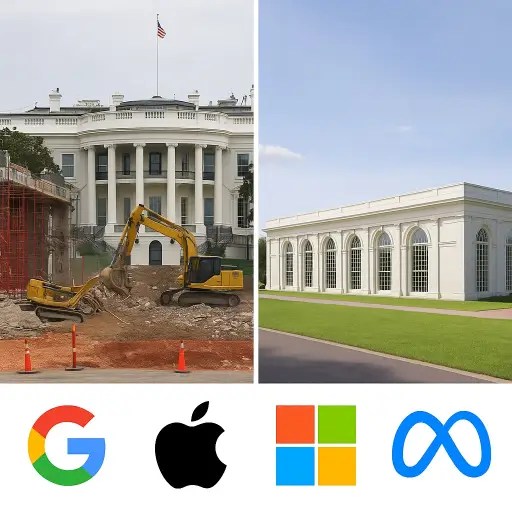
Google, Apple, Microsoft and Meta join major donors in a $300 million private‑funded rebuild of the East Wing — raising questions about influence, transparency and the meaning of “public” in “People’s House”.
In a bold move that signals a new era of public‑private partnership at the heart of U.S. government, major technology firms have stepped up to fund an ambitious reconstruction at the White House. On the agenda: the demolition of the historic East Wing and its replacement with a vast new ballroom – a project estimated at some $300 million, entirely financed by private donations, most notably from tech giants.
According to documents released by the administration and verified donor lists sourced by media outlets, companies including Google LLC, Apple Inc., Microsoft Corporation and Meta Platforms, Inc. are among those underwriting the transformation of the East Wing into an event space vastly larger than anything previously available at 1600 Pennsylvania Avenue.
The renovation plan, disclosed earlier this month, places the expansion at roughly 90,000 square feet and upgrades the building’s event capacity to unprecedented levels for the White House complex. That figure marks a substantial leap from earlier estimates (which had hovered near $200 million) and underscores the scale of private money entering what has traditionally been a publicly‑funded institution.
Why Tech Is Donating
From the donors’ perspective, the project offers a rare opportunity: underwriting an iconic national landmark while gaining informal association with the White House itself. For tech firms navigating regulatory scrutiny, shifting political terrain and an increasingly geopoliticised tech sector, the donation appears both strategic and symbolic.
Take Google’s parent company, for example: it reportedly contributed more than $20 million “on behalf” of the project as part of a settlement tied to a legal dispute over user‑content moderation and the former President’s YouTube account. Microsoft, Meta and Apple similarly appear on the donor list, though specific amounts have not been universally disclosed.
The administration and the nonprofit vehicle managing the funds, the Trust for the National Mall, emphasise that no taxpayer dollars will fund the project — making the effort a private‑sector makeover of a public building.
The Controversies Build
Yet while the money may be private, the implications are undeniably public. Preservationists point out that the East Wing, though less heralded than the main White House structure, remains a historic component of the complex. The sudden demolition — reportedly begun ahead of full regulatory review — has drawn accusations of bypassing the National Capital Planning Commission process and the National Historic Preservation Act regime.
Equally contentious is the donor‑list itself, described by some Democratic lawmakers as “looking very much like a shakedown” that grants corporate backers privileged access to one of the most symbolic venues in U.S. politics. Representative Bennie G. Thompson has asked contributing firms for detailed disclosures, citing concerns about quid pro quo and the ways in which donations to the People’s House may translate into power.
What It Says About Governance
The project raises broader questions about the future of governance and philanthropy in an era of big tech. If the White House — arguably the single most visible symbol of democracy in America — is refurbished by corporate cash, what does that say about the boundary between public institution and private sponsorship?
Analysts say this marks a striking turn: instead of congressional appropriations, infrastructure at the federal executive level is now reliant on donor-driven capital. That may ease burdens on the treasury short‑term, but sets a precedent that critics say could hollow out public accountability.
Outlook and Stakes
Construction crews are already reportedly active on the site, with the East Wing demolition underway and preparations for the new ballroom moving ahead amid the broader political backdrop of a federal funding standoff. The administration says the ballroom will be completed well before the end of the current presidential term, although most observers remain sceptical of that timeline given scale and regulatory uncertainty.
For the tech companies involved, the stakes are significant. With government regulation looming large — and antitrust, privacy and security issues all on the table — the implicit alignment with the White House is a strategic investment. But with it comes heightened scrutiny: corporate boards will now face questions not just about profits and innovation, but about the ethics of underwriting national political infrastructure.
Final Word
As Wednesday’s donor dinner inside the White House ballroom‑under‑construction reportedly included executives from Google, Amazon and Lockheed Martin, one thing is clear: the era of strictly public funding for the symbolic centres of power may be changing. Whether that shift will enhance or erode democratic norms remains the question that will define this chapter.




 The Tower Post