Independent candidate wins roughly 63% of first‑preference votes in a sweeping mandate, reshaping Ireland’s symbolic head of state role
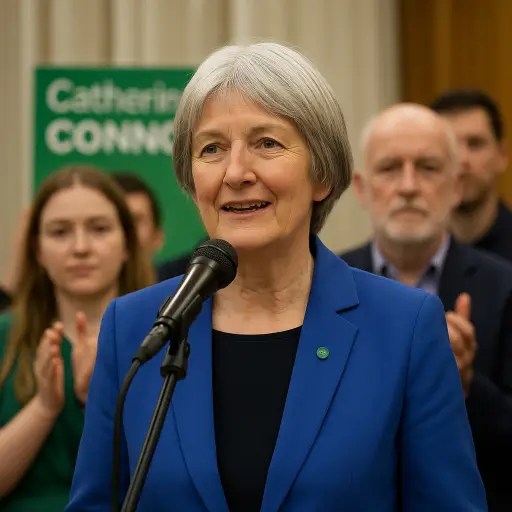
Dublin, Ireland — In a historic and decisive result that stunned the political establishment, independent candidate Catherine Connolly has been elected President of Ireland by the largest margin ever in the country’s presidential race. With approximately 63 % of first‑preference votes, she outpaced her nearest rival by a considerable margin, underscoring both her personal appeal and a shift in the national mood.
A Mandate Beyond Expectations
Connolly’s victory, announced at the official count centre in Dublin, was confirmed after her centre‑right opponent conceded the race earlier in the day. Her achievement — securing roughly 63 % of first‑preference votes — marks a new record in Irish presidential election history. Analysts say the scale of the win speaks not only to her campaign’s resonance but also to the broader discontent with traditional party politics.
From Galway Roots to National Stage
Connolly, a former barrister and long‑standing independent lawmaker from Galway, has steadily built a reputation for grassroots advocacy, social justice and an outspoken approach to foreign policy and Irish neutrality. Her rise from local politics to national prominence reflects a political journey grounded in community representation rather than party machinery.
Why the Vote Leaned Her Way
Observers highlight several factors contributing to her landslide:
- A campaign that emphasised inclusion, social equality and giving voice to those who feel ignored by mainstream politics.
- Voter fatigue with the dominant centre‑right parties, which failed to galvanise support despite their long tenure.
- Strong backing from several left‑leaning parties and independent groups, aligning behind her candidacy as a unified alternative.
- A style of campaigning that appealed to younger voters, urban constituencies and those prioritising climate, housing and social justice issues.
The Role Ahead — Symbolic Yet Significant
Although the presidency in Ireland is largely ceremonial, Connolly’s win carries symbolic heft. She inherits the office from Michael D. Higgins, who served two terms and shaped the role with a high public profile. Connolly has pledged to make the office “a president for all,” emphasising listening, reflection and speaking out when needed.
In her victory speech, she stated:
“I will be a president who listens, who reflects and who speaks when it’s necessary. Together we can shape a new republic that values everybody.”
Challenges and the Road Forward
Despite the glow of victory, Connolly steps into an environment fraught with challenges:
- Low turnout and high spoiled ballots: The election was marked by a historically low turnout and a record number of invalid or spoiled ballots, signalling widespread voter disengagement.
- Expectations vs. Role Limitations: With the office’s limited executive powers, Connolly will need to navigate carefully to meet the heightened expectations her landslide will generate, especially around housing, cost‑of‑living, and Ireland’s international stance.
- Scrutiny of foreign policy positions: Some of her views — particularly on international matters — have already drawn scrutiny and controversy, suggesting that her presidency may include more visible commentary than usual for the role.
What This Means for Irish Politics
Connolly’s emergence as president marks a moment of potential transformation:
- For the left‑wing and independent movements, her victory is a powerful affirmation that electoral successes beyond the traditional parties are attainable.
- For the centre‑right establishment, the result is a wake‑up call: even a ceremonial office can become the site of significant political messaging.
- For the Irish public, the election reflects deeper undercurrents — dissatisfaction with the status quo, appetite for change, and willingness to invest in an alternate voice.
Looking Ahead
As she prepares to take office later this year, Connolly will be watched not just for what she says, but for how she uses the position to shape tone, dialogue and national unity. While her role may not carry sweeping executive power, the sheer scale of her mandate gives her a platform few predecessors have had.
In many ways, the story of this election is not only about who won, but why they won — and what that tells us about Ireland’s evolving political identity. With her record margin, Catherine Connolly has not only made history, she has posed new questions about the future direction of the republic.


 The Tower Post