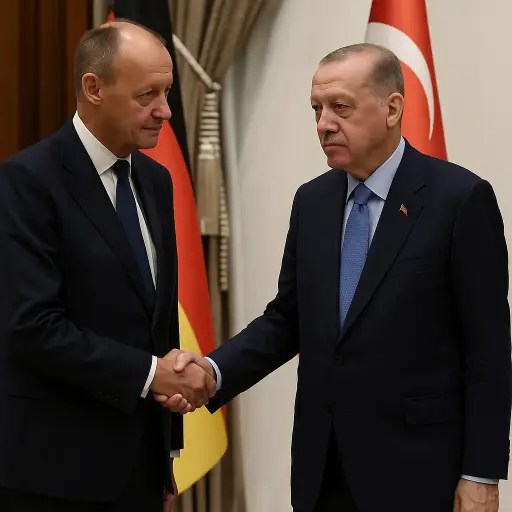
On his first official visit, German Chancellor Friedrich Merz travels to Türkiye to deepen ties on defence cooperation, EU‑Turkey migration dialogue and broader strategic alignment.
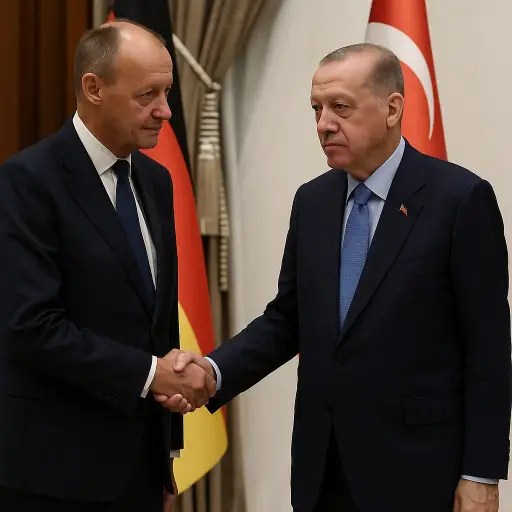
Ankara / Berlin — This Thursday, German Chancellor Friedrich Merz lands in Ankara for his inaugural official visit to Türkiye, taking up a full‑spectrum agenda stretching from defence and migration to EU‑Turkey strategic relations. Government spokesmen in Berlin have described the trip as “very important” for Germany, underlining Türkiye’s dual role as both a NATO ally and key dialogue partner across multiple international forums.
A pivot towards defence cooperation
At the core of discussions is a heightened focus on defence collaboration. Germany and Türkiye are navigating a closer alignment in military and strategic domains, including potential deals for fighter jets and tighter aerospace‑industry links. Reports suggest that Germany may bring proposals for a multibillion‑euro Eurofighter arrangement to the table. This defence agenda dovetails with Berlin’s broader intent to deepen European autonomy in security affairs—something Merz has signalled repeatedly since taking office. For Ankara, meanwhile, the prospect of advanced Western armaments comes at a critical juncture: Türkiye is seeking to bolster its military edge in a volatile eastern Mediterranean theatre. While the German government must balance these ambitions with sensitivities of neighbouring states, the bilateral momentum appears strong.
Migration and EU‑Turkey relations
Besides defence, migration remains high on the agenda. With Türkiye hosting millions of refugees and serving as a gateway for migration flows into Europe, Germany views cooperation with Ankara as indispensable. Merz’s visit signals a desire to recalibrate the Germany–Turkey partnership on migration: Germany will seek clearer commitment from Türkiye on border security, returns and broader migration management. The announcement in Berlin specified that economic cooperation, migration and security would go hand in hand. On the EU side of things, Germany hopes to advance discussions on the future of EU–Turkey ties. Though full membership remains off the table for now, the theme of a “privileged partnership” is being revived.
Strategic relations: beyond bilateral ties
Merz’s Ankara trip is not simply about Germany and Türkiye alone. Berlin sees Ankara as a strategic node in a shifting European security and geopolitical architecture. One German deputy spokesman stressed that Türkiye matters not only as a NATO partner but also as “a dialogue partner on many international political issues”. The Ukraine war, Mediterranean dynamics, energy geopolitics and migration linkages all converge in this visit. For Merz’s government—relatively new at the helm—the trip offers a chance to demonstrate diplomatic reach and reinforce Germany’s posture as a continental power.
Challenges and sensitivities
That said, the path ahead is not free of friction. Defence cooperation with Türkiye inevitably triggers concerns among other European capitals, particularly over regional power balances in the Mediterranean. The Eurofighter rumours, for instance, already fuelled commentary on Greece’s objections. On migration, German domestic politics remain sensitive: voters expect firm action on migration control, integration and returns. Any perceived softening of Germany’s stance could provoke domestic pushback. Moreover, Türkiye’s own shifting domestic and foreign‑policy posture introduces unpredictability: Ankara has at times pursued divergent paths from its NATO allies, raising questions about reliability and strategic alignment.
What to watch for
In practical terms, observers will watch for three key outcomes from this visit:
- Agreements or MoUs on defence cooperation — whether fighter‑jet deals, co‑production arrangements or deeper military‑industrial linkages.
- Migration and return framework — announcements signalling Türkiye’s willingness to step up border and refugee‑flow management in concert with Germany/EU.
- High‑level joint statement — a visible diplomatic signal of Germany‑Türkiye convergence, possibly covering Ukraine, NATO, Mediterranean security and EU‑Turkey strategic ties.
Why the timing matters
The timing of the visit matters: With Europe facing a complex web of security challenges—Ukraine, the Eastern Mediterranean, migration pressure, energy competition—Germany is keen to reaffirm its influence. Merz’s choice of Türkiye as his first official foreign destination underscores Ankara’s elevated diplomatic standing in Berlin’s agenda. At the same time, this visit will serve as a litmus test of the Merz government’s foreign‑policy posture: whether it favours pragmatic partnerships, how it balances German domestic concerns with international ambition, and how it positions Germany amid shifting trans‑Atlantic and European dynamics.
Bottom line: Chancellor Merz’s mission to Ankara is more than a routine state visit; it is an opening act of a deeper pivot in Germany–Türkiye relations. With defence, migration and broader strategy on the table, this week’s dialogue may shape not only bilateral ties but also Germany’s role in Europe’s evolving security architecture.



 The Tower Post