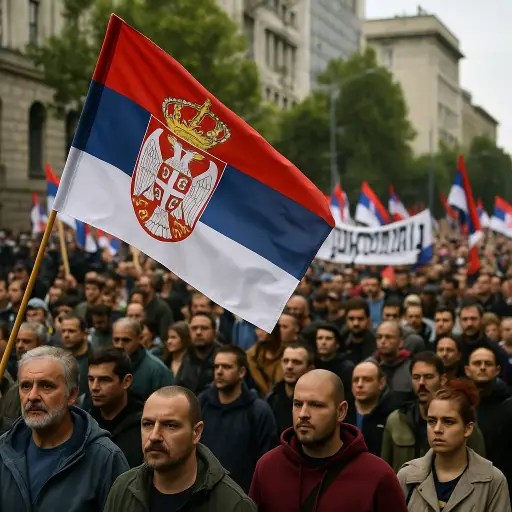
As thousands of Serbians take to the streets against a sprawling lithium development, Europe’s candidate country is under the spotlight — testing its democratic credentials and the European Union’s willingness to safeguard values.
The roar of chanting protesters echoing through the streets of Serbia this week underlines a somber reality: for the European Union, the promise of democratic standards in its aspirant states is facing a stark test. In the western region of Jadar, where one of Europe’s most ambitious lithium‑mining projects is set to be developed, citizens are once again mobilising — not merely against mining, but against the wider question of government transparency, independent institutions and the EU’s credibility in upholding its own values.
A mine becomes a movement
The controversial project, known as the Jadar lithium‑boron project, situated in Serbia’s Mačva District, involves one of the world’s largest known deposits of lithium oxide. Having initially had its licences revoked in early 2022 after widespread public protest, the project has since been revived — backed by a raw‐materials agreement struck between Serbia and the European Commission, as well as the participation of the mining giant Rio Tinto.
For locals, the mine is not about batteries for electric cars somewhere else. It’s about water, farmland, homes and trust in a government that many feel is opaque. “We cannot live without clean air and water, but we can live without lithium batteries and electric cars,” declared one protest leader.
Democracies in question
Beyond the environmental concerns, the protests carry a broader democratic weight. Since late 2024, Serbia has seen a wave of anti‑government street action, student blockades and civil society mobilisation — in a country formally seeking EU membership but accused of sliding towards authoritarianism.
Analysis by independent institutions flags a worrying pattern: arrests of activists, pressure on professors, suppression of dissent, and key decisions taken with limited consultation. The mining issue has become a focal point for all of it. The EU, for its part, has advanced the lithium project as a “strategic” initiative, aligning Serbia with European green goals — yet critics say this alignment came at the expense of demanding stronger protections for democratic governance.
Tensions between values and strategy
From Brussels’ vantage point, Serbia occupies a geopolitical sweet‐spot: it can provide critical raw materials for Europe’s green transition and help reduce reliance on China. But the very same deal casts a shadow — for if the EU privileges resource access over democratic norms, what message does that send about standards versus convenience?
Serbian authorities have replied by stressing the mine will adhere to “highest environmental and human rights standards” and that economic development must go hand in hand with integration with Europe. Meanwhile, protestors remain sceptical: they argue that the government has stacked the deck in favour of large investors, limited genuine public consultation and taken decisions behind closed doors.
On the streets — and at risk
Recent days in Belgrade and beyond saw new demonstrations — with farmers, students and environmental activists coordinating road‑blocks, village meetings and rallies. The message: this mine is no longer simply a project, it has become a symbol of governance. One of the protest slogans: “Democracy or mining, you cannot have both.”
Security forces have been active too. While the authorities warn of illegal blockades and public‑order risks, human‑rights monitors express concern that the line between crowd control and suppression is thinning.
What’s at stake
For Serbia, the stakes are high. A country that talks big about joining the EU must show more than aspirations. It must show functioning independent institutions, free assembly, transparent decision‑making and respect for civil society. All of which are under tension.
For the EU, this is a reputational test. If it allows a candidate country to slide towards autocracy or sideline civil society in exchange for critical minerals, the credibility of its enlargement policy suffers. As one commentator put it: “The Serbian case illustrates that the EU can only exert limited influence on the country’s government… but it must strategically use its available leverage to mitigate the existing risks.”
Heading into Thursday’s horizon
As we approach the end of October, the protest momentum continues and the government is facing a crisis of legitimacy. The Jadar project is still in its preparatory phases, but the symbolism has already been realised: a mine in the making has become a mirror for democracy itself.
The next few days could prove decisive: whether the authorities will open a genuine dialogue, whether the EU will raise governance concerns publicly, and whether protestors will sustain pressure. One thing is clear: the question in Serbia is no longer just whether it joins Europe — but what kind of Europe it becomes.


 The Tower Post