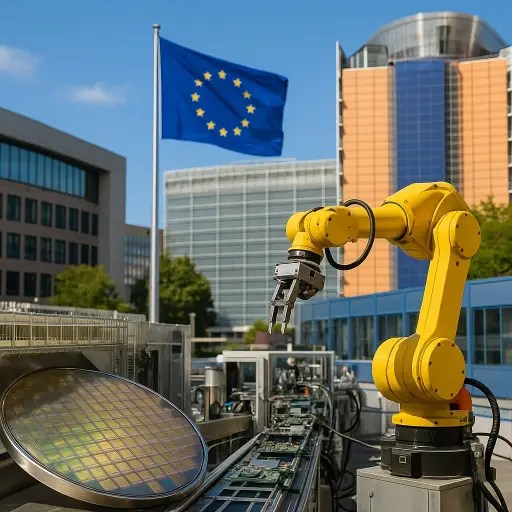
The European Commission today unveiled a landmark co-investment vehicle to bolster Europe’s high-tech growth companies in strategic fields — signalling a new phase in its push for technological sovereignty.
The corridors of Brussels buzzed this week as the European Commission announced the foundation of the Scaleup Europe Fund, a multi-billion-euro growth-stage investment vehicle aimed squarely at Europe’s deep-tech champions. The move marks a dramatic escalation in the continent’s ambition to rewrite its technological trajectory — from being seen as a follower to becoming a frontrunner in fields such as artificial intelligence, semiconductors, robotics and other strategic hardware-software combinations.
According to Commission documents and partnering investor statements, the new fund will operate as a publicly-backed yet privately-managed investment vehicle. The Commission is partnering with several leading European institutional investors and private growth funds, with the aim of driving capital into late-stage rounds of European companies in deep-tech fields.
For years, European policymakers have acknowledged a gap in the “scale-up” phase of the innovation chain — dozens of world-class research and start-ups emerge in Europe, but comparatively few grow into global market leaders. Fragmented national funding systems, relatively modest late-stage private capital, and regulatory hurdles have all been cited as constraints. The Scaleup Europe Fund is intended to close that gap by providing meaningful investment at a size and scale sufficient to compete globally.
In announcing the initiative, the European Commission emphasised not only economic growth but strategic technological sovereignty. The fund will address Europe’s need to “ensure that the best of Europe can choose Europe” rather than relocate abroad due to lack of capital or support.
Strategic Focus Areas
The fund’s target sectors reflect a deliberate shift towards hardware-intensive, long-horizon technologies which have been under-funded in Europe compared to the U.S. and China. These include:
- Artificial Intelligence and machine-learning architectures;
- Semiconductors and microelectronic manufacturing;
- Robotics and autonomous systems;
- Quantum technologies and advanced computing;
- Advanced materials, energy technologies and space applications.
By backing these domains, the fund aims to strengthen Europe’s supply-chain resilience and reduce reliance on external actors for core technologies. It is also a response to growing recognition that technological leadership is central to jobs, competitiveness and security.
Investment Mechanism & Timeline
The Scaleup Europe Fund will function as a growth-capital vehicle, making equity (or quasi-equity) investments in companies beyond the early-stage startup phase — typically in major funding rounds to scale operations, commercialise technologies and expand internationally. While the exact size of the fund has not been disclosed, it is described as “multi-billion-euro” and expected to be in the double-digit billions.
Management of the fund will be outsourced via a competitive process: the Commission along with founding private investors will appoint a management company to run it. The first investments are targeted to begin in the spring of 2026.
Importantly, the fund will be open to additional investors and co-investments — this is designed to help mobilise private capital rather than replace it, leveraging public backing as a catalyst. It also complements existing EU instruments such as the European Innovation Council (EIC) but fills a gap at the growth/scale-up stage where many European firms have struggled.
Implications for European Tech Ecosystem
For Europe’s deep-tech ecosystem, the announcement is a significant signal of intent. Entrepreneurs and investors have often pointed to the lack of accessible capital at late stages as a systemic barrier: strong early-stage research or prototyping may occur, but scaling manufacturing, achieving international market reach or conducting large R&D programmes requires deeper pockets. With the new fund, the continent is signalling it wants to stay home-grown “unicorns” as well as global champions.
From a geopolitical perspective, the initiative also reflects broader concerns about Europe’s technological competitiveness — particularly in a world where the U.S. and China have dominated many high-growth sectors. By backing critical technologies that underpin digital infrastructure, defence, health and industry, Europe is betting that its future economic strength will depend on mastery of the hardware-software nexus, not merely app development.
However, challenges remain. The sheer scale of global competition means the fund will need to coordinate not just capital, but talent, regulation, ecosystem infrastructure, and cross-border alignment. Europe’s regulatory environment, while advanced in many respects, still faces criticism for complexity and fragmentation. The ability of the fund to deliver meaningful outcomes will depend on how quickly and effectively it can move from announcement to deployment.
What Comes Next
In the coming months, the founding investors will finalise commitments, the competitive tender for the management company will be issued, and the detailed investment strategy will be published. Companies in growth stage across the EU and associated countries should prepare to engage with the mechanism: those building world-class scalable technologies in AI, semiconductors, robotics, quantum and advanced materials may find a new growth avenue opening.
For policymakers, the next phase will test whether the fund can mobilise beyond symbolic sums and demonstrate meaningful outcomes — scaled firms, jobs, manufacturing base, global leadership. If successful, the Scaleup Europe Fund could mark a turning point in Europe’s tech landscape: not just innovation in the lab, but industrial-scale growth and global competition.
For the European innovation ecosystem, the message is clear: the era of “research only” may be ending — now Europe is aiming to industrialise, scale up, and lead.




 The Tower Post