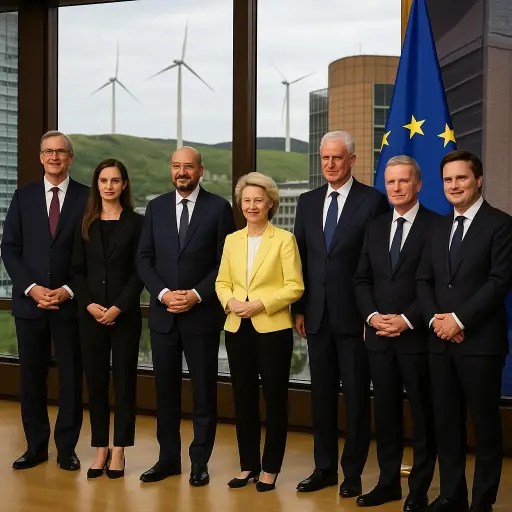
At a high‑level summit this Thursday, Nordic prime ministers joined European Commission officials to map out joint strategies on energy security, industrial competitiveness and external dependencies.
In a climate of mounting geopolitical uncertainty and disrupted supply chains, the prime ministers of the Nordic nations convened with senior European Commission representatives this Thursday to signal a renewed partnership on securing Europe’s critical inputs and competitiveness. The meeting, held in a neutral venue and culminating in a joint communiqué, underscores how the Nordic bloc is positioning itself as a key actor in Europe’s strategic response to external pressures.
Unity in a vexed supply‑chain moment
The discussion covered three connected fronts: energy security, supply‑chain resilience and industrial competitiveness. Nordic leaders emphasised that their region’s unique strengths — abundant renewable energy potential, advanced clean‑tech industries and linkages to northern shipping and logistics routes — provide a natural foundation for Europe‑wide action. The European Commission in turn underlined that the bloc faces a “strategic moment” in preventing further disruptions from global shocks.
One senior Nordic official described the summit as “a coming of age for our region’s role in Europe’s strategic autonomy”. The leaders agreed to deepen collaboration on hydrogen and offshore wind exports, expand battery‑material value chains, and strengthen infrastructure links between the Nordic states and central Europe. At the same time, they emphasised diversifying away from single‑source dependencies for raw materials and critical components.
Energy flows, renewables and a tougher neighbourhood
Energy remained a dominant item on the agenda. With Russia’s war in Ukraine still destabilising European gas and electricity flows, Nordic states — whose energy landscape is increasingly dominated by renewables, interconnectors and storage capacity — argue that they can act as both stabilisers and forwards‑looking innovators.
During the meeting, a number of concrete proposals were floated: constructing new subsea interconnectors linking Nordic grids to the Baltic states and Germany, co‑investing in hydrogen pipelines running north‑south, and establishing a Nordic‑European “resilience corridor” for energy supplies in emergencies. The European Commission welcomed the idea of aligning its forthcoming infrastructure package with Nordic projects, offering targeted funding and streamlined permitting processes.
Several prime ministers stressed that energy policy is inseparable from geopolitical strategy. “Secure supply chains begin with secure power,” one leader stated. The implication: Europe’s pursuit of clean energy isn’t only climate‑driven but also a matter of national security.
Industrial competitiveness: from raw materials to finished goods
On the industrial front, the summit recognised that while Europe has made headway in green technologies, it faces stiff competition internationally — particularly in battery manufacturing, rare earths processing and high‑precision machinery. The Nordic region’s small but advanced economies are champions in these domains, and their governments pitched the idea of “Nordic hubs” that feed into the larger EU industrial ecosystem.
Topics included: domesticising more of the upstream supply chain (mining, refining of battery metals), forging public‑private partnerships for large‑scale advanced manufacturing, and using existing trade‑agreements to reduce vulnerability to external shocks. The European Commission affirmed its interest in extending State‑aid flexibility and piloting “resilience contracts” through 2026, aiming to enable rapid deployment of critical facilities without singular dependence on Asia.
Facing external pressure: Russia, China and the global chessboard
Beyond economics and energy, the tone of the summit acknowledged the broader strategic context. The Nordic region, long accustomed to navigating great‑power proximity, brought its experience to bear: resilience not just in markets but in tech, logistics, maritime routes and digital dependencies.
Speakers warned of “diplomatic or economic coercion” risks — an implicit reference to China’s growing leverage in key raw materials and Russia’s history of disrupting supply flows. The European Commission said it would launch a “stress‑test” of Europe’s critical supply‑chain links to external states later this year, with the Nordic states committing to supply regional data and coordinate responses.
Challenges ahead: implementation, cost and coordination
While the summit produced a strong joint statement and several promising initiatives, observers caution that turning ambition into delivery will not be easy. Enumerated risks include: high infrastructure costs, regulatory bottlenecks across multiple jurisdictions, market‑distorting subsidies, and political fatigue within the European Union’s multi‑layered governance.
A key question remains how to prioritise projects given limited budgets. Some Nordic governments noted they will require EU co‑financing as well as private‑sector commitments, and warned that “national champions” cannot be built without risk‑sharing across borders.
In Brussels, Commission officials emphasised the need for immediacy: supply‑chain disruptions this year have already cost Europe billions in lost output and forced producers to push up prices. The hope is that this Nordic‑EU alliance can produce a few high‑impact “quick wins” by mid‑2026 to bolster credibility.
Why the timing matters
The timing of the meeting reflects mounting urgency. With next year’s EU budget cycle on the horizon, new infrastructure programmes in the pipeline and global geopolitical risk rising, the Nordic‑EU axis seeks to shape rather than only respond. The adoption of a unified front now sends a signal to global investors, upstream suppliers and partner states that Europe is turning words into coordinated action.
Moreover, as decarbonisation deadlines loom and supply‑chain reshoring becomes more politically salient, the Nordic region’s readiness to export expertise and integrate with the broader EU economy positions it as a pivotal link between the North and the Continent.
What to watch next
- Whether the European Commission moves in its upcoming work‑programme to create a dedicated “Nordic‑EU Resilience Fund” for energy and supply‑chain projects.
- Which specific interconnector or hydrogen pipeline project gets the green light first—and how quickly.
- How industry players in the Nordic states respond: will we see public‑private consortia launched this year?
- Whether non‑EU Nordic states (such as those associated via EFTA) will be included in the emerging framework or remain peripheral.
- The extent of coordination between this Nordic‑EU initiative and broader EU policy on China, raw‑material access and trade defence.
In summary, the summit of Nordic prime ministers and European Commission leadership this Thursday marks the most tangible convergence yet of northern European and continental strategic interests in energy, supply chains and competitiveness. While much of the work lies ahead, the partnership now appears aligned on purpose: Europe’s resilience rests as much on the North as it does on the West and South.
 The Tower Post