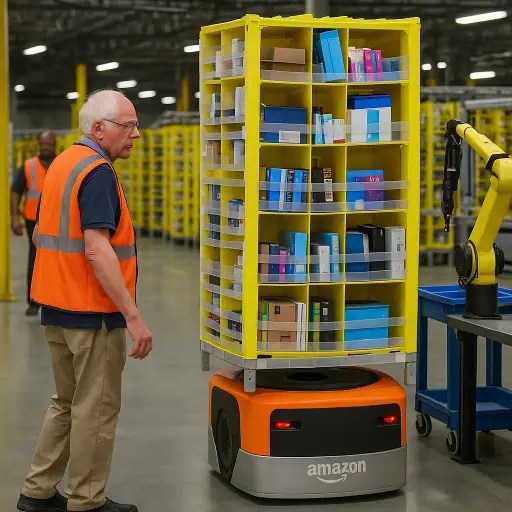
U.S. Senator challenges Amazon founder on how robotics and job‑impacting automation are shaping the company’s workforce and policy stance
In a high‑profile hearing this week, Bernie Sanders launched a pointed line of questioning at Jeff Bezos, founder of Amazon Inc., over the company’s accelerating use of automation in its fulfillment centres—and what it means for employment, worker protections and the future of labour in America.
Sanders, known for his advocacy on labour rights and corporate accountability, pressed Bezos on the pace and transparency of automation at Amazon. He asked: how many jobs are being eliminated or fundamentally transformed by the company’s robotics initiatives? What safeguards are in place for displaced workers? And how is Amazon preparing its workforce for a future in which machines increasingly take over tasks formerly done by humans?
Bezos responded that Amazon remains committed to both hiring and innovation—and that automation is intended to augment jobs, not simply replace them. He highlighted the company’s investments in training and career development, and said that “we are focused on creating opportunities for our employees to move up, learn new skills and work alongside technology.”
But Sanders rejected the premise that automation and job growth are easily reconcilable, saying the two often conflict in practice. He cited concerns from labour groups that Amazon’s robotics rollout has coincided with stagnating wages at many fulfillment‑centre jobs, rising pressure on remaining employees to keep pace with machines, and limited clarity on long‑term employment pathways for workers laid off or reassigned.
The Automation Surge
Amazon has increasingly incorporated robots and AI systems into its logistic operations: mobile robots deliver goods to human pickers, artificial‑intelligence systems assist with sorting and packing, and new “robotic workstations” aim to reduce travel time and physical strain for workers. Industry reporting has flagged that some robotics models introduced by Amazon are capable of handling thousands of items per hour—raising questions about how many human positions might be supplanted.
Bezos acknowledged that the company has rolled out “hundreds of thousands” of automation units across its system and that more are on the way. He emphasised that Amazon’s intention is to “free employees from repetitive, manual work and allow them to focus on higher‑skill tasks,” though he did concede that some roles will change or disappear over time.
For Sanders, the worry lies in the gap between promise and lived experience. He pointed to warehouse workers who say quotas have increased after robotics were deployed; others say retraining programmes are scattered and not consistently accessible. “When robots arrive, jobs shift—and many workers are left scrambling,” Sanders told Bezos. He urged Amazon to publish a full assessment of how automation will affect employment levels over the next five years, including plans for displaced employees, wage trajectories and career ladders.
Worker Impact & Policy Implications
Labour advocates testified alongside Sanders, describing a dual narrative: on one hand, automation may yield safer, more efficient operations; on the other, it raises the spectre of fewer entry‑level jobs and increased precarity for frontline workers. Some pointed to the central role Amazon plays as one of the largest private‑sector employers in the U.S., meaning its practices ripple across logistics, retail, and manufacturing supply chains.
Sanders used the hearing to press for policy reforms: stronger documentation of automation’s impact, mandatory worker consultation ahead of major deployment, and incentives for companies like Amazon to invest in worker retraining rather than simply invest in machines. He also raised the idea of tax incentives tied to human‑centred employment rather than pure automation.
Bezos pushed back on the notion of forced mandates, arguing that innovation must remain agile and market‑driven. He said Amazon would prefer to collaborate with policymakers rather than be constrained by rigid rules—but he committed to providing more disclosures around automation strategy and workforce implications.
What Comes Next
The public exchange marks a turning point in the broader debate over automation’s place in major American employers. With Amazon’s scale and visibility, radar is now on how such companies will balance cost‑ and efficiency‑driven deployment of robotics against commitments to human employment and career advancement.
In the coming weeks, Sanders is expected to introduce legislation aimed at requiring major firms to report automation metrics alongside employment data. Amazon, meanwhile, must decide whether to voluntarily elevate its internal disclosures and worker education programmes.
For workers at Amazon’s fulfilment centres, the contention remains: will robots continuously augment human roles—or will machines eventually reduce the need for humans altogether? The answer may hinge not only on technology, but on how companies, governments and labour advocates negotiate the changing contours of work.




 The Tower Post