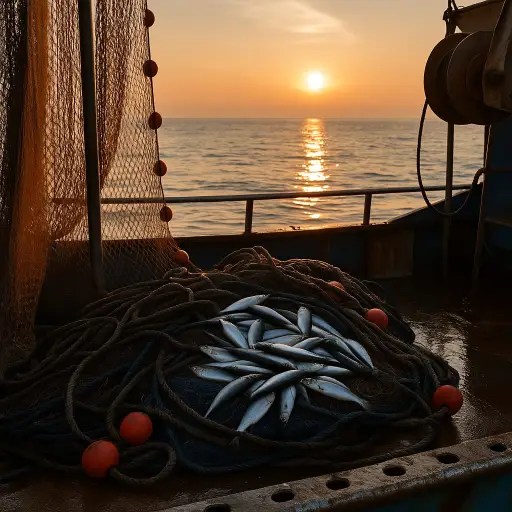
EU fisheries ministers deliver a politically‑negotiated framework for herring, cod, plaice, sprat and salmon that balances sustainability and economic concerns
On the last Friday of October this year, the ministers responsible for fisheries from across the European Union met in the format of the Council of the European Union and reached a political agreement on catch limits for 2026 for key fish stocks in the Baltic Sea — a milestone in the bloc’s effort to align the fishing sector with longer‑term marine‑ecosystem goals while supporting coastal communities.
A Delicate Balance
The agreed framework covers the principal commercial species in the Baltic Sea — notably herring, cod, salmon, sprat and plaice — and comes after months of scientific advice, stakeholder lobbying and political negotiation. The European Commission had formally proposed catch‑opportunity limits for 2026 in August, citing deeply troubling assessments for many stocks.
Those assessments, carried out by the International Council for the Exploration of the Sea (ICES), showed that cod stocks in both the western and eastern Baltic have failed to rebuild despite years of very constrained fisheries, and that herring and sprat stocks remain vulnerable, particularly in the Bothnian Sea and western Baltic.
In response, the Commission’s proposal called for significant reductions in by‑catch limits for cod, sharp cuts for certain herring stocks and modest adjustments to others — while maintaining or slightly increasing opportunities for salmon in the Gulf of Finland. The Council’s agreement now gives a political green‑light for applying those limits, subject to finalising quotas and national allocations.
Key Features of the Agreement
According to the Council decision, the following broad features characterise the 2026 catch‑limit regime in the Baltic Sea:
- A continued ban or near‑ban of targeted fisheries for the most depleted stocks of cod, with only by‑catch allowances in place. The new regime underlines that cod needs sustained time to recover.
- A mixed approach to herring stocks: while some (such as central Baltic herring) will see quotas maintained, others previously under intense pressure (such as Bothnian Sea herring and western Baltic herring) face steep reductions, or in some cases merely incidental by‑catch provisions.
- For sprat and plaice, modest adjustments were agreed: sprat quotas are largely maintained, recognising their role as forage fish in the ecosystem, while plaice is treated more cautiously given its lower commercial volume in the region.
- Salmon receives somewhat better treatment: in the Gulf of Finland area, a marginal increase was proposed, signalling recognition of its relative strength compared to other stocks.
The agreement also emphasises the interplay of ecosystem health, fishing‑community livelihoods and the rules of the EU Baltic Sea Multiannual Plan (MAP) and the Common Fisheries Policy (CFP).
Stakeholder Reactions: Cautious Optimism
Environmental‑non‑governmental‑organisations welcomed the political watering‑down of some of the Commission’s harsher proposed cuts, but stressed that the agreement must be followed by rigorous implementation and monitoring. One NGO statement noted that the Commission’s proposal already offered a “precautionary lead” to which the Council must adhere if the sea’s ecosystem is to stand any chance of recovery.
Meanwhile, fishers and industry representatives welcomed the fact that the agreement allows continued fishing activity in the Baltic’s key regions, but many noted that the path ahead remains difficult. With operational costs rising, fuel prices volatile and ecosystems under strain, the sector will need support to adapt to the new limits and gear‑changes required.
What the Deal Means in Practice
For EU‑member‑state administrations that allocate national quotas under the Council decision, the next months will bring detailed negotiations on national shares of the total allowable catch (TAC) for each species. Once those are concluded, fishers operating in the Baltic will need to plan for the 2026 season under the new constraints.
In practical terms:
- For cod fisheries: expect only incidental by‑catch permitted in many areas, especially for fleets that used to target cod directly.
- For herring: fleets targeting central Baltic herring may continue under roughly stable conditions, but those fishing in areas with severely depleted stocks will face sharp reductions.
- For sprat and plaice: the less dramatic quota changes imply a relatively stable season ahead, other constraints permitting.
- For salmon: in the Gulf of Finland region the small uptick may allow marginally higher catch levels, though broader ecosystem pressures (warming seas, reduced oxygen, habitat disruption) still loom large.
On the enforcement side, the agreement spells out that monitoring and compliance will be guided by the existing control regulation applicable to EU fisheries, meaning national inspectors, log‑book obligations and satellite/monitoring systems will remain key.
A Sea Under Pressure
The Baltic Sea is a semi‑enclosed basin, characterised by brackish waters, slow turnover and high sensitivity to environmental stressors — nutrient load, warming, deoxygenation and fishing pressure all interact. The fisheries ministers’ decision comes against the backdrop of repeated warnings that small‑pelagic stocks (herring, sprat) are the linchpin of the food web: if they collapse, larger predators and the wider marine ecosystem suffer.
In addition, the cod stocks have proven especially recalcitrant. Despite longstanding closures of direct cod fisheries in certain regions, recovery has been slow and scientists continue to raise concern that past fishing pressure and environmental change together have eroded resilience.
What’s Next and the Watch‑Points
With this agreement, the stage is set, but many of the finer details — national allocations, vessel‑fleet adaptations, gear‑change incentives, support for small‑scale fishers, and ecosystem‑restoration measures — will determine whether the 2026 regime will mark a turning point or simply another flat year of limited progress.
Key watch‑points include:
- Whether the click‑through from political agreement to national quota allocations is timely and transparent.
- How quickly fleets can adapt gear and practices (for example to reduce by‑catch or shift species targets) and whether financial support is sufficient.
- Whether ecosystem restoration measures (habitat improvements, reducing nutrient loads, maintaining spawning grounds) accompany the fishing‑limit regime; without such measures, fishing limits alone may fall short.
- Whether monitoring and enforcement are up to the task: quota compliance, correct reporting and oversight of by‑catch remain perennial weaknesses in mixed‑species fisheries.
- How climate‑driven changes (sea‑temperature rise, oxygen‑deficit zones) will further complicate recovery trajectories even under reduced fishing pressure.
Conclusion
The agreement reached by the EU fisheries ministers for 2026 in the Baltic Sea represents a politically significant step: it aligns with scientific warnings, accepts the need for constrained fishing on key stocks, and provides a framework for the member states to plan ahead. Yet it is not a ‘silver‑bullet’ solution — the real test will come in how the terms are implemented on the water, how fishers adapt, and whether broader ecosystem pressures can be addressed in tandem. If the Baltic Sea is to move toward healthier fish stocks, the next few years will be pivotal.




 The Tower Post