
Brussels summit endorses joint anti‑drone and air defence capabilities, enhanced border protection and space‑asset development to counter East‑flank pressures
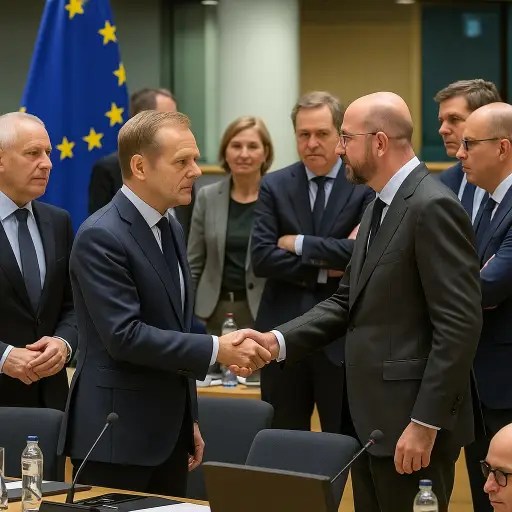
As the final Friday of the month draws to a close in Brussels, the European Council has formally endorsed a sweeping defence‑readiness blueprint aimed at confronting immediate threats posed by Russia and Belarus. The conclusions issued by the Council lay out a series of urgent priorities—joint anti‑drone and air defence systems, bolstered external border‑protection, and the accelerated development of space‑based assets. The aim: to give the 27‑state bloc a more credible deterrent posture on its eastern flank and beyond.
At its meeting, the European Council assessed the joint communication launched by the European Commission and the European Defence Agency as they presented the “Defence Readiness Roadmap 2030”. The document maps out a five‑year trajectory to transform Europe’s defence industrial base and operational posture, including a clear focus on hybrid threats emanating from Russia and Belarus. The Council’s conclusions emphasise that recent violations of EU airspace and intensifying hybrid attacks render this work urgent.
Eastern flank under strain
The decision to prioritise the eastern flank is explicitly linked to recent airspace incursions by Russia and Belarus and an uptick in hybrid sabotage, cyber‑attacks and drone activity. The Council’s text states that Europe must “be better equipped to act autonomously, in a coordinated way, and with a 360° approach, with immediate and future challenges and threats.”
In practical terms, the roadmap directs Member States to step up the protection of land, air and maritime borders across the EU — not just the eastern frontier but all outer boundaries.
Focus areas for capability‑building
Several capability areas are flagged for immediate action:
- Anti‑drone and air defence systems: The Council underscores the necessity to work on joint projects to strengthen detection, tracking and neutralisation of unmanned aerial threats.
- Space‑based assets and services: Recognising the increasing vulnerability of satellites and other dual‑use infrastructure, the roadmap calls for accelerated development of space assets for defence and security.
- Joint procurement & industrial base: The Council stresses moving from national silos to aggregated demand, standardised requirements and production at scale — including for SMEs and mid‑caps.
- Border protection & resilience: The conclusions link hybrid threats to infrastructure vulnerability (energy, digital, under‑sea) and set enhanced border protection as a key pillar.
Institutional shift and oversight
In what may prove a decisive shift in European defence governance, the Council has expanded the remit of the European Defence Agency, making it responsible for an annual readiness report (supported by the Commission and the High Representative) to be presented each October. The roadmap anchors the development of metrics, milestones and accountability into the Member States’ commitments.
Political and strategic implications
This roadmap marks a pivot: from Luxembourg declarations and piecemeal capability efforts to a coordinated European‑level approach. As one policy commentator put it, the Commission is “bidding for the driving seat” in defence, precisely because national capacities and coordination had proven insufficient.
At the same time, while the Council gives strong backing, some flag‑ship projects originally proposed (such as the so‑called “Eastern Flank Watch” and “European Drone Defence Initiative”) were referenced but not fully adopted in the conclusions—pointing to ongoing debates about scope and leadership.
What happens next
The Council asks Member States to finalise coalitions for key capability areas by year‑end and to launch concrete projects in the first half of next year. Financial instruments are to be mobilised (including EU budget flexibility, loans and aggregated procurement) to underpin this effort.
Although the roadmap stretches to 2030, the sense of urgency is immediate: the hybrid threats from Russia and Belarus are described as “intensified” and current vulnerabilities demand rapid remedy.
Challenges ahead
Despite the strong political signal, significant obstacles remain:
- National sovereignty vs. European coordination: Defence remains a core national competence, and some capitals resist deeper EU‑level steering of capability development.
- Fragmentation risk: With many possible capability coalitions, the roadmap warns of repeating old mistakes unless priorities are tightly managed.
- Industrial and procurement complexity: Translating aggregated demand into actual production in European defence industry ecosystems will take time and investment.
- Finite urgency window: The threats identified—airspace breaches, hybrid attacks—have already materialised; failure to deliver quickly could undermine credibility.
In sum, as Europe closes the month, the European Council’s decision sends a powerful message: the continent will no longer treat defence as peripheral. Instead, the readiness roadmap embeds the belief that Europe must develop the full‑spectrum capabilities — air, space, border, industrial and technological — to deter and defend in an age of hybrid threats from Russia and Belarus.
If implemented, it may mark a turning point in the EU’s evolution from a political‑economic union to a more serious security actor.
But as the roadmap acknowledges, the coming years will be decisive — whether Europe can act at pace and scale remains to be seen.




 The Tower Post