
Markets weigh corporate earnings even as trade optimism and AI‑deal momentum underpin sentiment
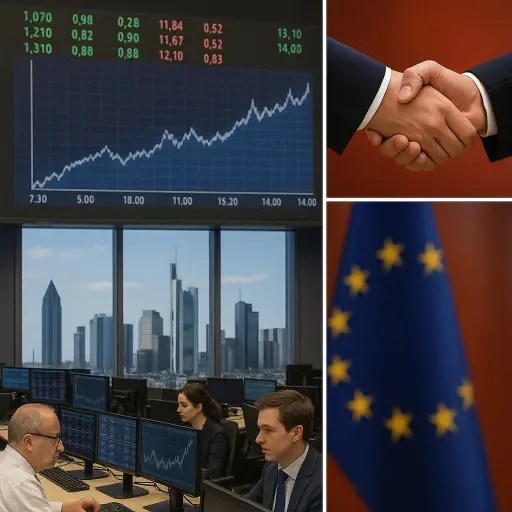
As European equity markets approach recent peaks, investors are balancing optimism over a possible breakthrough in trade ties between the United States and China with the persistent reality of mixed corporate earnings results. Across the Continent, major indices are trading near all‑time highs, in part driven by hopes of a truce in global trade tensions and fresh momentum in artificial‑intelligence deals and other technology investments.
Trading on hope, anchored by earnings
European shares posted yet another session near their highs this week, buoyed by encouraging signals that the U.S. and China may inch closer to a formal trade framework. According to reports, a meeting between the two sides is anticipated, and investors appear to be pricing in an outcome that could ease tariffs and other trade frictions.
Markets have responded accordingly: banks and technology stocks in Europe have gained ground, while defensive sectors such as healthcare have lagged. One commentary described the mood as “kind of solved and on a much better footing at least temporarily.”
Yet, this optimism is tempered by a sober recognition that corporate earnings across Europe have not uniformly supported the up‑trend. Several major firms disappointed expectations, reminding markets that valuations remain exposed if trade hopes falter.
The trade‑deal effect
What appears to be driving much of the market lift is the perception that a U.S.–China deal could unlock a new wave of global trade growth, and restore a sense of confidence among risk assets. In Europe, index gains this week reflect that renewed appetite.
Beyond direct trade flows, the broader implication is that if the world’s two largest economies can find a modus vivendi, global supply chains and investment flows may be less burdened by tariffs, export controls and policy uncertainty. In practice, that could help European exporters and manufacturers regain momentum, and support cyclical parts of the market such as banks and industrials.
Still, analysts caution that even with trade hopes elevated, the market is leaning heavily on that narrative. Should talks stumble—or central banks deliver less accommodative messages than hoped—the rally may face headwinds.
AI, tech deals and Europe’s caught‑up moment
In tandem with the trade story, Europe is seeing increased focus on artificial intelligence, chip development and tech‑industrial partnerships—areas where the trade détente signal matters. Europe’s technology and telecom firms are attracting renewed interest as global investment seeks growth outside the U.S. spectrum.
For example, a Finnish telecom equipment company surged after a commitment of U.S. investment tied to AI initiatives—highlighting how trade optimism and tech investment flows are interlinked.
This phase may offer Europe a “catch‑up” moment, with companies formerly overshadowed now gaining attention. That said, many of the heavy lifting stories remain U.S. centric, meaning Europe still plays with a slight lag and remains exposed to global developments.
Central banks, valuations and the risk landscape
While trade optimism and tech deals underpin the current mood, central bank policy remains the persistent tailwind—or headwind—watch. Markets expect that the Federal Reserve will signal a rate cut this week, while the European Central Bank is widely anticipated to hold steady.
With interest rates pivotal to equity valuations—especially in sectors like banks and technology—any hawkish surprise could dampen sentiment. Many strategists note that European equities are now trading very near their highs, and the margin for error may be narrowing.
One major bank recently upgraded its euro‑zone stocks thanks to improved valuations and reduced positioning. But the same bank warned that earnings must catch up and macro risks remain real.
Key themes and outlook
Pros
- Trade optimism between U.S. and China is providing a credible narrative lift.
- European tech and industrial companies stand to benefit from the shift in global investment flows.
- Central bank expectations are tilted toward looser policy in the U.S., which supports risk assets globally.
Cons
- European corporate earnings remain patchy; disappointments may trigger pull‑backs.
- Valuations are elevated; the rally may be increasingly driven by sentiment rather than fundamentals.
- Any misstep in trade negotiations or central‑bank messaging could quickly reverse the mood.
What investors are doing, and should watch
Investors appear to be rotating into more cyclical and value‑type exposures within the European market—banks, industrials, tech infrastructure—while trimming more defensive plays such as non‑cyclicals and healthcare. This reflects a willingness to engage in “risk on” mode as long as trade, policy and earnings threads remain intact.
Watch‑points for the coming days:
- The official communiqué from the U.S.–China meeting—any signs of failure or ambiguity could unsettle markets.
- Corporate‑earnings reports from key European companies—strong results could reinforce the rally; weak ones may expose vulnerability.
- Central‑bank commentary, especially from the ECB—if the tone is less dovish than expected, valuations could come under pressure.
- Global macro surprises—such as inflation or employment data—that might disrupt rate‑cut expectations or feed uncertainty.
Conclusion
At the close of this month, European equities find themselves in a favourable light: near recent highs, buoyed by trade optimism and tech investment hopes, and with central‑bank policy broadly supportive. Yet this favourable light comes with caveats. The market’s advance appears increasingly reliant on a positive sequence of events: trade breakthrough, strong earnings, stable policy guidance.
If one or more of these pillars falters, the rally may lose steam quickly. For now, European markets enjoy the momentum, but with an eye on the calendar and an ear to policy rooms and negotiation halls around the world.



 The Tower Post