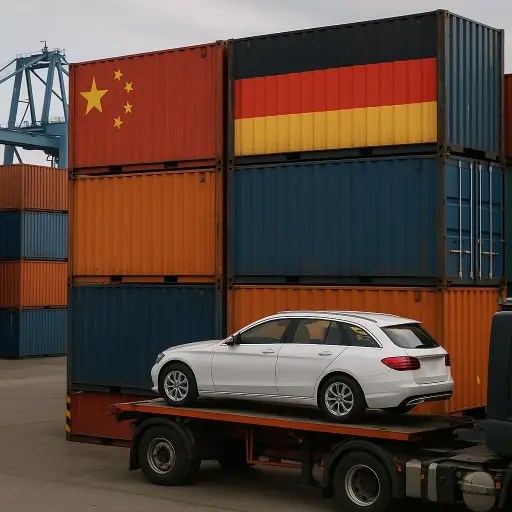
Surge in Chinese imports and U.S. export slump mark a turning‑point for Germany’s global trade map

In a striking shift of global trade patterns, Germany’s trade relationship with China has surged ahead of the United States, according to preliminary data covering the first eight months of the year. While Berlin and Washington have traditionally been among one another’s most important economic partners, the new figures suggest the flows of goods are increasingly moving along different axes.
The German Federal Statistical Office (Destatis) indicates that total trade — the sum of exports plus imports — between Germany and China has overtaken that with the United States in the current period. Analysts attribute the change to a combination of higher U.S. tariffs, a stronger euro, softer demand for German industrial exports, and a rebound in Chinese trade momentum.
A transatlantic pause, an eastern pivot
For years, Germany has leaned heavily on the U.S. market for its high‑value exports — automobiles, machinery, specialty chemicals and industrial inputs. But this year, U.S. import duties and policy headwinds have weighed heavily. German exports to the U.S. have fallen by more than 7 % compared with a year earlier, a sharp decline for a key trading relationship.
Concurrently, Germany’s imports from China have climbed, even as German exports to China shrank. This has produced a dynamic in which Chinese goods are flowing into Germany at an accelerated pace — reinforcing China’s place as the country’s top trade partner, even if not evenly in Germany’s favour.
Why the shift matters
This realignment carries economic and strategic significance. First, for Germany — Europe’s largest economy and a major exporter — the erosion of demand in the U.S. market signals increased vulnerability. The export slump is not just a statistical blip: it reflects a structural exposure to trade policy risk and currency headwinds. A stronger euro makes German exports less competitive abroad, while non‑tariff barriers in major markets like the U.S. add further friction.
Second, the growing relative weight of China as a trading partner raises new questions. While Germany will welcome increased trade volumes on the surface, the structure of that trade matters. A surge in imports without a parallel export recovery can tilt the balance of power and deepen dependency. Some German analysts are already sounding alarm bells about the imports coming in at very low cost and the downstream effects on German manufacturing.
Third, from a geopolitical viewpoint, Germany’s trade pivot comes at a time of rising global trade tensions. The U.S., under a renewed emphasis on tariffs and trade leverage, is sending ripples through its traditional partners. Europe and Germany in particular are finding themselves at a crossroads: maintaining ties with Washington on security while confronting divergent economic interests. Meanwhile, China continues to assert its role in global supply chains and trade flows, sometimes as a partner, sometimes as a competitor.
Sectoral pressures and industrial implications
The impact is most acute in traditional German export sectors. Automobiles, industrial machinery and chemicals — staples of Germany’s export strength — are feeling the squeeze. U.S. automotive import duties and slowed demand for German‑made industrial goods in America are part of the story. At the same time, German firms face intensifying competition from Chinese producers and supply‑chain re‑gearing, especially in intermediate goods and components.
On the import side, Chinese‑manufactured goods are entering Germany in greater volume — some analysts voice concern about possible dumping and the downstream effects on German suppliers. The net effect is a subtle but significant shift in Germany’s trade vector: less one‑sided exporting to the U.S., more two‑way trade with China, but not always on terms favourable to German manufacturing.
What Germany could do next
For Berlin and the German business community, the changing trade map warrants three practical responses:
- Diversify export markets. If reliance on the U.S. is becoming riskier, Germany may seek to strengthen trade ties in other regions — Asia beyond China, Africa, Latin America. This could mitigate the exposure to any single partner’s policy shifts.
- Upgrade supply‑chain resilience. With trade flows shifting, German industry may benefit from rethinking its sourcing and production frameworks, bringing more value‑added processes back home or into allied economies, and reducing reliance on low‑cost imports that undercut key sectors.
- Engage in trade diplomacy. Germany will have to navigate its positioning carefully: balancing economic opportunities with China against deeper strategic ties with the U.S. and the EU’s wider policy frameworks. Trade policy is increasingly intertwined with geopolitical risk, and Germany finds itself in the middle of that dynamic.
Outlook and caution
While the headline of China overtaking the U.S. as Germany’s largest trading partner may carry a sense of immediacy, the underlying dynamics suggest caution. The export decline to China (which is even steeper than the drop to the U.S.) shows the relationship isn’t simply one of unconstrained growth. Imports may rise, but balanced, sustainable trade requires exports too — and Germany has seen those exports dipping.
Moreover, trade data covering only the first eight months of the year are by nature provisional. Full‑year outcomes may vary, particularly if global growth picks up or policy changes occur. Yet the trend is unmistakable: Germany’s trade map is being redrawn.
As Germany approaches the end of the calendar year, companies, policymakers and analysts alike will closely watch whether the momentum holds and how the economy adapts. For the 31st Friday of the month, the message is clear: Germany is navigating a new era in global trade — and the axis has shifted.



 The Tower Post