
With polls showing Geert Wilders and his Party for Freedom (PVV) potentially emerging as the largest party, the Dutch snap election may determine whether the country’s mainstream still holds the reins or the far right breaks through.
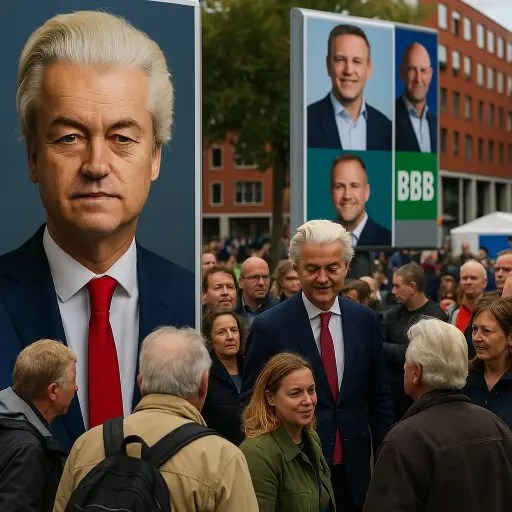
The Netherlands heads into an unexpectedly high-stakes snap general election that analysts believe could mark a turning point for the country’s political direction. The ballot offers a litmus test: can the mainstream parties check the advance of the far right, or will voters hand the reins to a populist, anti-immigration, anti-Islam agenda?
The election was triggered after the collapse of the previous government, following the withdrawal of the PVV from the ruling coalition over disagreements on asylum and migration policy. Polls in the run-up suggest the PVV remains in first place among voter preferences — yet its path to power is far from certain.
A rising challenge
At the heart of the campaign is Geert Wilders, leader of the PVV, who has long made anti-Islam and anti-immigration rhetoric a hallmark of his appeal. His party presents itself as the defender of Dutch identity, promising stricter controls on migration, more autonomy from EU mandates, and a sharper focus on the “native” electorate. For many voters dissatisfied with the housing crisis, rising living costs, and what they perceive as an out-of-touch political elite, the PVV offers a disruptive voice.
But the challenge is not simply one of policy: it is one of legitimacy. Several major parties have stated explicitly that they will not form a coalition with the PVV, meaning that even if Wilders’ party wins the largest vote share, converting that into governing power is not guaranteed.
The mainstream’s counter-move
On the other side of the ledger stand moderate parties — centre-right, centre-left and liberal voices — which have increasingly cast the election as a referendum on the far right rather than a routine domestic contest. For many voters the issues of housing, healthcare and cost of living loom large; for others, the question is whether the Netherlands will maintain a coalition built around liberal democratic norms or drift toward populism and polarisation.
Notably, the centre-left alliance of GroenLinks–PvdA has attempted to re-frame the election as one about more than immigration – a chance to tackle social and economic inequalities. Meanwhile, parties of the centre-right and Christian-democratic tradition are trying to reclaim voters who flirted with populist messaging but may balk at its implications if it crosses certain red lines.
Stakes for Europe and democracy
The Dutch election takes place at a moment when far-right and populist forces are active across Europe, making the outcome significant beyond the Netherlands. Should the PVV secure the largest share of seats and yet be excluded from forming government, it may signal the resilience of mainstream coalitions. If the PVV enters government, even in a supporting or junior role, it could mark an acceleration of far-right influence in one of the region’s founding liberal democracies. Observers are watching closely to see whether the normalisation of far-right rhetoric has reached a tipping point.
What to watch
Analysts point to several key factors in the election’s outcome:
- Seat distribution vs. vote share: The Dutch system means that winning most votes does not automatically guarantee dominance in coalition negotiations.
- Coalition formation: With many parties ruling out cooperation with the PVV, much will depend on which alliances coalesce after the vote.
- Messaging vs. moderation: The PVV has in recent years attempted more moderate tones to broaden its appeal, yet its core agenda remains polarising.
- Issue salience: While migration remains central, issues like housing affordability, energy costs and public services are shaping voters’ decisions.
The dilemma for Dutch voters
For the average Dutch voter, the choice may feel stark: stick with parties offering incremental reform within the established system, or back a party promising a sharp break with the past. Some voters drawn by the PVV’s anti-establishment pitch are also weighing the risks of governance with a party viewed as outside conventional consensus politics. For others, this election may serve as a chance to reaffirm the Netherlands’ commitment to pluralistic governance and liberal values.
The outcome and beyond
If the PVV emerges as the largest party but remains sidelined from government, the result could embolden the far right nonetheless — illustrating strength but also exposing limits. By contrast, if the centre holds and the PVV falters, the election may represent a push-back, a moment of re-assertion by the moderate centre. Either way, the result will reverberate: for Dutch politics, for coalition-building dynamics in Europe, and for debates over nationalism, migration and identity.
As Dutch citizens cast their votes, the world watches. Not just a domestic contest — this is a test of whether the Netherlands will chart a familiar centrist course or move further into uncharted populist waters.


 The Tower Post