
As earnings from the tech elite loom, Wall Street eyes the interplay of earnings, monetary policy and US‑China trade tensions.
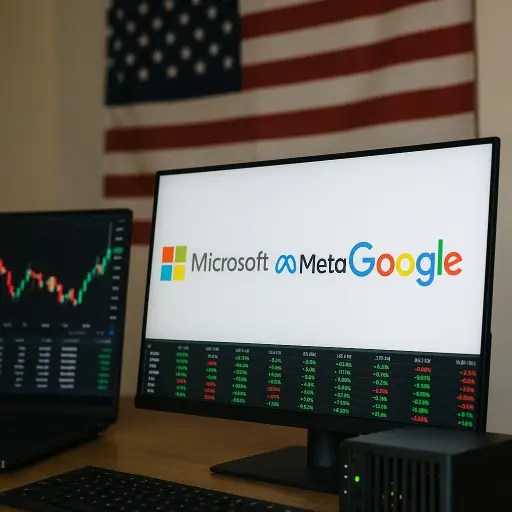
This week (the final trading days of the month) marks a pivotal moment for the U.S. technology sector, as major companies prepare to report and policymakers convene against the backdrop of a fraught global trade environment. The results of the upcoming earnings for Microsoft Corporation, Alphabet Inc. and Meta Platforms, Inc. are poised to send ripples not only through the markets, but through broader themes of AI investment, interest‑rate policy and U.S.–China trade diplomacy.
Earnings: Growth, scrutiny, and the AI question
Microsoft is due to post results shortly, with attention centred on its cloud business and AI initiatives. Analysts expect the company’s core platform to continue growing at double‑digit rates, and the market is pricing in a meaningful share‑move ahead of the release.
Alphabet and Meta likewise step into the spotlight this week. Their reports will not only provide another read‑out on digital advertising and cloud services, but also lay bare the returns on huge AI investments. Meta in particular has drawn attention for its heavy outlays in AI hardware, business messaging and ad‑tech infrastructure.
Together these reports carry outsized significance: the so‑called “big tech” firms account for a substantial share of the market‑cap of key U.S. indices, meaning their performance has wavering implications for broader investor sentiment.
However, the earnings questions go deeper than mere topline numbers. Investors will be watching for signs of softness in ad demand, margin pressure from infrastructure build‑out, and evidence that the AI boom is translating into scaled, sustainable profitability. Some analysts caution that the valuations of these companies rest heavily on lofty expectations of growth and transformation.
Monetary policy: The Federal Reserve on hold and rates in focus
Compounding the corporate backdrop is a major policy event: the Fed is expected to cut interest rates this week, signalling a shift in monetary policy even as inflation remains a point of concern. According to several accounts, the rate move may be modest, and officials may refrain from offering a strong forward path, given the division within the Fed over the pace of easing.
For the tech giants, the policy context matters for several reasons. Lower borrowing costs can support investment‑heavy business models in cloud, data centres and AI. On the flip side, weaker economic momentum may weigh on ad spending, enterprise capex and consumer tech uptake. A cautious Fed could therefore send mixed signals: supportive of growth, but signalling underlying weakness.
Global trade: U.S.–China tensions and implications for tech
Entering into this mix is the diplomatic dimension: a high‑level summit between U.S. President Donald Trump and Chinese President Xi Jinping is scheduled this week in South Korea, as markets hope for a thaw in trade and technology tensions. China has formally confirmed the meeting, raising investor hopes of progress in easing export‑controls and tariffs.
The tech sector is deeply exposed to U.S.–China trade policy. Supply‑chain disruptions, export restrictions on semiconductors, and broader bilateral friction all loom as potential headwinds. Some coverage suggests that optimism about a U.S.–China framework is already bolstering equity markets.
For Microsoft, Alphabet and Meta, the global dimension adds another layer: how resilient their business models are to trade friction, and whether they can capitalise on growth—even amid increasing geopolitical risk.
The risk‑reward calculus for markets
Taken together, the convergence of big‑tech earnings, Fed policy and U.S.–China diplomacy makes this week a kind of stress test for markets. A strong set of results could embolden growth narratives, lift risk assets and reinforce confidence in secular tech themes. Conversely, any disappointment—whether in earnings guidance, policy signals or trade truce breakdowns—could trigger sharp volatility.
For investors and market watchers, key questions include: Can the tech titans convert gargantuan AI investment into meaningful returns? Will the Fed’s pace of easing strike the right balance between growth support and inflation vigilance? And will the U.S. and China use this summit to chart a clearer path forward, or simply kick the can down the road?
What to watch in the coming days
- From Microsoft: growth in the Azure cloud business, AI‑services uptake and margin trajectory.
- From Meta & Alphabet: advertising trends, AI‑capex impact, supply‑chain/trade‑risk disclosures.
- From the Fed: the size of the rate cut (widely anticipated at 25 basis points), and the tone of future guidance.
- From the U.S.–China summit: language around trade, export‑controls and technology cooperation or confrontation.
Conclusion
As the trading week accelerates toward its conclusion, markets stand at a convergence of corporate performance, monetary policy and geopolitics. The earnings from the tech behemoths may offer the most tangible evidence of how deeply AI‑led transformation is embedded in business‑models. But their implications will radiate much further: into how policymakers calibrate the next cycle of rate cuts, into how global trade frameworks are renegotiated, and into how investors parse risk and opportunity in an increasingly complex world. If all goes well, the week could mark a reaffirmation of tech dominance and global stability. If it doesn’t, it may spark a sharper reassessment of valuations, policy assumptions and strategic bets. Markets, and perhaps the world’s digital infrastructure, will be watching closely.




 The Tower Post