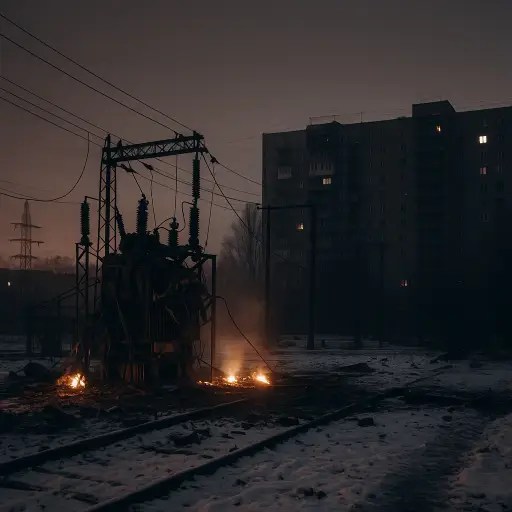
As winter looms, massive missile and drone strikes batter Ukraine’s electricity sector, leaving millions in the dark and civilians at risk

KYIV, Ukraine – A wave of missiles and kamikaze drones launched by Russia ripped through Ukraine’s critical energy infrastructure, plunging large swaths of the country into darkness and setting the stage for a chilling winter of uncertainty. According to Ukrainian President Volodymyr Zelenskyy and government officials, more than 650 unmanned aerial vehicles and over 50 missiles were deployed in the assault.
In a statement issued on social media, Zelenskyy warned that Moscow’s strategy is no longer confined to battlefield targets: “They are attacking our lights, our heating, our homes. They want to freeze us into submission.” Analysts and Ukrainian officials alike describe the campaign as “systematic energy terror,” deliberately timed to sap morale and disrupt daily life as the arrival of winter threatens deeper hardship.
The scale of the strike
The breadth of the attack was striking. Overnight, air‑defence systems tracked drone swarms of the Shahed‑type, cruise missiles and hypersonic weapons including the Kinzhal. Despite high interception rates, critical infrastructure points were nonetheless hit — thermal power plants, key substations, high‑voltage transformers and transmission lines across multiple regions. With the grid already under strain, officials say the damage is substantial.
In addition to structural damage, the human toll is already emerging. At least two civilians are confirmed dead and more than 17 wounded, including children as young as two years old.
Outages, curfews and concern
In immediate response, nationwide power restrictions were imposed across all oblasts to stabilise the system and prevent cascading failures. Many Ukrainian households woke to darkness, heating systems offline, and the spectre of water and sewage interruptions looming. The energy sector, already depleted of spare parts, warned that its ability to repair and replace damaged equipment may be pushed to the brink.
“The damage is not only physical, it is psychological,” says one engineer from the national grid operator. “When you cannot guarantee that your children will have heat at night, you feel the war inside your home.”
Strategic logic and winter vulnerability
Military analysts say the pattern is consistent with Russia’s evolving targeting doctrine. Whereas early in the war strikes were concentrated near front‑line military sites, the current campaign appears aimed squarely at civilian infrastructure and national lifelines. With winter approaching, depriving Ukraine of electricity has both material and psychological impact: freezing homes, darkening streets, disrupting hospitals and cooling down morale. Experts warn that conditions in many cities could deteriorate rapidly if power, heat and water services are not restored.
Ukraine’s response and international dimension
In the face of the assault, Ukrainian leaders called for urgent delivery of Western air‑defence systems and increased international support. They say Moscow must be held accountable for what they describe as a deliberate campaign of civilian disruption. Meanwhile, neighbouring countries scrambled; for example, Poland briefly scrambled fighter jets after the strike triggered alarm beyond Ukraine’s borders.
Energy companies in Ukraine are deploying emergency shutdown schedules, creating “points of invincibility” where citizens can charge phones and warm up—even as repair crews race against the clock. But the damages are deep: some high voltage transformers, built on Soviet‑era designs, may take months to replace.
What lies ahead
As temperatures begin to fall, the stakes are rising. The window for repair before widespread suffering sets in is narrowing. The coming months could see cascading humanitarian effects: hospitals unable to sustain operations, communities cut off, and entire neighbourhoods forced offline in rotating black‑outs.
For Kyiv, the challenge is two‑fold: stabilise the grid while continuing to defend against further waves of attack. For Moscow, the calculus appears clear: if you cannot take territory, you can attempt to freeze a population into submission.
In the end, Ukrainians say, whether the lights come back on will matter not just for comfort, but for resilience. “If we remain cold, dark and powerless, they win in the nights when we fear what comes next,” one municipal official says. “We must prove that we can keep the lights on — even in the darkest hours.”

 The Tower Post