
Latest survey data for the euro‑zone reveal a modest yet meaningful decline in household debt‑to‑income and corporate debt‑to‑GDP ratios, suggesting improved balance‑sheet resilience amid economic uncertainty.
As Europe enters November 2025, fresh data from the euro‑area financial survey show that both households and non‑financial corporations are slowly reducing their levels of indebtedness relative to income and output. While not dramatic, the declines reflect a continuation of the cooling in leverage that has been unfolding since the pandemic‑fueled build‑up of debt.
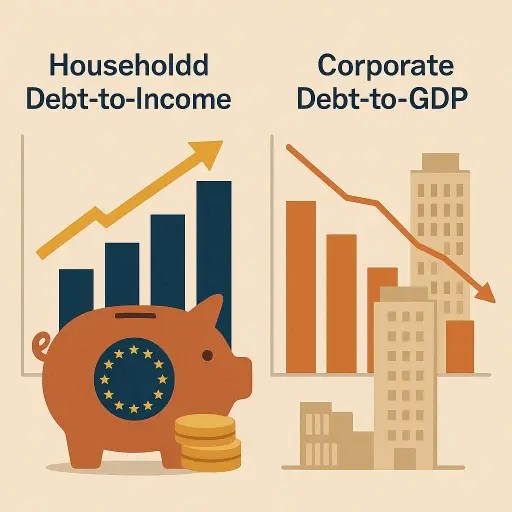
According to the latest release, households in the euro area have pared back their debt relative to income, with the debt‑to‑income ratio falling to 81.5 % from 82.8 % a year earlier. At the same time, non‑financial corporations (NFCs) saw their debt‑to‑GDP ratio decline to 66.3 %, down from 67.9 %.
These figures mark an incremental shift in a debt environment that for years has been marked by elevated levels of borrowing and subdued growth. The modest reductions suggest that households and firms are responding to higher interest rates, cost pressures and perhaps a degree of prudence in the face of global economic headwinds.
Households: Debt moderation amid tighter conditions
For households, the drop in the debt‑to‑income ratio to 81.5 % indicates that the average household’s debt burden is now lower relative to its disposable income than it was a year ago. While the decline is small, it is significant in what remains a challenging environment for many consumers: inflation remains above target in many countries, real wage growth is modest, and borrowing costs have risen.
Analysts suggest that several factors are likely driving the improvement: slower growth in new lending, higher repayments, a rebalancing of savings and consumption, and possibly some consumers exercising caution rather than taking on fresh debt.
The easing of household leverage is welcome news for financial stability watchers: indebted households are more vulnerable to shocks, including interest‑rate hikes, a wage setback or property market softening. A lower debt‑to‑income ratio gives a slightly larger buffer.
However, it is far from a guarantee of comfort: with debt still almost 1.5 times income, many households face a high servicing burden. The cooling is gradual, and the broader macro environment remains uncertain.
Corporations: Output‑based leverage slips
Turning to the corporate sector, non‑financial corporations in the euro area have also reduced their indebtedness relative to output. The latest data show a debt‑to‑GDP ratio of 66.3 %, down from 67.9 % a year earlier. Though the consolidated measure has been hovering in the mid‑60s for some time, even a small reduction suggests that firms are either de‑leveraging, generating stronger output or a mix of both.
Several dynamics may be contributing: companies scaling back growth investments, reducing new borrowing, or improving cash‑flows enough to shrink debt relative to output. Additionally, moderate growth in credit volumes suggests that firms are less aggressive in adding debt in the current environment of elevated interest rates and softer demand.
From a financial‑stability perspective, a lower corporate debt‑to‑GDP ratio helps reduce systemic risk. Firms with lower leverage are less fragile in downturns, have greater access to financing, and are better positioned to weather a profit squeeze.
Broader implications and outlook
While the declines are modest, they interplay with other themes in the euro area economy. For instance, the fact that households and firms are slightly de‑leveraging comes at a time when growth remains sluggish, inflation and rates remain elevated, and geopolitical tensions continue to weigh on sentiment.
On the positive side, the moderation of debt growth enhances resilience: households have a modestly improved capacity to absorb shocks, and firms carry less leverage relative to output.
On the flip side, the pace of improvement is slow. At these levels of indebtedness, even a minor adverse shock (e.g., a sharp rate increase, property slump, or earnings hit) could still ripple across the economy. The backdrop of weak productivity growth and structural headwinds means that policy buffers remain thin.
For policymakers and financial‑watchers, the takeaway is cautiously optimistic: the euro‐area economy is showing signs of stabilising under the weight of debt, but without a more robust growth vintage and stronger momentum in balance‐sheet repair, vulnerabilities remain.
Conclusion
To summarise: as of early November 2025, households in the euro area have lowered their debt burdens relative to income to about 81.5 %, while non‑financial corporations have reduced their debt relative to GDP to around 66.3 %. These movements reflect moderate but meaningful progress in debt‑adjustment in a challenging macroeconomic landscape.
Although the improvements do not herald a dramatic turnaround, they suggest that both households and firms are responding to higher costs and increased uncertainty by slowing debt accumulation and improving resilience. If sustained, these trends may help bolster financial stability and support smoother economic adjustment ahead.




 The Tower Post