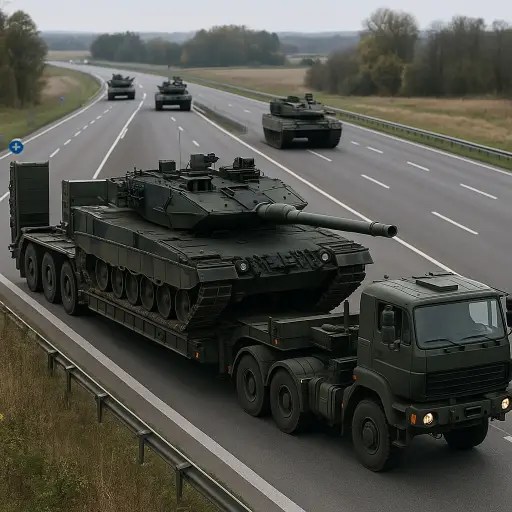
Brussels moves to designate continent‑spanning logistics corridors that would rush heavy armor east if tensions with Russia boil over
The mood in Brussels has shifted. What began as a series of technical workshops about bridges, axle loads, rail clearances and border paperwork has morphed into a political project with unmistakable intent: make the European mainland traversable for heavy armor at a moment’s notice. Officials call it “military mobility.” Inside ministries it is spoken of more plainly as a war‑highway— a web of priority routes that would carry tanks, self‑propelled guns, fuel trains and spare parts from the industrial heart of the continent to the exposed frontier in the east.
The European Commission is preparing a proposal that, if adopted by member states, would stamp selected roads, rail lines, river crossings and ferry links as designated corridors for the movement of large formations in a crisis. The map under discussion links ports and depots in the west with assembly areas near the Baltic and Black Sea regions, threading through the low countries, the German plain and the central European highlands before fanning out toward Poland, the Baltics and the Danube basin.
This is not the first time Europe has talked about mobility. In the years after the Cold War, the subject faded as allies focused on peacekeeping and counterinsurgency far from home. Freight rail privatized, toll roads proliferated, border checks reappeared in fits and starts, and defense planners lost influence over civil engineering. The war in Ukraine— grinding, attritional and close— revived a forgotten truth: tanks matter less if they cannot reach the fight. The new plan tries to correct that, not by militarizing every kilometer of asphalt and track, but by designating arteries, hardening weak points and clearing bureaucratic thickets before a crisis erupts.
At the heart of the concept is a simple promise: when the alarm sounds, convoys should be able to depart within hours, pass borders without waiting for stamps, and roll over bridges and through tunnels without detours or last‑minute inspections. To make that promise real, the corridors combine three layers. The first is legal. Pre‑approved permissions would allow oversized columns, hazardous cargo and night movements to cross jurisdictions without custom waivers. The second is physical. Bridges are surveyed and strengthened, tunnels assessed for clearance, loading ramps added to rail yards, and turnouts lengthened so that flatcars carrying armored vehicles can be assembled quickly. The third is digital. A shared picture of capacity— axle limits, work sites, traffic, rail pathing— would let commanders and transport ministers adjust in real time.
None of this is glamorous. The work list reads like the diary of a civil engineer: replace bearings on an aging viaduct; add a lay‑by near a motorway interchange so a column can stage; dredge a riverside berth so a heavy‑lift barge can dock; wire a customs gate to a joint database. Yet each fix removes a friction point that, in aggregate, decides whether reinforcements arrive before a crisis crests or after it has hardened into tragedy.
The political case rests on deterrence. Eastern capitals have insisted for years that intent without mobility does not deter. If allies can only pledge solidarity while their armor idles behind paperwork or diverts around a weak bridge, an adversary can gamble on speed. A credible corridor system shortens that window. It signals that reinforcements can appear not at leisure but on a schedule measured in briefings rather than seasons. That message is aimed as much at Europe’s own publics as it is at Moscow: the continent is taking logistics seriously again.
Skeptics see risks. They warn that branding infrastructure as a war‑highway could be read as escalatory, inviting retaliation in the gray zone. A bridge that is publicly known as a strategic crossing becomes an obvious target for cyber mischief, sabotage or disinformation. Others worry about cost and disruption. Freight companies bridle at the prospect of priority slots that bump commercial trains; local leaders balk at nighttime convoys thundering past towns; environmental groups raise alarms about noise corridors cutting across protected areas. The Commission’s answer is a blend of money, routing discipline and transparency: fund upgrades through existing transport envelopes, push the heaviest flows onto rail where possible, and publish environmental mitigation alongside military requirements.
There is also the question of sovereignty. Roads and rails are national assets. Defense planning straddles the European Union and NATO, sometimes harmoniously, sometimes not. To avoid turf wars, the corridor project is being designed to overlay, not overwrite. Routes are chosen with national transport ministries, then synced with NATO’s logistics command. Exercise schedules are matched so that a multinational drill can serve double duty: training soldiers while also testing a segment of the network under realistic load. When a gap appears— a bridge with insufficient strength, a customs gate that still requires a paper stamp— it is added to a shared dashboard rather than buried in an after‑action binder.
Industry is watching closely. For rail operators, the plan could mean steady orders for heavy flatcars and locomotives with the torque to pull them through gradients. For road builders, it means contracts to shore up overpasses and widen shoulders at key junctions. For ports, it promises investment in roll‑on/roll‑off ramps, marshalling yards and secure fuel storage. The Commission’s pitch is that these are dual‑use upgrades. A bridge strengthened for a tank column is also a bridge that can carry modern freight safely; a rail yard that can load armor quickly can also speed intermodal cargo; a customs gate tuned for emergency throughput should also reduce delays during holiday surges.
Still, logistics is never only about steel and concrete. It is also about rhythm and rehearsal. The corridors will not earn trust until convoys of real vehicles— tracked and wheeled— pass along them in multinational exercises. That means booking rail paths months in advance, coordinating with police, and warning citizens along the routes that a night of rumble is coming with a purpose. In the past, such movements too often arrived as a surprise to communities, feeding rumors and resistance. Officials say they will do better this time: earlier notices, tight time windows, and, where possible, moving the noisiest segments onto steel wheels rather than rubber tires.
Security planners emphasize resilience. A corridor system is only as strong as its alternatives. River ferries and coastal links are being knitted into the plan so that a blocked tunnel does not freeze an entire axis. Fuel and spare parts will be pre‑positioned at multiple depots rather than stacked in a single vulnerable site. Cyber ranges are testing the rail signaling and traffic‑management systems that shepherd trains and convoys, probing for weaknesses that could cause cascading delays. Even mundane questions— where do drivers rest, who tows a broken tank transporter, which roadside station can dispense large volumes of diesel without draining civilian supply— are being logged and answered in advance.
Diplomatically, the corridors occupy a careful middle ground. They are a European Union initiative, yet they lean on NATO doctrine and standards. They respect national command of forces, yet they assume a level of cross‑border trust that, not long ago, felt aspirational. They are defensive by design, yet they project a kind of quiet resolve. The point is not to race toward the frontiers, planners say, but to make sure that if racing ever becomes necessary, the road is ready.
The public, for now, will mostly see ordinary worksites: a crane swapping segments on a bridge, a new slab poured at a rail siding, a noise barrier rising along a motorway. The label attached to these scenes— war‑highway— is bound to stir emotions. But strip away the rhetoric and the project comes down to an old European craft: building connections that hold under stress. In an era when lines on the map are being tested, keeping the arteries open becomes an act of insurance.
As early November unfolds, officials insist the corridors are not a provocation but a precaution. They argue that clarity about movement reduces miscalculation and that hardened infrastructure shortens crises rather than deepens them. Europe, in short, is trying to buy time— the most precious commodity in any emergency— with concrete, rails, code and signatures prepared in peacetime. Whether that investment pays off will be judged not on a parade ground, but in whether the routes never have to be used at their full design load.
For now, the work continues: survey teams under gray skies ticking off bearings and joints; transport planners threading timetables so freight and armor can coexist; diplomats aligning texts so national pride and collective need point the same way. The war‑highway is not a ribbon of new asphalt. It is a promise that the continent will not be caught immobile. And it is a reminder that in Europe, the distance between safety and danger can be measured less in miles than in minutes— and in whether the road ahead has been cleared in time.

 The Tower Post