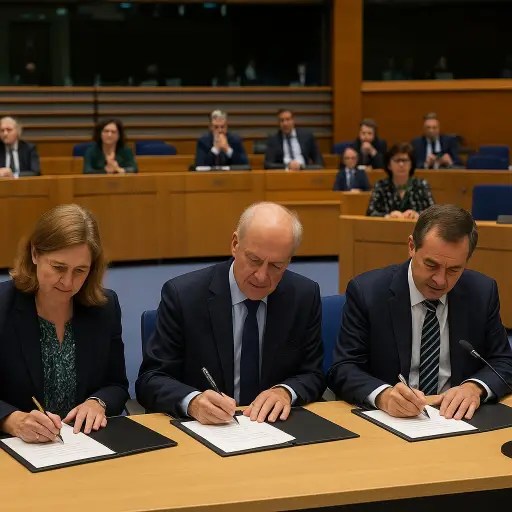
Four major political groups in the European Parliament issue a joint ultimatum to Ursula von der Leyen’s European Commission over the proposed 2028‑34 Multiannual Financial Framework.
A dramatic turn in the ongoing budget negotiations of the European Union: four of the largest political groupings in the European Parliament have fired off a pointed letter to Commission President Ursula von der Leyen, signalling they will not accept the current draft of the long‑term budget unless significant amendments are made.
The Commission last summer presented its proposal for the next Multi‑annual Financial Framework (MFF) 2028‑2034, pegged at nearly €2 trillion, laying out a sweeping agenda built around greater flexibility, strategic autonomy, industrial competitiveness, cohesion, and a restructured own‑resources system.
However, the strong response now from the Parliament signals that the draft is far from being a smooth sailing to adoption. The letter, co‑signed by the group leaders of the European People’s Party (EPP), the Progressive Alliance of Socialists and Democrats (S&D), Renew Europe and the Greens/European Free Alliance (Greens/EFA) calls on the Commission to revise key elements of the proposal, declaring bluntly: “The Parliament cannot accept this as a basis to start negotiations.”
What’s at the heart of the confrontation?
At issue are multiple layers of contention:
Ambition vs. reality
While the Commission’s draft emphasises a stronger, more resilient Europe capable of responding to geopolitical shocks, investing in defence, and boosting green and digital transition, the Parliament’s letter argues that the document falls short of delivering the necessary impetus. The Parliament demands clearer safeguards on cohesion, fairness between regions, transparency in funding and a stronger role for Parliament in monitoring execution.
New revenues and fiscal pressures
The draft MFF anticipates significant new own‑resources (such as carbon border taxes, e‑waste levies, and corporate contributions) in order to avoid increasing national contributions. But some Members of Parliament view the revenue proposals as opaque or too reliant on uncertain streams, raising questions about fairness and national fiscal implications during a period of economic strain. The letter underscores the need for clearer, predictable and equitable funding mechanisms.
Parliament’s role and political leverage
By uniting the EPP, S&D, Renew and Greens/EFA groups, the Parliament has effectively declared it will block progress unless its red‑lines are met. Given that its consent is required for final adoption of the MFF, this is a strong sign of institutional push‑back against the Commission’s assumed dominance in setting the agenda. It reflects growing institutional assertiveness.
Why now?
The timing is telling. The Commission’s proposal was published in mid‑July, setting out the framework for the period 2028‑34. Over the past months, national governments, member‑state finance ministries and regional stakeholders have voiced concerns and reservations. The Parliament’s intervention now helps shift the debate from behind‑the‑scenes negotiation to a more public and potentially fractious phase.
The coalition of four parliamentary groups — notably including groups that usually cooperate with the Commission — indicates the depth of dissatisfaction. It is not simply opposition from fringe parties, but a mainstream challenge. The letter from S&D, for example, had already publicly flagged issues with key political elements of the proposal.
What happens next?
The coming weeks will likely see intensified negotiations. Key dynamics to watch:
- Amendment demands: The Parliament will expect the Commission to table revised proposals addressing its demands — potentially reducing budget size, reallocating funds, increasing cohesion/regional funding, or enhancing oversight.
- Member‑state negotiations: Even if the Parliament and Commission move closer, national governments still must agree by unanimity on the MFF through the Council. The interplay between capitals, Commission and Parliament adds complexity.
- Timeline and risk: The push‑back introduces risk of delays. The longer the impasse, the greater the uncertainty for programmes, regions and beneficiaries across Europe.
- Institutional precedent: If the Parliament succeeds in reshaping the draft, it reinforces its role in EU budgetary governance and may signal a shift in the power balance between Commission, Parliament and member states.
Stakes for Europe
Why does this matter? The next long‑term budget is meant to underpin the EU’s strategic agenda — climate transition, digital competitiveness, defence, cohesion, mobility and social inclusion. A mis‑aligned budget could weaken one or more of those pillars. Conversely, a robust budget is often heralded as the bedrock for Europe’s ambition to act with strength, unity and autonomy.
Moreover, for regions and sectors depending on EU funding, the outcome will shape long‑term investment flows. Delays or major reallocation could disrupt planning for agriculture, cohesion, research, defence, migration, public health and external action.
Conclusion
The European Parliament’s revolt against the Commission’s near‑€2 trillion budget proposal signals a turning point in the EU’s internal dynamics. The Commission may still control the drafting, but the Parliament is reminding Brussels that its consent matters — and that it will wield that power. With member states still to be aligned, the clock is ticking and the politics are heating up.
As negotiations progress, it will be essential to watch whether the Commission offers meaningful adjustments, whether the Parliament holds firm, and whether the member states sign on. The outcome will not only shape Europe’s finances for the next seven years but may also recalibrate the institutional balance of power in the EU.


 The Tower Post