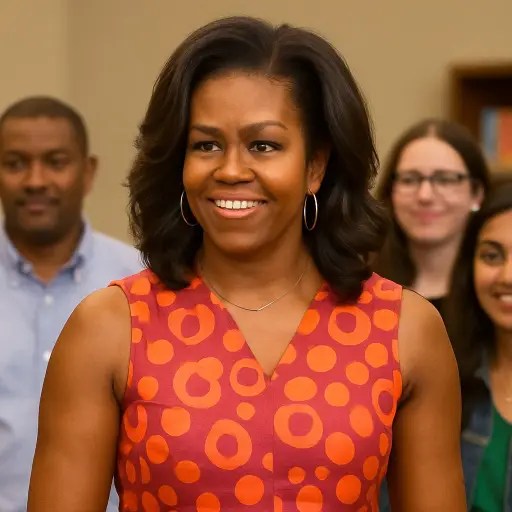
How the former First Lady used wardrobe choices to amplify diversity, representation and empowerment — and now unpacks the story in her new book The Look
On this crisp early November morning, as the leaves fall and the fabric of public life shifts, Michelle Obama offers a renewed perspective on what she once called her “wardrobe of purpose.” In a recent wide‑ranging interview to promote her new book, The Look, she reflects not only on dresses and suits but on how, during her eight years as First Lady, the very act of getting dressed became a means of communicating much deeper truths about identity, inclusion and belonging.
From the moment she entered the national spotlight, Michelle Obama was aware of the scrutiny. “During our family’s time in the White House, the way I looked was constantly being dissected—what I wore, how my hair was styled,” she writes in The Look. That awareness, far from paralysing her, became a springboard: a way to transform clothes from silent background into active message.
Fashion with a purpose
What distinguishes Michelle Obama’s style legacy is not simply aesthetic flair but the intentionality behind each outfit. Prior coverage of her period in the White House underlined how she drew on a palette of designers, colour choices and silhouettes to subtly reflect values of empowerment.
In the new book, she explains how every visit, every state‐dinner, every classroom tour offered a choice: What do I want this look to say? To whom am I signaling? Which shoulders am I raising up, which histories am I honouring, which future faces am I including? Selecting a dress by a young Black designer wasn’t only about supporting talent — it was about visibility. Choosing bold colour, accessible labels or mixing high/low pieces was a way to say: this is for everyone.
Representation in every seam
Michelle Obama repeatedly highlights how representation matters — not just abstractly but viscerally. She notes that seeing someone who looks like you or someone whose story mirrors yours wearing something powerful can shift what you believe is possible. Through fashion she told stories of motherhood, of urban Black womanhood, of Midwestern roots, of academic ambition, of public service, of grace under pressure. In The Look, she writes: “This book is about more than fashion. It’s about confidence. It’s about identity. It’s about the power of authenticity.”
One anecdote stands out: early in her tenure, she wore a sleeveless dress for her official portrait, prompting commentary on her arms rather than the message of the photograph. She turned that distraction into reflection — about who is allowed what form, how dress codes impose on bodies, and how dress can become an act of self‑assertion.
Fashion as inclusion, not exclusion
What is often forgotten in the stylised photo‑ops is that Michelle Obama also used more casual, unexpected wardrobe moments to reinforce her message: mixing labels, wearing denim, choosing accessible and relatable pieces — thereby dismantling the idea that powerful style is exclusive or elite.
By doing this, she opened space for more inclusive imagery of what leadership looks like. Not just in tailcoats and gowns, but in confidence and representation. In the interview, she emphasises that she always asked: “Am I speaking to the people who rarely feel spoken to?” Her wardrobe became one thread in a broader fabric of inclusion.
The book and the moment
The Look arrives just as public conversations intensify around diversity, representation, and visual culture. Published by Crown Publishing Group and conceived as a richly illustrated visual narrative, the book features more than 200 photographs, many previously unpublished, traversing her journey from the South Side of Chicago to the White House and beyond. Michelle says she felt that at this stage in life she had the freedom to reflect and reinterpret: to reclaim her story rather than simply be framed by the gaze of others.
For readers, the book functions on many levels: a fashion chronicle, a memoir of visual identity, a blueprint for using style as voice, an archive of cultural signalling. But at its heart it’s a statement of inclusion—of who gets to dress, who gets to be seen, and how clothes can amplify message.
Why this matters now
In November 2025, with the world grappling with issues of representation in politics, media, business and culture, Michelle Obama’s fashion narrative offers a timely case study. It reminds us that inclusion isn’t only about who sits at the table, but also about who shows up, how they show up, and what their presence conveys. In an era of hyper‑visual politics and social media aesthetics, wardrobe becomes more than decoration—it becomes diplomacy.
And as this interview brings out, the lesson extends beyond the red carpet. For anyone who ever wondered if dress matters, Michelle’s journey says: yes — but only if what you wear is aligned with why you wear it; only if you bring intentionality; only if you wear it for the people whose stories you want highlighted.
In her own words
During the interview, Michelle Obama reflected: “When you step into a space, your clothes can either mute you or make you visible. I chose visibility. I chose that I wanted young girls, girls of colour, working‑class girls, immigrant girls, all the girls who never thought of someone like me at the podium — I wanted them to see possibility.” That line, she says, guided even the smallest outfit decisions.
As The Look reaches shelves, it invites readers not just to admire the fabrics and silhouettes, but to interpret the messages. To ask: what story does this outfit tell? Who is it for? What conversation does it open?
For Michelle Obama, fashion wasn’t the point — empowerment was. Representation wasn’t the point — belonging was. And now, as she walks us through the pages of her style journey, she hands us the tools to do the same in our own lives.

 The Tower Post