
Online‑only fast‑fashion brand makes its first permanent
physical store debut at Paris’s historic BHV — and the U.S. trade is
watching.
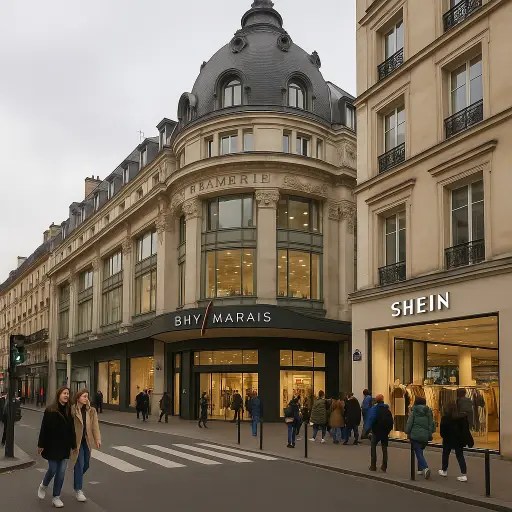
Paris – A major shift in the global retail landscape is unfolding this
week as Shein, the Chinese‐founded ultra‑fast‑fashion giant formerly
known for its purely digital business model, prepares to open its first
permanent bricks‑and‑mortar store — and not just anywhere: in central
Paris. The move, scheduled for early November at Bazar de l’Hôtel de
Ville (BHV) (commonly known as BHV Marais), signals a strategic pivot
for the brand — and is being closely watched by American fashion
retailers and analysts alike.
While Shein has run pop‑up stores and experiential outposts in prior
years, this inauguration marks its first worldwide permanent store,
positioning the brand in physical retail for the long term. For U.S.
fashion trade watchers, the opening invites questions: What does this
mean for the online‑only playbook? Could physical retail become a
strategic advantage again, even for ultra‑fast fashion brands? And how
might consumers respond?
A strategic leap into physical space Up to now, Shein has built its
business on lightning‑fast online operations, trend‑driven
micro‑collections, and social‑media‑fueled demand cycles. But the Paris
store marks a distinct turn: the brand is investing in real estate, in
space, in on‑floor merchandising. As reported, the store will occupy the
sixth floor of BHV Marais, offering “thousands” of items at low price
points in a circa 1,000 m² space. The timing is strategic: the
department store ecosystem in Europe, and particularly in France, has
been under pressure from online competition and changing consumer
behaviour. By placing itself inside a historic Parisian retail landmark,
Shein gains visibility, local legitimacy, and experiential access to
walk‑in consumers. From the perspective of U.S. retailers, the move
suggests that even digital natives see value in engaging customers
offline — perhaps as a way to lock in brand loyalty, reduce returns or
broaden storefront impact beyond screens.
Why the U.S. fashion trade is watching 1. Reinventing the physical
footprint: Many U.S. brands have scaled back physical stores in favour
of online focus. Shein’s move could signal a reversal or an alternative
path: physical presence not to replicate traditional mall play, but to
serve as a brand beacon. U.S. retail watchers will ask: could Shein’s
model scale beyond Paris? Could U.S. theatrics follow? 2. Supply‑chain
implications: Shein’s ultra‑fast production and distribution engine has
largely operated in online mode. A physical store introduces variables:
inventory management, returns, in‑store experience. U.S.
brands—particularly fast‑fashion competitors—may scrutinise the
logistics and economics of the pivot. 3. Consumer dynamics: In the U.S.,
fast‑fashion consumption is already well‑established. But how will the
offline store perform — will in‑store upgrades attract new demographics,
or will it cannibalise the online business? U.S. trade publications and
executives will monitor whether the store generates incremental growth
or simply serves as a marketing vehicle. 4. Regulatory and reputational
context: Shein has faced regulatory scrutiny in Europe over
environmental, labour and data concerns. U.S. retailers, mindful of
sustainability and brand image risk, will observe how Shein navigates
that terrain in a physical world.
Local resistance and broader tensions The Paris opening is far from
uncontested. Local brands, labour groups, and municipalities in France
have raised alarms. They see Shein’s ultra‑fast‑fashion model as
antithetical to the city’s tradition of quality craftsmanship and
sustainable commerce. In particular, BHV’s partnership with Shein has
triggered walk‑outs and brand withdrawals from suppliers. Several French
labels have publicly distanced themselves from the move. For U.S.
brands, the debate raises a flag: how will brand‑building,
responsibility and regulatory exposure interplay when a fast‑fashion
digital brand enters physical retail en masse?
What’s next — and what to track With the Paris store scheduled for early
November, industry observers will be closely watching key indicators: –
Footfall and conversion: Will the store attract not just digital natives
but local Parisian shoppers unfamiliar with Shein? – Product mix and
pricing: Does the in‑store assortment mirror the online offering, or
will it differ significantly? – Returns and sustainability: How will the
return rate compare to online? Will the in‑store model allow for more
efficient reuse or resale? – Scaling strategy: The French rollout
already includes further planned openings in five regional department
stores via BHV’s parent company Société des Grands Magasins (SGM). U.S.
trade will ask: will this testing ground lead to a U.S. presence or
influence competitor strategy in America?
The retail moment in context This move by Shein taps into a wider trend:
the boundaries between online and offline retail are increasingly
blurred. Digital brands are experimenting with stores (showrooms,
pick‑up hubs, brand flagships) and physical retailers are doubling down
on experience and brand‑identity. Shein’s entry into Paris comes at a
time when many retailers in the U.S. and Europe are rethinking the role
of the store — not just for transactions, but as brand theatres.
Given Shein’s scale, speed and global ambition, its Paris experiment may
well become a case study in digital‑native brands going physical. For
U.S. fast‑fashion rivals, legacy mid‑market retailers and even luxury
players, the implications could be significant: if Shein succeeds, it
may prompt re‑evaluations of physical‑store utility, brand presence, and
omnichannel integration.
Final thoughts As the calendar approaches early November, the opening of
Shein’s Paris store may appear modest in square metres—but symbolically
it is huge. It signals the online giant’s belief that physical retail
still has a role in a hyper‑connected world. For U.S. fashion watchers,
this is more than a European footnote: it is a strategic test, a market
disruption and possibly a harbinger of how even the leanest digital
brands will engage real‑world consumers.
The catch? Shein must navigate local resistance, regulatory headwinds
and the complexity of in‑store operations, all while maintaining its
fast‑fashion cost and speed advantage. If it pulls it off, the ripple
effects across the trans‑Atlantic fashion industry could be felt soon.




 The Tower Post