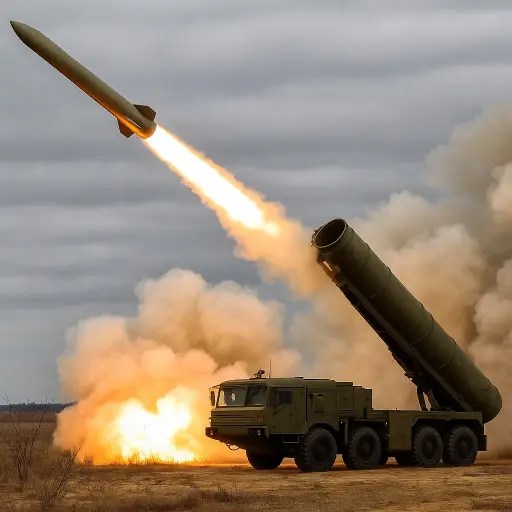
The deployment of the missile that ended the INF Treaty raises alarm as it enters the Ukraine war for the first time
The reported deployment of the Russian ground‑launched cruise missile 9M729 cruise missile (NATO designation SSC‑8) in combat operations against Ukraine has reignited global concerns about arms‑control breakdowns, treaty violations and Europe’s strategic vulnerability. According to Ukrainian officials and Western analysts, Moscow has fired at least 23 missiles of this type since August 2025 — a first known combat use of a missile at the centre of the crisis that collapsed the Intermediate‑Range Nuclear Forces Treaty (INF Treaty).
From treaty dispute to battlefield
The 9M729 missile has been controversial for years. Developed by the Russian company NPO Novator, it is a land‑based cruise missile which the United States and NATO long argued exceeded the INF Treaty’s range limits (500 km minimum for prohibited systems).
Russia denied the claims, maintaining the missile’s range was below the ban threshold. But in 2019 the U.S., backed by NATO, concluded that Russia was in violation of the treaty and formally withdrew.
Now Ukraine’s government says Russia has moved the missile from the category of strategic arms‑control question into active use. A higher‑level Ukrainian official said the missile was “the same weapon that triggered the collapse of the INF Treaty.”
Operational impact and strategic alarm
According to Ukrainian sources, one of the missiles launched on 5 October reportedly flew over 1,200 km. Analysts say that puts the weapon into the intermediate‑range category of concern and means it can threaten much deeper into European territory than typical battlefield missiles. Western open‑source assessments and the CSIS Missile Threat project estimate its potential range at up to 2,500 km depending on payload.
Such range combined with mobility (on transporter‑erector‑launcher vehicles), terrain‑hugging cruise flight profile and dual conventional or nuclear capability make the missile a difficult target for air‑defences and a troubling addition to the war in Ukraine. Ukraine argues that its air defence network must now extend farther from the front and cover threats launched from deep inside Russia or Russian‑occupied territory.
Treaty regime under pressure
The use of the 9M729 in Ukraine marks a symbolic and practical departure from the era when the INF Treaty constrained a class of weapons for three decades. The 1987 treaty had required the United States and the Soviet Union (later Russia) to eliminate all ground‑launched ballistic and cruise missiles with ranges between 500 and 5,500 km and their launchers.
By deploying the missile it once claimed was treaty‑compliant, Russia sends a signal that it no longer considers itself bound by those earlier limits. Indeed, Moscow formally declared in 2025 that it would no longer abide by its self‑imposed moratorium on intermediate‑range missiles.
For NATO and the U.S., the move poses a stark question: without treaty constraints, how will Europe respond to a class of missiles that can fly from Russian territory into allied states without warning, potentially with nuclear payloads?
Repercussions for the Ukraine war and beyond
For Ukraine, the 9M729’s use complicates the balance of fire‑power and air‑defence. Kyiv has asked Western partners for longer‑range cruise missiles (for example, sea‑ or air‑launched American Tomahawks or European equivalents) to hold Russian launch sites at risk. Without deploying such capabilities, Ukraine argues, Russia can attack from deep inside its territory with longer reaction times thrown off by lower‑flying, terrain‑hugging profiles.
From a broader strategic viewpoint, the deployment may trigger an arms‑race dynamic. Once narrowly regulated arms classes are introduced into active European battlefields, other states may respond with comparable or asymmetric capabilities—accelerating instability. Some analysts say Europe may now need to rebuild intermediate‑range deterrence and re‑invest in air and missile defence layers.
Russian perspective and denial
Moscow has maintained that the 9M729 is compliant and that Western claims of range violations were unfounded. A statement from the Kremlin spokesman noted that Russian officials “refuted all claims very convincingly” and emphasised that questions about specific weapons should be addressed to the Ministry of Defence.
From Moscow’s point of view, the erosion of the INF regime and the deployment of intermediate‑range systems by the U.S. and NATO in Europe have justified a reciprocal posture. Russia contends that Western missile defences and forward deployments near its borders have created “destabilising missile potentials” and that the self‑imposed moratorium is no longer viable.
Policy choices ahead
The deployment of the 9M729 in Ukraine raises several decision‑points:
- For Ukraine and its allies: Is there a pressing need to supply extra long‑range strike weapons, to allow Ukraine to retaliate or pre‑empt Russian launchers at depth? If so, what are the risks of escalation?
- For NATO/Europe: Can air‑ and missile‑defence systems adapt to terrain‑hugging, long‑range cruise missiles launched from Russian territory? Should intermediate‑range weapons be redeployed by Allies to signal deterrence?
- For arms‑control regimes: Is a new treaty framework feasible? Or has the technical and political environment changed so much that resolution will require new, multilateral arrangements covering more states and missile types?
- For Russia: Does combat use of the 9M729 signal a threshold shift (from deterrence to battlefield employment) of such missiles? How will adversaries interpret this: as a tactical weapon or a strategic one?
Conclusion
The reported combat deployment of the 9M729 cruise missile marks a pivotal moment in modern arms control and warfare. A weapon once the focus of treaty debate is now entering the war in Ukraine, erasing the boundary between strategic arms‑control rhetoric and tactical battlefield reality. With Europe’s missile defences and deterrence architecture under strain, the future of intermediate‑range warfare appears to be resurfacing — loudly and contemporaneously.
As of November 2025, the implications remain unfolding: for Ukraine’s survival, for European security, and for the future of arms‑control. The question now is less whether the rules have changed, and more whether the institutions and alliances are ready to adapt.




 The Tower Post