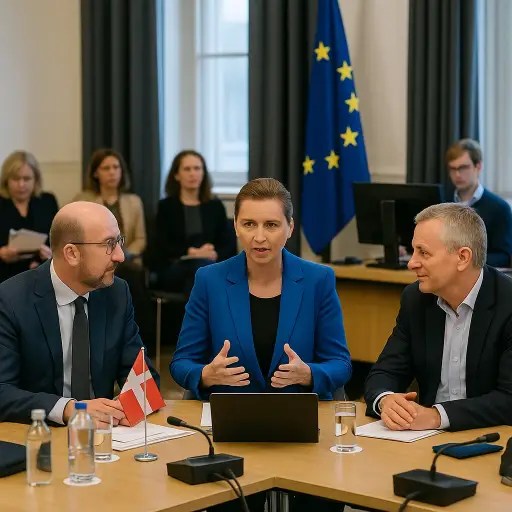
Under the Danish Presidency, Europe’s culture and media ministers gather to pledge support for Ukraine’s cultural heritage and defend media integrity in an age of democratic disruption
In the heart of Copenhagen, ministers responsible for culture and media from across Europe assemble at an informal meeting hosted under the Council of the European Union’s Danish Presidency. Over two days this week, their discussions spotlight two critical pillars of democratic life: the safeguarding of cultural heritage in the war‑torn landscapes of Ukraine, and the resilience of independent media across the European Union.
The backdrop could not be more pressing. With Ukraine’s cultural monuments battered by conflict and European democracies facing growing threats from disinformation and foreign‑influence campaigns, the ministers aim to translate shared concerns into joint policy commitments and concrete action. Under the Danish flag, the meeting takes on a symbolic dimension: culture, media and identity are being framed not as mere sectors, but as frontline defences.
Culture in Crisis, Heritage at Risk
Day one in Copenhagen places the restoration of cultural heritage in Ukraine centre‑stage. Ministers will discuss how bombs, missile strikes and collateral damage over recent years have destroyed historic sites, archives and cultural institutions — not only shattering physical monuments but eroding pieces of national identity. In that context, the agenda moves beyond mere rebuilding: it explores how culture can serve as infrastructure for recovery, social cohesion and rebuilding democracies.
One senior minister put the urgency in stark terms: “When a city’s theatre, museum or library lies in ruins, it isn’t just a building gone — the memory and self‑understanding of a society are under attack.” The gathering intends to launch a framework for EU‑wide cultural support to Ukraine, aligning funding, expertise and heritage‑protection mechanisms. At the same time, the ministers will explore ways to integrate Ukrainian cultural restoration into broader regional recovery strategies, linking physical repair with symbolic renewal.
Free Media, Free Democracy
On the second day, attention shifts to the integrity of media in EU democracies. Independent journalism, newsroom safety, digital literacy, transparency and foreign‑influence defences all figure on the agenda. European ministers recognise that, in a world of deepfakes, platform‑algorithm power and state‑sponsored disinformation, media ecosystems can be as threatened as historic monuments.
The Danish Presidency has indicated that a joint ministerial declaration is in the works — one that would affirm the essential role of culture and media as twin bulwarks for democracy. A statement circulated ahead of the meeting notes that “the right to know, the right to remember and the right to create” are interconnected. Such a formulation links heritage and media under a broader concept: democratic resilience.
Why This Matters Now
With the war in Ukraine still ongoing and Europe’s strategic environment in flux, the timing of the meeting is significant. The ministers are responding both to the immediate damage inflicted by war and to the longer‑term erosion of democratic norms. These twin challenges — of rebuilding culture and defending information ecosystems — aren’t separate but entwined.
In practical terms: a Ukrainian museum being restored today may serve as a venue for media literacy programmes tomorrow. A newsroom protected by new transparency rules will cover reconstruction efforts more credibly, helping citizens make sense of complex recovery narratives. In Copenhagen, ministers hope to forge those links.
What to Watch
- The text of the ministerial declaration: Will it include binding commitments or stronger monitoring mechanisms for media freedom and heritage restoration?
- Funding trajectories: Which member states will step up resources, and will the EU allocate new instruments aimed explicitly at culture‑and‑media resilience?
- Follow‑through mechanisms: Will the ministers establish a working group, a permanent forum or an annual check‑in to maintain momentum?
- Ukraine’s role in the process: Beyond being a focus of aid, will Ukrainian cultural actors and media‑sector stakeholders be integrated in partnership, not simply as recipients?
- Linkages to other policy areas: For example, how will heritage restoration tie into climate‑adaptation concerns or how will media integrity tie into platform regulation and digital policy?
A Broader Vision of Resilience
This Copenhagen gathering implicitly recognises that building resilient democracies requires more than surface‑level security measures. It demands attention to identity, memory, narrative, shared values and an informed public. Culture matters: a theatre, a library, a reconstructed church are more than bricks and mortar. They’re anchors of a society’s sense of self. Media matters: an independent radio station or robust digital outlet is more than a business model. It’s a conduit of truth, accountability and community.
For Europe, the meeting signals that recovery is not simply about roads and pipelines, but about stories, symbols, citizens and rights. For Ukraine, it offers a moment of solidarity and tangible support. For democracies facing new turbulence, it is a reminder that resilience is as much about culture and media as it is about defence and diplomacy. The two days in Copenhagen may not change everything overnight — but if the right frameworks emerge, they could mark an important step toward preserving Europe’s democratic architecture.

 The Tower Post