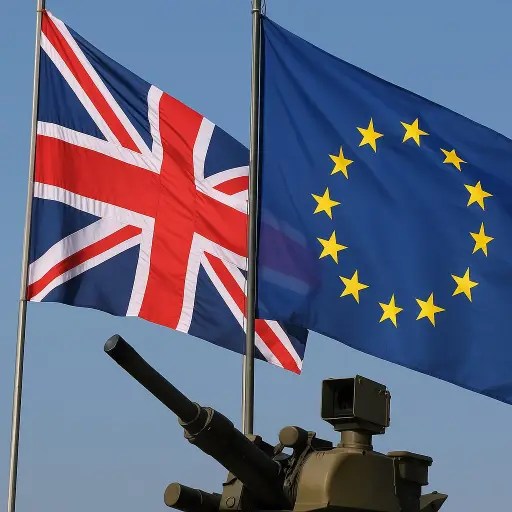
A strategic opening for the UK to plug its post‑Brexit defence gap via the European Defence Fund
As the calendar turns to early November 2025, the United Kingdom is on the cusp of securing a breakthrough in its defence partnership with the European Union that could narrow a critical strategic divide left by Brexit. Officials from London and Brussels are reportedly finalising a deal by mid‑November that would pave the way for British firms and defence institutions to gain access to the European Defence Agency‑mandated collaborative schemes — specifically the European Defence Fund (EDF) and related procurement pools that the EU established to boost its defence‑industrial base.
A Reset in the Defence Relationship
Since its departure from the EU, the UK has relied on bilateral and NATO‑centric arrangements for its defence industrial policy. However, the UK’s exclusion from EU defence procurement mechanisms has long been regarded by strategic analysts as a gap in its post‑Brexit security posture.
In recent months, the UK and EU have signalled the need for a recalibrated relationship. At their summit earlier this year in London, both sides signed a security and defence partnership that laid much of the groundwork for deeper access to EU programmes.
The core of the breakthrough is that UK defence firms could soon be eligible to join consortiums bidding for EDF‑funded research & development and capability‑building projects — but under specific terms still being hashed out.
Why This Matters Strategically
For the UK, association with the European Defence Fund offers multiple advantages:
- access to multi‑national collaborative R&D projects which reduce costs and boost interoperability across Europe;
- a chance to strengthen UK firms’ export pipelines into wider European supply‑chains;
- a signal that the UK continues to be a meaningful actor in European defence even after Brexit.
For the EU, welcoming the UK capitalises on London’s defence industrial base and military capacity, aiding its aim to bolster Europe’s “strategic autonomy” amid growing global competition and supply‑chain vulnerabilities.
The Missing Pieces: Investment, Access and Oversight
While the broad deal is in place, the final details remain to be finalised. According to Brussels via think‑tank analysis, the UK’s full participation will likely require:
- a formal association agreement (mirroring models used for Norway or other non‑EU states) enabling UK firms to lead or co‑lead EDF projects.
- a defined financial contribution by the UK towards the fund or programme overheads — the UK will not access such schemes on a purely gratis basis.
- governance and industrial safeguards ensuring that UK‑based activities respect EU rules on procurement, state aid and sensitive technologies.
In particular, current UK access is still partial: UK entities can participate in collaborative projects supported by the EDF only if they waive funding and participate on non‑preferred terms, in effect limiting their full entry.
Countdown to Mid‑November
With both London and Brussels signalling their intention to wrap up the outstanding technical negotiation steps over the coming weeks, many believe that a formal UK association to the EDF could be announced imminently. Reports indicate that a roadmap for accession was expected “in a matter of weeks” back in spring.
Should the deal be signed by mid‑November, UK defence firms could start preparing bids for the 2026 EDF cycle, and the UK could officially join European defence‑tech consortia alongside member‑states.
Implications for Defence Industry & Policy
- UK industry: Firms like those in aerospace, naval systems, advanced sensors and cyber‑defence could benefit from cross‑border funding, joint bids and shared programmes.
- UK government policy: The deal offers a strategic win for the government — a tangible sign that Britain remains engaged in European defence architecture without re‑joining the single market or customs union.
- EU policy: Incorporating the UK may enhance the pool of expertise and capacity available for EU joint capability development, but it also raises questions about how much industrial preferential treatment (if any) will be granted to UK firms relative to EU firms.
- Geopolitical messaging: The announcement would send a strong message of trans‑Atlantic and European unity in the face of Russia’s aggression in Ukraine and rising Sino‑US strategic competition.
Challenges Ahead
Despite the positive momentum, several obstacles remain:
- Some EU member‑states, particularly France, have pushed for caps or restrictions on non‑EU firms’ participation in major defence procurement, which could affect UK access terms.
- UK defence firms may still face competitive hurdles in EU‑led consortia, given rules on origin, funding eligibility and lead‑partner status.
- The broader UK‑EU relationship remains influenced by disputes over other policy areas (trade, fisheries, migration) which could still cast a shadow over the defence deal.
- Implementation and oversight of the association agreement will require both sides to align on security of information, export controls and industrial‑base integrity. The UK‑EU joint framework emphasises this point.
Looking Forward
If indeed the UK joins the European Defence Fund by mid‑November, this marks a significant milestone in post‑Brexit UK‑EU relations and Europe’s defence architecture. For the UK, it is a pragmatic way of bridging the strategic gap left by Brexit in a rapidly polarising security environment. For the EU, it is an opportunity to deepen industrial cooperation while retaining defence independence.
In the weeks ahead, attention will focus on the financing model (how much the UK will pay), the industrial‑access rights (will UK firms lead bids or remain partners), and the governance safeguards (how the UK aligns with EU procurement, oversight and technology rules).
Meanwhile, defence‑industry analysts and the media will be watching the first wave of tenders under the EDF framework and whether British firms are indeed eligible. If all goes as planned, the association will begin to yield practical collaborations in 2026 and beyond.
For now, what is clear is that the reset of UK‑EU defence relations is no longer just symbolic — it is entering a practical phase. And with the expected announcement by mid‑November, the UK may finally plug one of its enduring post‑Brexit strategic gaps.




 The Tower Post