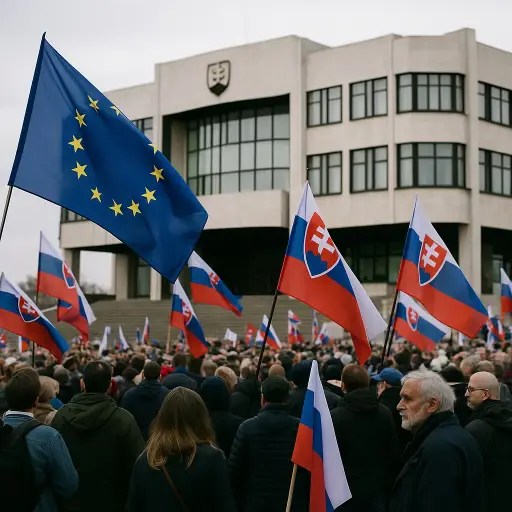
With renewed alarm from the Renew Europe group and the European Commission, Brussels faces a fraught week as the Slovak Republic’s government pushes reforms seen as undermining independent media and judicial safeguards — stoking tensions ahead of key EU agenda items.

As the week of 3–7 November begins, the European Union finds itself under pressure to respond forcefully to mounting concerns over deteriorating rule‑of‑law standards in Slovakia. At the heart of the scrutiny lies the government’s handling of media independence, judicial reform and institutional accountability — issues flagged by the Renew Europe group and echoed by other EU bodies.
Media independence in retreat
The spotlight is on Bratislava, where decisions by the government of Robert Fico’s coalition have raised red flags among Brussels watchers. A recent mission by the Media Freedom Rapid Response (MFRR) concluded that Slovakia faces a “deep crisis” of media freedom, citing growing media capture and rising threats to journalists.
Simultaneously, the European Broadcasting Union warned that public‑broadcaster reforms would pose a serious threat to editorial autonomy.
In late 2023, the Renew Europe group issued a pointed reminder: “Prime Minister Fico’s shameful and unprecedented attack on the rule of law in Slovakia needs counter‑action from the EU institutions.”
The message for Brussels this week is clear: whatever path Slovakia adopts for its media sector will be a test of the EU’s commitment to press freedom.
Judicial reform and rule‑of‑law trajectory
The government’s overhaul of Slovakia’s judicial architecture continues to loom large. Key among the concerns is the abolition of the country’s Special Prosecutor’s Office—until recently tasked with high‐level corruption cases. The Council of Europe’s Group of States against Corruption (GRECO) has urged Slovakia to reassess its use of fast‑track lawmaking and reductions in penalties for white‑collar crime.
In September 2025 the European Parliament adopted resolutions voicing “profound concern” about these developments.
The core risk: what happens in Bratislava this week may shape whether the EU activates its rule‑of‑law conditionality mechanism — a potent tool that can lead to budget suspensions or legal actions against member states.
The week’s agenda and flash‑points
Over the next days Brussels will keep a very close watch on three overlapping developments:
- Parliamentary debate in Bratislava: The Slovak legislature is expected to revisit amendments to the criminal code and legislation affecting public‑service media governance. The speed of passage and transparency of these debates are themselves under scrutiny.
- Renew Europe group’s statements: The liberal centrist bloc in the European Parliament is due to issue new warnings ahead of the plenary week in Strasbourg, underscoring Slovakia’s trajectory and its implications for the wider Union.
- European Commission’s next move: Commissioners will decide whether to initiate formal inquiries or trigger financing conditionality. An internal assessment beginning this week may determine whether Slovakia enters the same bracket as previous cases such as Poland or Hungary.
Why this matters — for Slovakia, for Europe
For Slovakia:
- A government that views media and the judiciary as obstacles rather than partners in governance may find fewer allies in Brussels and less access to EU funding.
- Domestic opposition and civil‑society groups in Slovakia are mobilising; for them this week may mark a defining moment.
For the EU:
- The bloc’s credibility as a guardian of democratic norms is on the line. Allowing backsliding in a member state just months after the last budget negotiations would send a weak signal.
- The precedent: how Brussels handles Slovakia could influence future relationships with other outlier countries.
Risks and possible outcomes
There are several plausible scenarios to watch:
- Escalation: Brussels could issue an ultimatum to Bratislava, warning of financing disruptions if reforms aren’t paused.
- Restraint: The Commission may adopt a “wait‑and‑see” posture, monitoring developments without immediate sanctions.
- Negotiated rollback: Slovakia may offer concessions on media governance or judicial reform to avert punitive measures — a scenario that EU officials will be actively seeking this week.
Looking ahead
As the calendar turns, the next few days are likely to define Slovakia’s standing within the European Union for some time to come. If Bratislava pushes ahead with contested reforms without meaningful dialogue, the EU may find itself forced into an unprecedented confrontation with a member state over the core question: what it then means to be a democratic European polity.
Brussels watchers will be closely reading speeches, parliamentary vote tallies, and formal letters this week. The signals coming out of Slovakia will reverberate well beyond its borders — because in the end, this is about the EU’s ability to enforce its own rules and values.

 The Tower Post