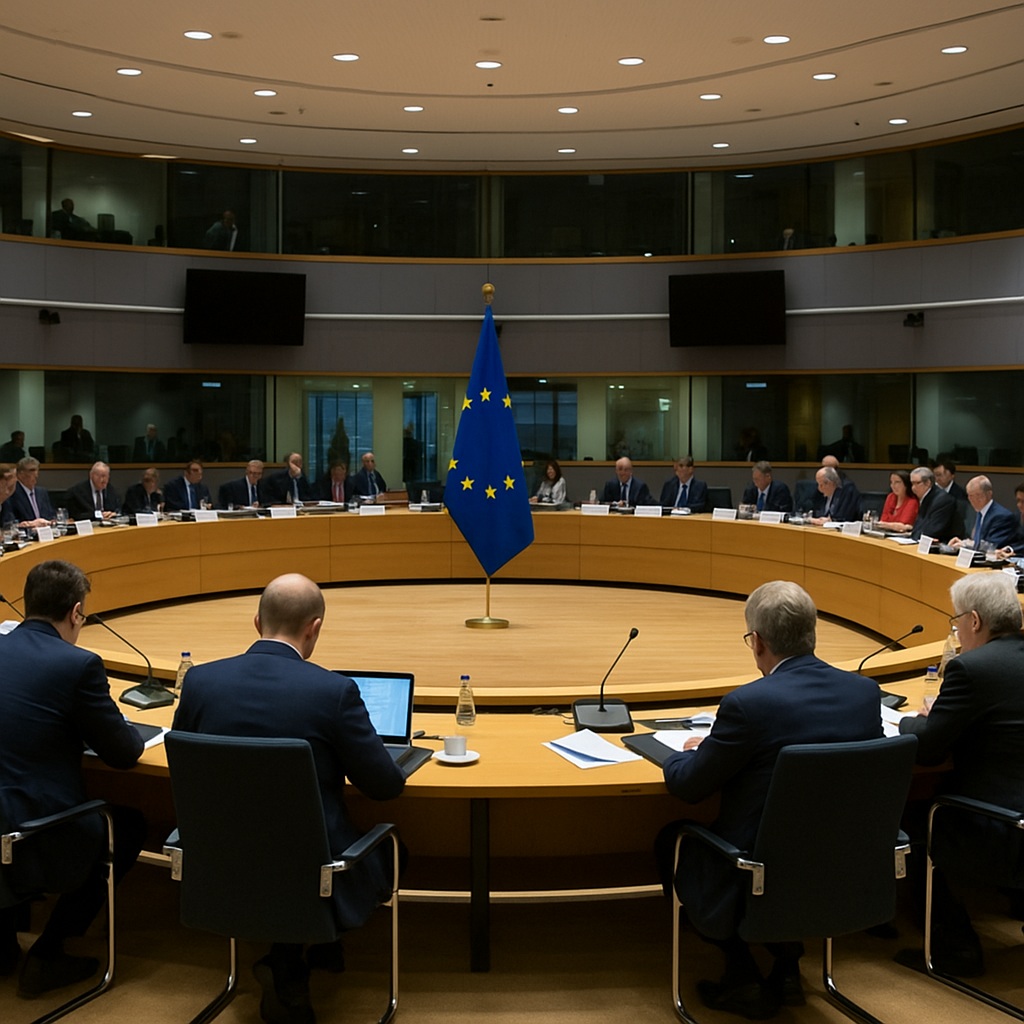
At a pivotal early‑November gathering, the Political and Security Committee convenes to chart next steps under the European Peace Facility and sharpen the bloc’s defence posture amid mounting geopolitical pressure
As Europe faces a shifting strategic environment, the political‑and‑security machinery of the Council of the European Union is meeting at a crucial juncture. On the scheduled date, senior representatives from all 27 member states will assemble in Brussels under the auspices of the Political and Security Committee (PSC) to decide on new assistance measures under the European Peace Facility (EPF)—alongside a broader array of security and defence items.
The Stakes: Aid, Strategy, and Signal
The EPF was established as an off‑budget instrument to allow the European Union to provide military and defence‑related assistance to partner countries, thereby enhancing its external security profile. By convening this session, the PSC is expected to review one or more substantive assistance measures under the EPF. While the precise content of the measures remains confidential, observers expect the outcome to signal the EU’s readiness not only to support immediate partner needs but also to sharpen its own security posture in a more contested global environment.
Beyond the EPF agenda, the meeting will also take up multiple security‑related items. According to the Council’s publicly available meeting schedule, the PSC routinely handles dossiers ranging from oversight of EU missions abroad, coherence of EU defence‑industrial policy, military mobility, and risk assessments related to external action. The convergence of an EPF decision with a broader security agenda elevates this session beyond routine business: it becomes a barometer of how the EU intends to act in an unpredictable era.
What to Watch
- Assistance Measure Under EPF: It will be important to observe whether the PSC recommends approval of an assistance package, the general orientation of that package—whether focused on lethal equipment, non‑lethal capacities, command and control, logistics—or whether it signals restraint. Previous EPF measures have ranged across these types of support.
- Safeguards and Controls: One recurring theme in EPF debates has been the balancing of speed of delivery and oversight of risk. The PSC’s treatment of these elements will reveal how the EU intends to manage complexity.
- Linkage to Broader Defence Agenda: The PSC will also assess derivative implications—how the assistance measure ties into supply chains, European defence industrial capacity, interoperability and readiness. The meeting thus serves not just as an approval forum but as a forum for aligning assistance with strategic objectives.
- Political Messaging and Member‑State Positioning: As always, the composition of the debate, the language of the conclusions or press‑statement and any dissent or reservation by member states will matter. The PSC is where national capitals often signal their red‑lines quietly before larger ministerial fora.
The Context: Why Now
The choice of this early‑November meeting date is far from accidental. Security and defence questions are rising on the agenda for the Union. The conflict in Ukraine, trans‑Atlantic uncertainty, Middle‑East spill‑over risks and the evolving landscape of hybrid threats have all contributed to a heightened climate. In this setting, the EU’s ability to act credibly and coherently is under scrutiny.
The EPF is one of the tangible tools in the EU’s toolbox—yet its use remains politically sensitive and operationally challenging. Reports indicate the PSC has in recent months processed concept‑notes for assistance measures under the EPF for various partner countries. This meeting represents the next step from concept stage to decision stage.
Moreover, while the PSC routinely meets to keep the machinery running, a meeting that is explicitly scheduled to decide on EPF assistance sends a message: Brussels is signalling that relative inertia is no longer an option. Member states appear to recognise that the EU—once primarily a normative actor—must now also demonstrate strategic weight in security and defence.
Potential Implications
- For partner countries: An affirmative outcome could translate into new equipment, training support or logistical frameworks from the EPF, accelerating their defence capacity and EU‑integration.
- For EU industrial and defence policy: The decision could push forward the alignment of procurement, interoperability and union‑wide capability building, and potentially bolster European defence industry actors if alignment is emphasised.
- For internal EU dynamics: Member states will watch how the decision, its safeguards, and cost‑sharing (or non‑cost‑sharing) are structured. Questions about burden‑sharing, arms supply, dual‑use export controls and transparency may resurface.
- For external audiences: The meeting’s outcome will send a signal beyond the EU. Whether favourable or cautious, the decision will affect perceptions among partner countries, adversaries and allies.
Looking Ahead
Once the PSC makes its recommendation (or possibly its decision), the matter will likely pass to the relevant ministerial configuration—possibly the Foreign Affairs Council or Defence Ministers—for endorsement. In parallel, follow‑through on implementation (e.g., contracts, delivery schedules, monitoring) will become the key operational challenge.
This meeting thus serves as a milestone: between concept and action, between strategy and capability, between dialogue and decision. The early‑November PSC session stands at the crossroads of the EU’s ambition to translate its values and diplomacy into tangible security outcomes.


 The Tower Post