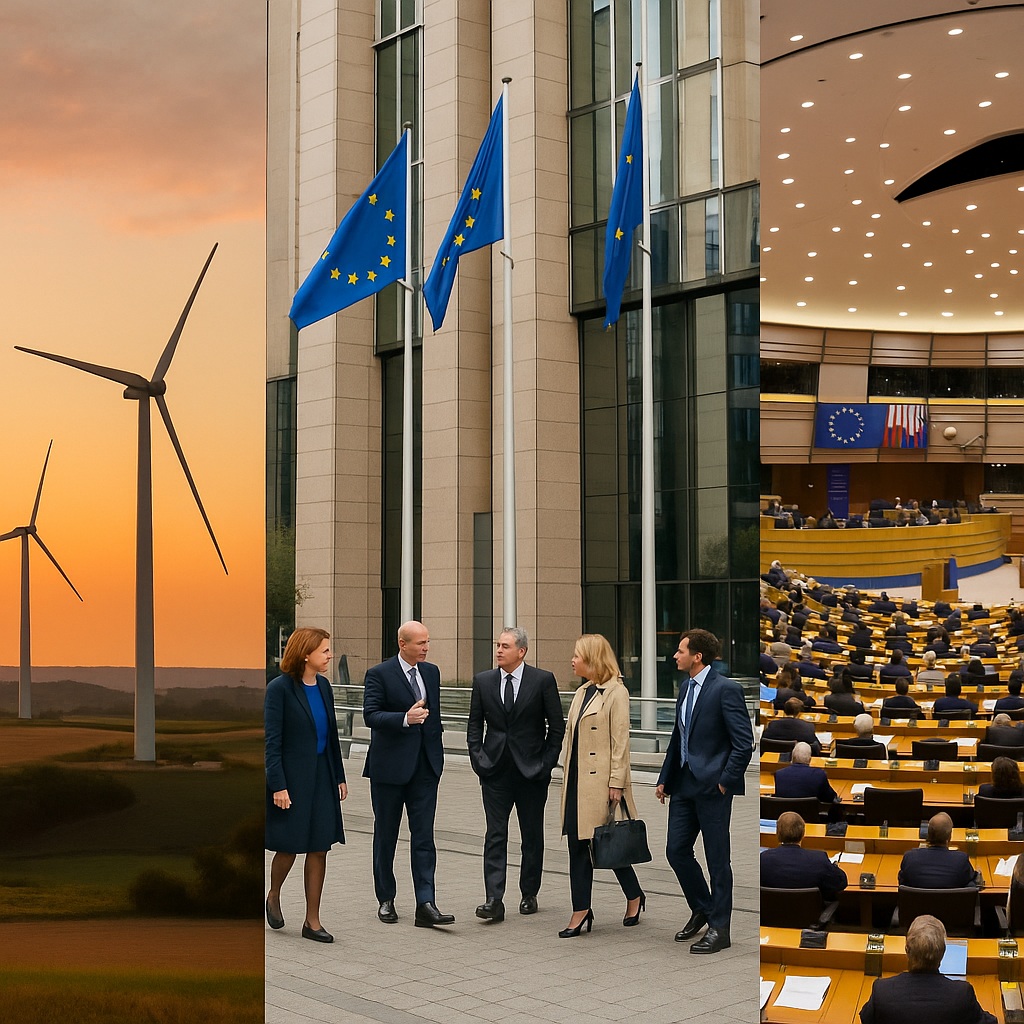
With a pivotal ministers’ meeting looming, the European Parliament and national capitals remain at odds over deeper emissions cuts by 2040 as the European Union presses ahead with its green agenda.
Ahead of the ministerial meeting, tensions are mounting across the European Union as member states and the European Parliament confront a critical impasse: should the bloc adopt a far more ambitious emissions‑reduction target for 2040? The divide is stark — on one side, greener capitals and MEPs pressing for a bold leap; on the other, reluctant governments citing cost, competitiveness and feasibility.
Parliament pushes for bold ambition
Inside the European Parliament in Brussels, green‑leaning MEPs are pressing hard. Having backed more stringent climate policy in recent years, the Parliament wants the EU to commit to a significantly higher emissions‑cut target for 2040, beyond existing commitments to 2030 and 2050 neutrality goals. They argue that without such a strong 2040 milestone the bloc risks falling short of its long‑term climate‑neutrality aspiration.
From the Parliament’s vantage, a clear 2040 target would serve as a “mid‑term inflection point” — signalling to markets, industry and member states that the transition is irreversible. Several committee chairs have made clear that they expect ministers to emerge from the meeting with a firm endorsement of the more ambitious pathway.
Member states remain deeply split
Yet among the national capitals the picture looks very different. Countries with heavy industrial bases and energy systems still reliant on fossil fuels urge caution. They warn that overly aggressive cuts by 2040 could undermine economic growth and energy security, especially in regions already struggling with transition costs.
In capitals across Europe, energy ministers warn of unintended consequences: job losses, weakened manufacturing, and social backlash if the transition is perceived as too fast. Smaller or newer member states with less fiscal headroom emphasise the need for flexibility, transitional funding and realistic phasing.
Meanwhile, a bloc of northern and western EU states is pushing the hardest for the ambitious target, buoyed by stronger clean‑technology sectors and political will. Their message: climate leadership is an opportunity, not a cost.
The ministers’ meeting: what’s at stake
The upcoming ministers’ gathering is being closely watched as a make‑or‑break moment. It is expected to signal whether the Council of the European Union will align with the Parliament’s call or opt for a more modest target. Beyond the headline figure for 2040, the meeting will likely address how to refine emissions‑trading mechanisms, sectoral obligations (transport, buildings, heavy industry) and financial support for transition regions.
Should ministers fail to agree, the Parliament may push for a legislative package to enforce the more ambitious goal, triggering a prolonged negotiation. If an agreement is reached, the EU could strengthen its global climate position ahead of the next international climate summit, sending a signal of unity and ambition.
Political dynamics and industry pressures
Politics in the EU have never been far from climate policy. The tension between ambition and affordability manifests in divergent national interests. Governments with large coal or gas sectors face domestic political headwinds; they fear being told to bear disproportionate burdens. Conversely, governments in greener economies see early transitions as competitive advantages.
Industry lobby groups are gearing up on both sides. Heavy industry warns of carbon‑leakage and loss of global market share if European costs surge ahead of international peers. Clean‑tech firms counter that stronger signals boost investment certainty, innovation and long‑term cost reduction.
What happens next?
With the fourth of November meeting approaching, negotiations in the corridors of Brussels are intensifying. Ministers will need to reconcile:
- A credible and legally binding 2040 target that reflects the Parliament’s urgency.
- An equitable burden‑sharing framework across member states with diverse starting points.
- Transitional mechanisms and financial tools to ease the burden on vulnerable regions.
- Alignment with existing 2030 and 2050 climate objectives to maintain consistency.
The outcome of this meeting will set the tone for the EU’s climate trajectory for decades to come. Should member states and the Parliament bridge their divide, the bloc could present a united front as a climate champion. But if the split endures, the EU risks internal fragmentation and weakened influence on the world stage.
Conclusion
The EU stands at a crossroads. On one path lies bold ambition: a strong 2040 emissions‑cut target, aligning long‑term vision with near‑term action. On the other lies a cautious route: more modest targets, built on flexibility and gradual transition. The meeting on the fourth of November will determine which path it takes — and with it, the credibility of the European climate project.

 The Tower Post