With its home games against Israeli clubs moved to Munich, the Turkish champion navigates a fraught intersection of basketball logistics, regional tensions and league governance.
It is early November 2025. In the lead‑up to its upcoming fixtures, champions Fenerbahçe find themselves playing home matches far from home. The Istanbul‑based powerhouse has announced that its scheduled home encounters against Israeli clubs will instead take place in Munich.
While on the surface the decision may appear as a logistical adjustment, the deeper currents run through geopolitics, league governance and the very meaning of a “home” court in modern sport.
The Move: Why Munich?
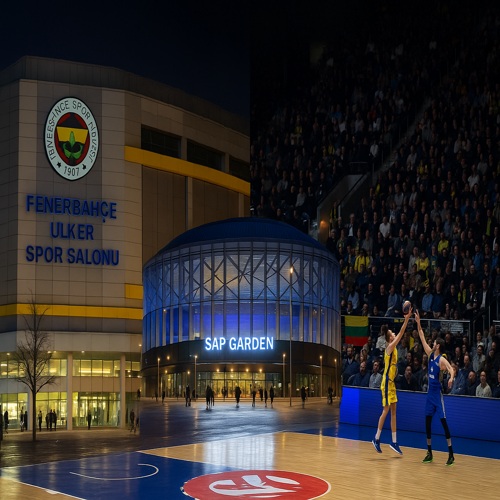
Fenerbahçe’s announcement specified that its home games against Israeli clubs will be relocated from Istanbul to Munich’s SAP Garden arena, following a security review by Turkish authorities.
Originally slated for Istanbul’s Ülker Sports and Event Hall, the games will now be staged in Germany — a neutral venue chosen under duress rather than by design. The club emphasised that the venue meets the top competition standards and that fans will still have access.
This isn’t the first time such relocation has taken place: Fenerbahçe previously moved home games against the same opponent last season to Lithuania under similar circumstances.
Security, Politics and Sport
The broader context is a resumed regional unrest following the conflict between Israel and Gaza. That backdrop has had ripple effects across European sport, with venues, travel, fans and safety all entering the equation.
Turkish authorities reportedly advised against hosting Israeli‑linked fixtures on home soil. In response, the club and league opted for relocation to ensure the fixtures proceed. While the decision fulfils the immediate need to hold the matches, the symbol is stark: home advantage is forfeited, replaced by logistical compromise.
For Fenerbahçe’s supporters, the issues are immediate: travel distances increase, ticketing logistics change, and the “local identity” of a home game is diluted. For the league, the move raises questions about neutrality, fairness and how to handle politically sensitive match‑ups in an ostensibly apolitical sporting arena.
Implications for Fenerbahçe and the EuroLeague
From a competitive viewpoint, Fenerbahçe loses several intangible benefits: the familiarity of its home court, the proximity of its fan‑base, and the momentum of local support. These are real competitive assets in a league where margins are thin.
From a governance perspective, the league (EuroLeague) and its organising body (Euroleague Commercial Assets) are caught in a bind: they must assure fixture fulfilment and safety, while maintaining the integrity of home/away designations and preserving fan experience. As of this month, the league has already approved a plan for Israeli clubs to resume hosting home games in Israel starting in December.
For Fenerbahçe, the relocation also means operational complexity: travel plans, security protocols, fan communications and marketing must all adapt. The club has signalled it will compensate season‑ticket holders and issued updates to ticketing processes.
A Precedent in Neutral Venues
Neutral‑venue relocations in sport are nothing new, but they usually occur for commercial or logistical reasons (e.g., international matches in overseas markets). What distinguishes this case is the political trigger and the forced nature of the move.
The precedent matters. If one fixture can be moved due to security/political concerns, then the concept of “home court” becomes malleable under external pressure. For fans, the intangible link between a team and its city may weaken. For opponents, the expectation of playing “away” might shift. For the league, the territorial and logistical integrity of its competition is tested.
Fan Sentiment and Local Identity
At the heart of sport is the connection between club and supporter. Fenerbahçe’s fans in Istanbul are asked to effectively sacrifice the home‑game experience: the familiar chants, the local travel plans, the communal ritual. Some will travel to Munich, but many will not.
Locally, the club must manage perception. On one side is the support for safety and the legitimacy of the move; on the other, there is potential frustration among fans who feel displaced. The narrative of “home” must shift — temporarily — to another country, and that shift carries symbolic weight.
The Bigger Picture: Sport Under Strain
This relocation is a micro‑cosm of the strain placed upon sport by geopolitics. Where once the playing field was considered separate, crises in one region now ripple into the scheduling, location and throughput of competitions. The EuroLeague’s decision to allow Israeli clubs to host again in December reflects a recognition of that interplay, and yet the intervening months remain vulnerable.
There is also a reputational component. The league must guard against the perception of biased relocation or discrimination. Transparent criteria and consistent application will be necessary if such moves become more common.
Conclusion
On this November date, Fenerbahçe’s forthcoming home fixtures may appear as just another chapter in a long season. But in moving the games to Munich, the club, its fans and the league find themselves navigating terrain far beyond rebounds and free‑throws. The intersection of sport, security and politics has once again forced a rethink of what “home advantage” truly means. For Fenerbahçe, the challenge lies not just in winning the games, but in preserving the identity of a home court that is, for now, elsewhere.



 The Tower Post