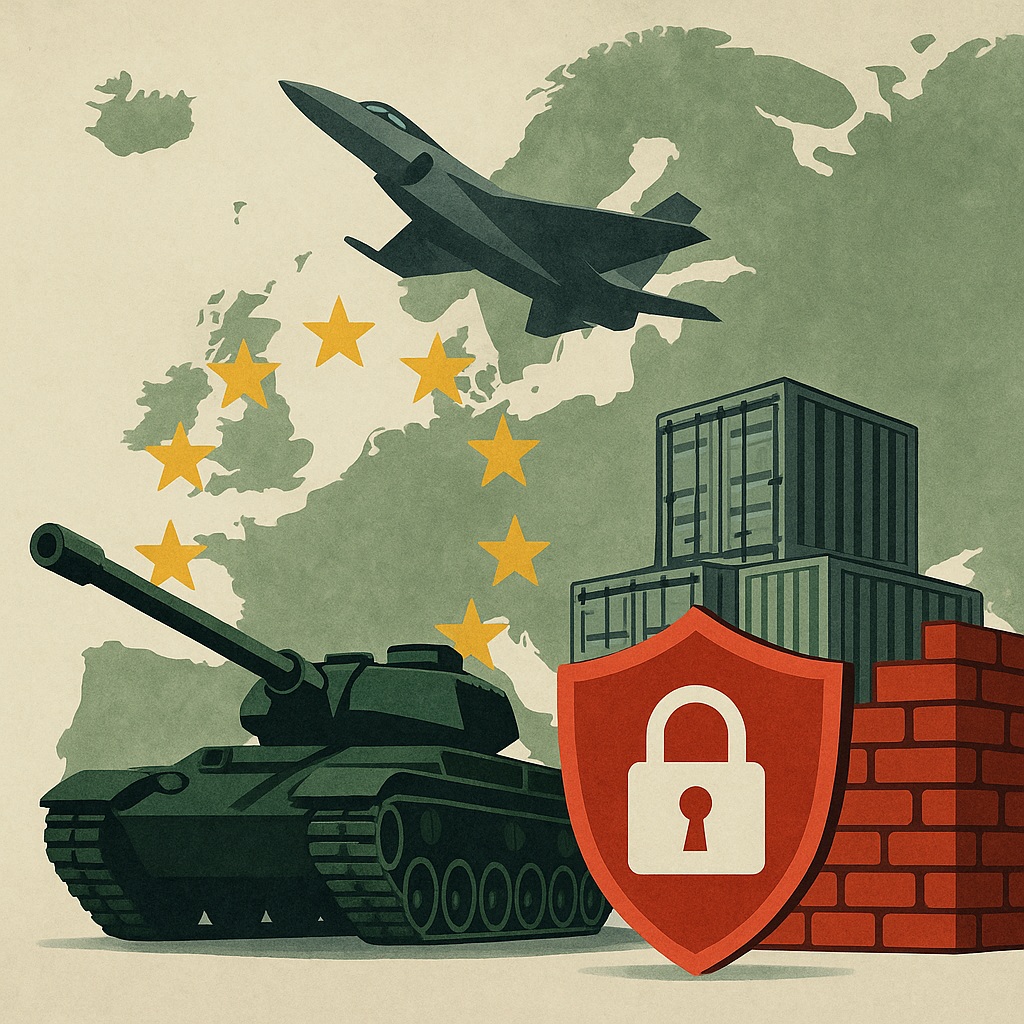
Despite rising budgets and policy ambitions, Europe faces a complex confluence of headwinds that may hold back its economic outlook into late 2025.
As of early November, Europe is navigating a challenging economic environment characterised by subdued growth, structural imbalances and growing security‑driven expenditure. The traditional engines of expansion in the region are under strain, and the interplay of defence costs, hybrid warfare risks, cyber‑threat proliferation and rising trade frictions is creating a multi‑dimensional drag. For policymakers and business leaders, the coming months will demand finely tuned coordination and agility.
Growing Defence and Hybrid‑Warfare Costs
Across Europe, governments are shifting budgets to meet amplified defence and security demands. The escalation of hybrid conflicts — not simply open wars but subtler forms of aggression, including cyber operations, information warfare and economic coercion — means that public spending is being diverted away from growth‑enhancing investment into maintenance of hard and soft‑security posture.
This budget pivot is not just a one‑off shock: as Europe ramps up readiness and seeks to deter external threats, the longer‑term effect is that fewer resources are available for infrastructure, research and development, and social investment. The increased allocation to defence budgets is therefore weighing on the space for “productive” spending, which has longer‑term growth pay‑offs.
Cyber Threats and the Hidden Drag on Productivity
Just as salient is the role of cyber risk. Europe’s dense interlinking of services, industry and supply‑chains means that cyber‑intrusions, ransomware attacks and data‑breaches carry not only direct costs but also erosion of trust, halting of operations and heightened regulatory responses. These disruptions impose a drag on productivity that does not always show up in headline growth figures but accumulates over time.
In addition, firms are increasingly diverting resources into resilience — backups, cybersecurity teams, regulatory compliance — rather than front‑line innovation or expansion. In effect, part of the growth engine is being re‑allocated to protection. That shift, though prudent from a risk‑management perspective, nevertheless acts as a brake on forward momentum.
Tariff Pressures and Trade Frictions
Simultaneously, Europe is contending with elevated trade tensions. Higher tariffs and trade barriers—not just between major powers but in regional supply‑chain linkages—are feeding uncertainty. With Europe deeply integrated into global value chains, especially in manufacturing and technology, even marginal increases in friction raise costs, disrupt logistics and reduce profitability.
The combined effect of defence, cyber‑security and trade frictions is therefore to create what may be called a “triple‑drag” matrix: higher cost base, slower productivity gain and greater uncertainty. For an economy already grappling with ageing demographics, slow transition in key sectors, and a legacy of pandemic‑era disruption, this forces policymakers to manage trade‑offs with particular care.
Budget Coordination Lags Behind Ambition
While budgets are rising, coordination among governments and institutions appears to lag. Several European countries have announced ambitious defence spending increases, yet the fragmentation of procurement, varying national rules and differing fiscal capacities mean that the efficiency of spending may be uneven. That reduces the potential multiplier benefit of higher spending.
Moreover, coordination between fiscal, monetary and regulatory policy remains difficult. With the European Central Bank (ECB) cautious about lowering rates given inflation risks, and national governments constrained by debt burdens and political uncertainty, the margin for macro‑policy support is limited. The fact that defence and security imperatives are crowding out other priorities complicates the task of sustaining growth momentum.
Regional Growth Outlook: Tepid at Best
In light of these headwinds, the outlook for economic growth across Europe has turned moderate. While a full‑blown recession is not the base case in most scenarios, many economies are expected to post growth rates below their historical averages. This reflects not only current constraints but also structural factors: slower productivity growth, demographic pressures and high energy transition costs.
For instance, manufacturing output in key export‑oriented countries is facing pressure from global demand softening, and services sectors that once provided uplifting growth are now dealing with cost pressures and labour shortages. In this context, fiscal stimuli will be less effective than in past cycles because they run up against the limits imposed by security spending and structural inertia.
Policy Imperatives and What Lies Ahead
In the face of these challenges, several policy imperatives emerge:
- Prioritise efficient defence spending: It is vital to ensure that the increase in security budgets does not simply inflate cost bases but is targeted at capability gaps, modernisation and shared procurement to secure economies of scale.
- Strengthen cyber‑resilience while unlocking innovation: Investments in cybersecurity must be balanced with continued support for digital innovation, so that protection becomes an enabler rather than a drag.
- Enhance trade supply‑chain resilience: Europe must deepen its internal value‑chains, diversify external linkages and mitigate tariff and non‑tariff barriers to sustain export competitiveness.
- Improve fiscal‑monetary coordination: With limited space for rate cuts and fiscal expansion, aligning policy tools, rethinking debt rules and reinforcing investment frameworks become ever more important.
- Focus on structural reform: Longer‑term growth will depend on reforms in labour markets, digital infrastructure, green transition and productivity‑enhancing investment — domains that may now compete with defence, but which cannot be deferred for much longer.
Conclusion: A Pivotal Moment for Europe
As of November 2025, Europe stands at a crossroads. The combination of external security pressures, rising costs, trade uncertainty and structural legacy issues means that a traditional growth rebound is unlikely without concerted action. Governments must walk a tightrope: reconciling immediate security imperatives with the need to preserve growth pathways and innovation momentum.
Success will depend not only on resources but on strategic clarity, cross‑border coordination and policy flexibility. The question for Europe’s political and economic leadership is whether the continent can respond deftly enough to these multi‑dimensional headwinds — or whether the economic drift becomes entrenched, setting the scene for protracted under‑performance in a rapidly changing global order.



 The Tower Post